ToolMage
Sign in

Best 1 Innovation Lab AI tools for Research

Popular Innovation Lab AI tools in Research include GitHub Next, helping you work more efficiently.

GitHub Next
Freemium

GitHub Next

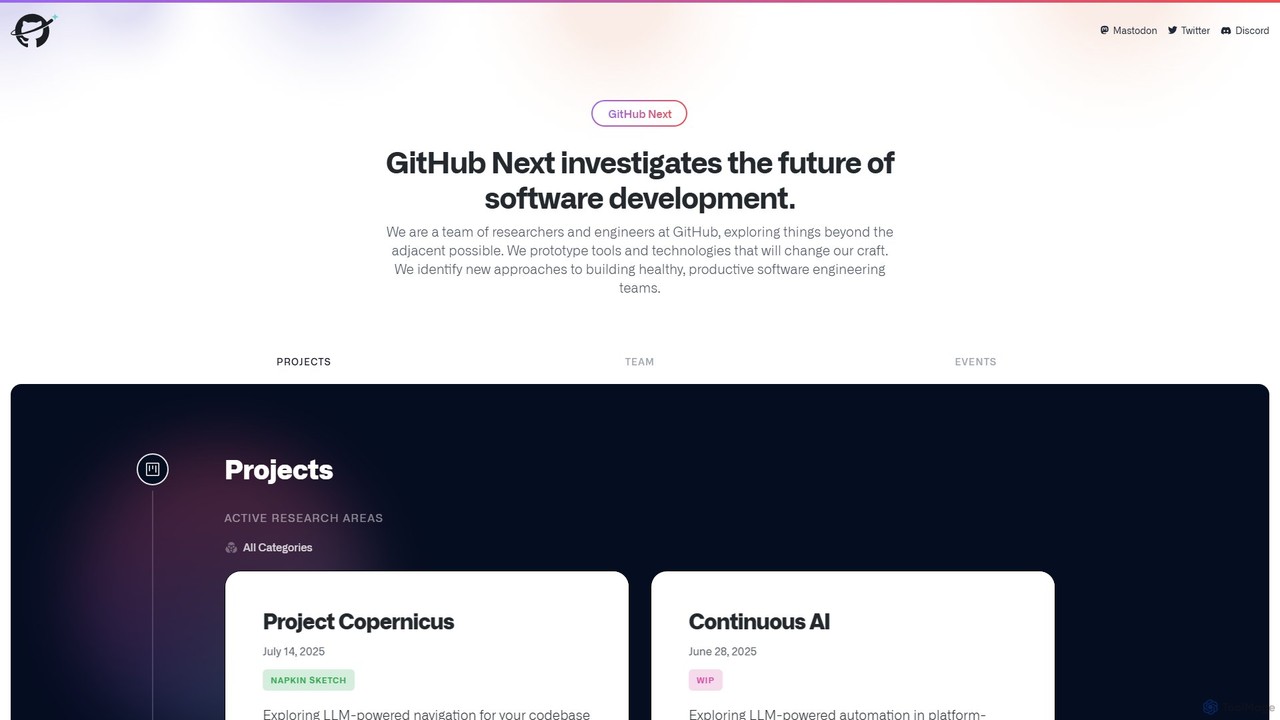
GitHub Next is GitHub's research and innovation lab, dedicated to exploring the future of software development. It pioneers new tools and technologies, with a strong focus on AI, to enhance developer productivity, collaboration, and overall experience.

Code Assistant
Visits 194.2KFavorites 114Likes 117

About Innovation Lab

Innovation Lab AI tools are a specialized segment within AI research tools designed to accelerate the generation, exploration, and validation of novel ideas and solutions. These tools leverage advanced AI models, including generative AI, simulation, and predictive analytics, to foster creativity, automate experimental design, and provide data-driven insights for future trends. They empower researchers, developers, and strategists to move beyond traditional methodologies, enabling rapid prototyping and the discovery of groundbreaking innovations across various domains.

Core Features

  • AI-Powered Idea Generation: Automatically generates diverse concepts, hypotheses, or designs based on specified parameters and existing knowledge.
  • Simulation & Modeling: Creates virtual environments to test theories, predict outcomes, and optimize processes without physical constraints.
  • Predictive Trend Analysis: Identifies emerging patterns and forecasts future market shifts, technological advancements, or scientific breakthroughs.
  • Automated Experiment Design: Suggests optimal experimental setups and parameters, reducing manual effort and accelerating discovery cycles.
  • Concept Validation & Prototyping: Helps evaluate the feasibility and potential impact of new ideas through data analysis and virtual prototyping.

Applicable Scenarios

These tools are crucial for R&D departments in technology and pharmaceuticals, product development teams seeking market differentiation, and strategic planners forecasting industry shifts. They facilitate the creation of new materials, drug compounds, software features, and business models by providing an environment for rapid ideation and testing.

How to Choose

When selecting an Innovation Lab AI tool, consider its generative capabilities, the accuracy and flexibility of its simulation models, and its ability to integrate with existing data sources. Evaluate the level of customization offered, the user interface's intuitiveness, and the tool's scalability to support evolving research and development needs.

Innovation Lab use cases

1

New Product Concept Development

Product development teams utilize Innovation Lab AI tools to generate a wide array of novel product concepts. By inputting market trends, user feedback, and technological constraints, the AI can propose unique features, design variations, and even entirely new product categories, significantly accelerating the initial ideation phase and ensuring market relevance.

2

Scientific Hypothesis Generation

In scientific research, particularly in fields like material science or drug discovery, researchers employ these tools to formulate complex hypotheses. The AI analyzes vast datasets of existing research, chemical structures, or biological interactions to suggest new compounds, experimental pathways, or theoretical models that might lead to breakthroughs, reducing the time spent on manual literature review and initial experimental design.

3

Strategic Market Trend Forecasting

Business strategists and market analysts leverage Innovation Lab AI to predict future market trends and identify emerging opportunities or potential disruptions. By simulating various economic, social, and technological scenarios, the tools provide data-driven insights into consumer behavior shifts, competitive landscapes, and investment areas, enabling proactive strategic planning.

4

Creative Content & Design Brainstorming

Marketing agencies and design studios use these AI tools to rapidly brainstorm and generate diverse creative content ideas. From advertising campaign concepts and visual design elements to narrative structures for storytelling, the AI can produce numerous variations, helping teams overcome creative blocks and explore unconventional approaches efficiently.

5

Optimizing Industrial Process Innovation

Engineers and operations managers in manufacturing or logistics apply Innovation Lab AI for simulating and optimizing complex industrial processes. The tools can model different production line configurations, supply chain routes, or resource allocation strategies to identify innovative improvements that enhance efficiency, reduce waste, and introduce new operational paradigms.

6

Urban Planning & Smart City Solutions

Urban planners and government agencies utilize Innovation Lab AI to design and test innovative solutions for smart cities. By simulating traffic flows, energy consumption patterns, or public service delivery, these tools help in developing sustainable infrastructure, optimizing resource distribution, and creating more livable urban environments before costly physical implementation.

Innovation Lab FAQ

What are AI Innovation Lab tools?

AI Innovation Lab tools are advanced AI applications specifically designed to foster and accelerate the process of generating, exploring, and validating new ideas, concepts, and solutions. Unlike general AI research tools that might focus on data analysis or literature review, these tools emphasize creative synthesis, simulation, and predictive modeling to drive groundbreaking discoveries and product development, acting as a virtual sandbox for innovation.

How do AI Innovation Lab tools differ from general AI Research tools?

While both fall under the broader "Research" category, AI Innovation Lab tools are distinct in their focus on creation and experimentation. General AI Research tools often assist with data collection, analysis, and literature synthesis. In contrast, Innovation Lab tools actively generate novel ideas, simulate their potential outcomes, and facilitate rapid prototyping, moving beyond analysis to active concept development and validation within a controlled environment.

What are the main benefits of using AI Innovation Lab tools?

The primary benefits include significantly accelerating the innovation cycle, reducing R&D costs by enabling virtual experimentation, and fostering unprecedented levels of creativity through AI-powered idea generation. They also provide data-driven insights for strategic decision-making, help identify emerging trends, and allow for the rapid validation of concepts, minimizing risks associated with new ventures.

Who can benefit most from AI Innovation Lab tools?

A wide range of professionals and organizations can benefit. This includes R&D departments in technology, pharmaceuticals, and manufacturing; product development teams; strategic planners and market analysts; scientific researchers; and creative professionals in design and marketing. Essentially, anyone involved in generating new ideas, exploring future possibilities, or optimizing complex systems through innovative approaches will find these tools invaluable.

What should I consider when selecting an AI Innovation Lab tool?

Key considerations include the tool's generative capabilities (e.g., text, image, code generation), the accuracy and flexibility of its simulation and modeling features, and its ability to integrate with your existing data and workflows. Also, evaluate the level of customization, the intuitiveness of the user interface, the scalability for future needs, and the robustness of its predictive analytics for trend forecasting.