ToolMage
Sign in

Best 2 Reading Assistant for Research

Popular Reading Assistant in Research include Summate and WebMagic AI, helping you work more efficiently.

Summate
Freemium

Summate

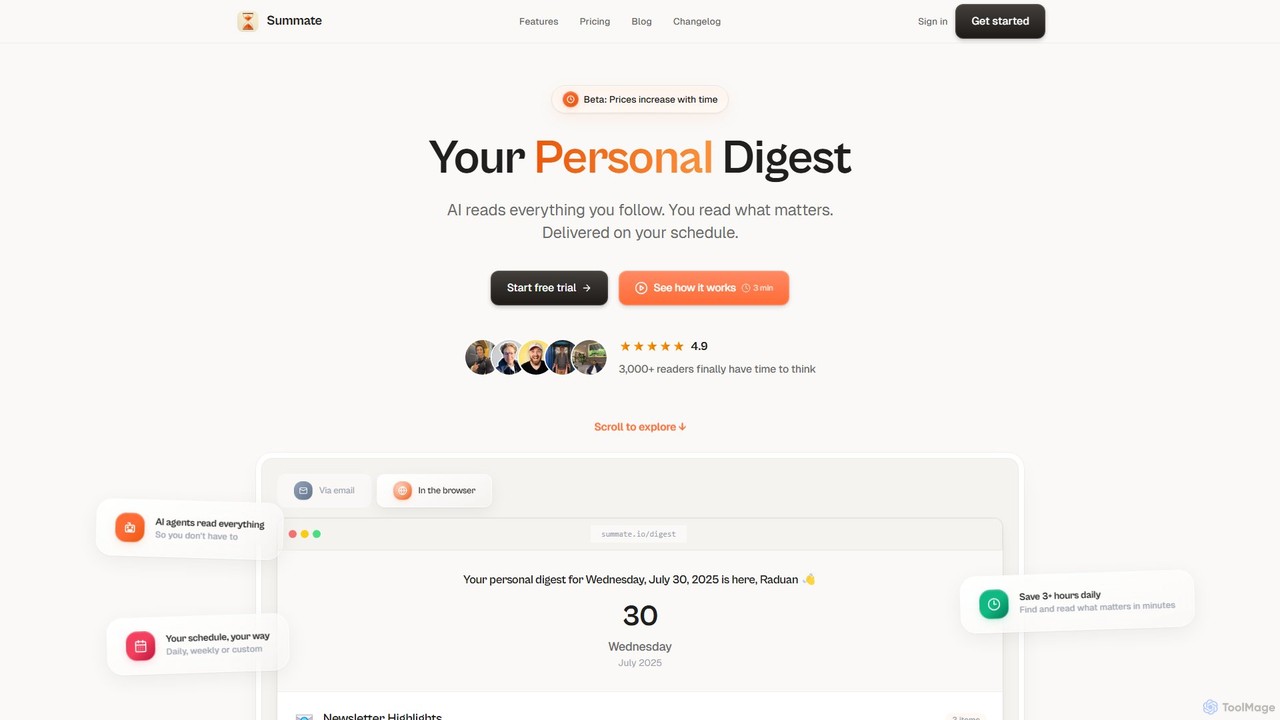
Summate is your personal AI digest service that transforms information overload into clarity. It aggregates content from your favorite newsletters, YouTube channels, blogs, and RSS feeds, delivering concise, AI-powered summaries on your schedule. Save hours daily and focus only on what truly matters.

Information Aggregator
Visits 7.6KFavorites 98Likes 98
WebMagic AI
Freemium

WebMagic AI

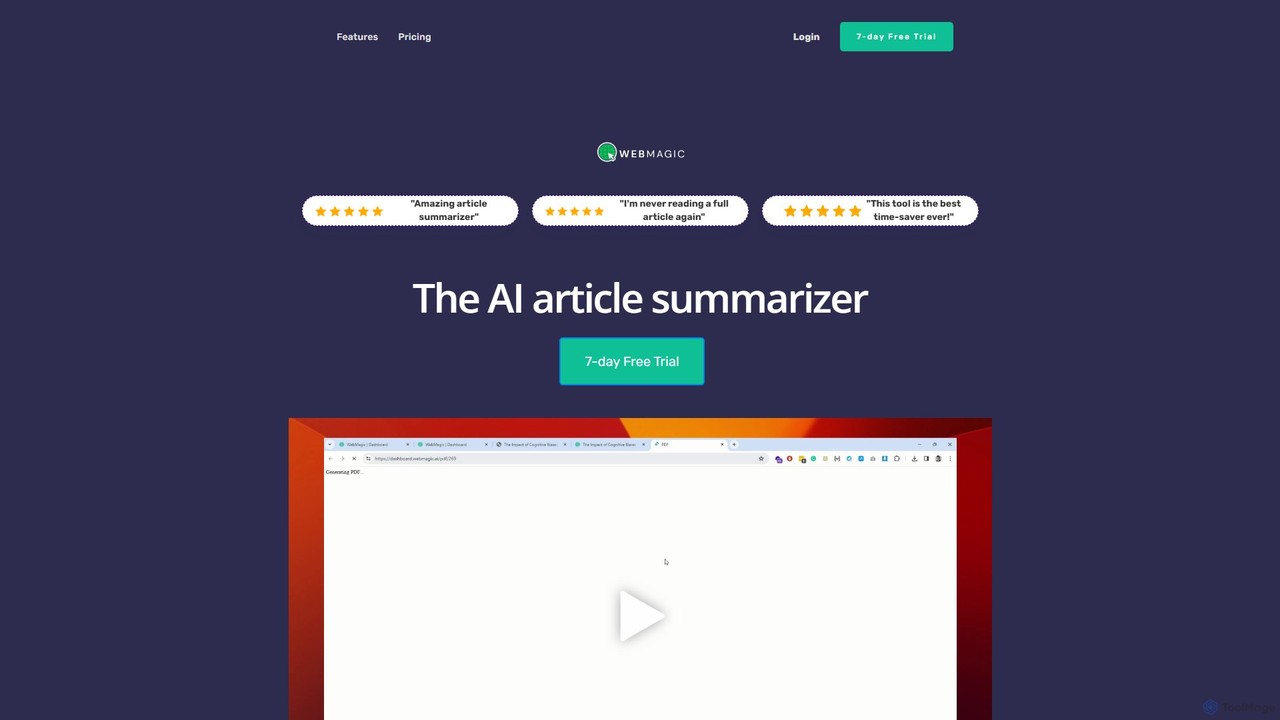
WebMagic AI is an AI-powered research assistant that instantly summarizes web articles and long texts. It helps users save time, increase reading productivity, and quickly grasp key information. With a user-friendly dashboard and a convenient Chrome extension, you can manage, tag, share, and download your summaries effortlessly.

Study Tool
Visits 4.3KFavorites 128Likes 128

About Reading Assistant

Reading Assistants are AI-powered tools designed to enhance text comprehension and information extraction from various documents. As a specialized sub-category within Research tools, they leverage natural language processing (NLP) to summarize content, answer questions, and highlight key information. These tools significantly streamline the research, learning, and analysis processes by making complex texts more accessible and manageable.

Core Features

  • Intelligent Summarization: Automatically condenses lengthy articles, reports, or books into concise summaries, highlighting main points and key arguments.
  • Contextual Q&A: Allows users to ask specific questions about a document and receive accurate, context-aware answers extracted directly from the text.
  • Keyword and Entity Extraction: Identifies and extracts important keywords, names, dates, and other entities, providing a quick overview of the document's core topics.
  • Readability Analysis: Assesses the complexity of text and suggests ways to simplify language or explains difficult concepts, aiding comprehension.
  • Multi-language Translation: Offers on-the-fly translation of text sections or entire documents, breaking down language barriers in research.

Applicable Scenarios

Reading Assistants are invaluable for professionals and students who regularly process large volumes of text. Researchers can quickly review academic papers, legal professionals can efficiently analyze case documents, and content creators can rapidly gather information for new projects. They are also highly beneficial for language learners and individuals with reading difficulties, providing tools to simplify and understand complex texts.

How to Choose

When selecting an AI Reading Assistant, consider its accuracy in summarization and Q&A, especially for your specific domain. Evaluate the range of supported document formats (PDF, DOCX, web pages) and languages. Look for integration capabilities with existing research or productivity tools. Finally, assess the user interface for ease of use and the availability of features like annotation, highlighting, and export options to ensure it fits your workflow.

Featured tool rankings

Reading Assistant use cases

1

Accelerating Academic Research Paper Review

University students and researchers can utilize Reading Assistants to quickly digest lengthy academic papers. By inputting a PDF or text, the tool can summarize key findings, extract methodologies, and answer specific questions about the research, saving hours of manual reading and helping to identify relevant studies more efficiently for literature reviews and thesis writing.

2

Efficient Legal Document Review

Legal professionals, such as paralegals and lawyers, can leverage Reading Assistants to quickly analyze contracts, case briefs, and discovery documents. The tools can identify key clauses, extract relevant dates and parties, and summarize complex legal arguments, significantly reducing the time spent on initial document review and ensuring no critical information is overlooked during litigation preparation.

3

Streamlining News and Article Consumption

Busy professionals and general readers can use Reading Assistants to stay informed without being overwhelmed by information overload. By feeding daily news articles, blog posts, or industry reports into the tool, users can receive concise summaries of the main points, allowing them to quickly grasp the essence of multiple sources and prioritize what to read in full, saving valuable time.

4

Enhancing Learning and Study for Students

Students from high school to university can significantly improve their study habits with Reading Assistants. These tools can break down complex textbooks or lecture notes into simpler terms, provide definitions for difficult vocabulary, and generate practice questions based on the material. This helps students grasp challenging concepts more easily, prepare for exams, and improve overall academic performance, especially in subjects with heavy reading loads.

5

Content Creation Research and Ideation

Content creators, marketers, and journalists can use Reading Assistants to conduct rapid research for articles, blog posts, and marketing campaigns. By processing numerous source materials, the tools can quickly extract key facts, statistics, and trending topics, providing a solid foundation for content development. This accelerates the ideation phase and ensures content is well-researched and authoritative, leading to higher quality outputs.

6

Supporting Language Learning and Comprehension

Language learners can significantly benefit from Reading Assistants by using them to understand texts in a new language. The tools can provide instant translations of unfamiliar words or phrases, simplify complex sentences, and even offer explanations of cultural nuances. This makes reading in a foreign language less daunting and more effective, accelerating vocabulary acquisition and improving overall language proficiency.

Reading Assistant FAQ

What are AI Reading Assistants?

AI Reading Assistants are software applications that use artificial intelligence, particularly natural language processing (NLP), to help users understand and interact with text more effectively. They go beyond simple text display by offering features like automatic summarization, on-demand Q&A, keyword identification, and translation, making complex information more accessible. These tools are invaluable for anyone dealing with large volumes of textual data, from students to professionals.

How do AI Reading Assistants differ from general AI summarizers?

While both can summarize, AI Reading Assistants offer a broader suite of interactive features beyond just condensing text. They often include capabilities like answering specific questions about the document, extracting key entities, translating sections, and even analyzing readability. General summarizers primarily focus on generating a concise overview, whereas Reading Assistants aim to facilitate deeper comprehension and interaction with the content, making them more suitable for detailed research and learning tasks.

What key features should I look for in an AI Reading Assistant?

When choosing an AI Reading Assistant, prioritize features that align with your specific needs. Essential capabilities include accurate summarization, robust contextual Q&A, and efficient keyword/entity extraction. Look for broad document format support (PDF, web pages, e-books) and multi-language processing. Additional valuable features are annotation tools, text-to-speech functionality, integration with other productivity apps, and a user-friendly interface that enhances your reading and research workflow.

Can AI Reading Assistants help with academic research?

Absolutely. AI Reading Assistants are particularly beneficial for academic research. They can rapidly process vast amounts of scholarly articles, journals, and textbooks, providing summaries, extracting key arguments, and identifying relevant citations. This allows researchers to quickly assess the relevance of a paper, understand complex theories, and build comprehensive literature reviews more efficiently, saving significant time in the initial stages of research.

How do AI Reading Assistants improve text comprehension?

AI Reading Assistants improve text comprehension by breaking down complex information into more digestible formats. They achieve this through features like summarization, which provides a high-level overview; contextual Q&A, which clarifies specific points; and readability analysis, which simplifies language. Additionally, instant definitions and translations help overcome vocabulary and language barriers, allowing users to focus on understanding the core message rather than struggling with individual words or phrases, leading to a deeper and faster grasp of the content.