Utilities Best in category 2 results System Analysis AI Tool

Popular AI tools in the System Analysis field of Utilities include bottleneck_calculator、Bottleneck Calculator, etc., helping you quickly improve efficiency.

Free
Bottleneck Calculator

Bottleneck Calculator

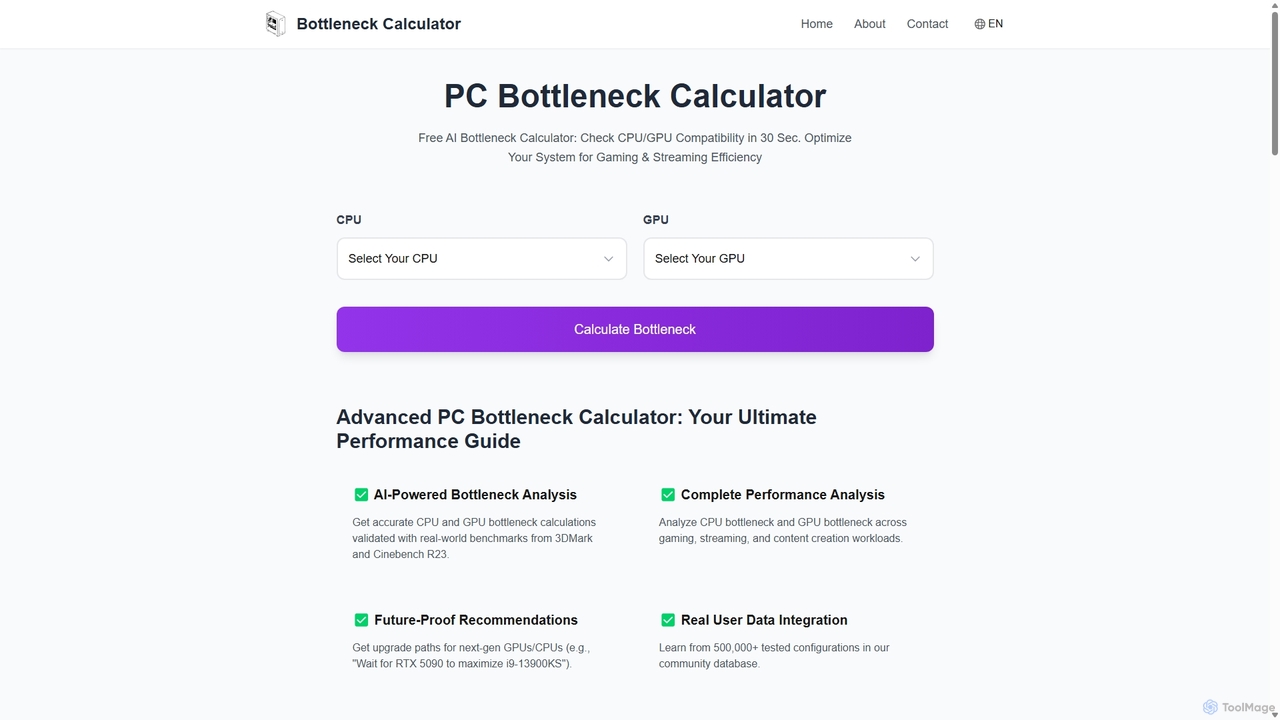
An AI-powered tool that instantly analyzes your PC's CPU and GPU compatibility to identify performance bottlenecks. Get accurate …

2.5K
Free
bottleneck_calculator

bottleneck_calculator

A free online tool for PC builders, gamers, and professionals to diagnose performance bottlenecks. By selecting your CPU, …

3.1K

About System Analysis

AI System Analysis tools are a class of utilities that leverage machine learning to automatically monitor, diagnose, and optimize the performance and security of complex IT systems. By processing vast amounts of data from logs, metrics, and traces, these tools can identify anomalies, predict potential failures, and pinpoint root causes of issues without manual intervention. This enables organizations to proactively maintain system health, enhance reliability, and accelerate troubleshooting processes. Their core advantage lies in uncovering hidden patterns and correlations that are often invisible to traditional monitoring solutions.

Core Features

  • Automated Anomaly Detection: Uses machine learning to learn normal system behavior and automatically flag deviations that could indicate problems.
  • Predictive Analytics: Forecasts future system states, resource needs, and potential failures based on historical data trends.
  • Root Cause Analysis (RCA): Intelligently correlates events across different system components to identify the origin of a failure or performance issue.
  • Log Pattern Recognition: Applies NLP to unstructured log data to cluster messages, detect error patterns, and extract meaningful insights.
  • Security Threat Identification: Analyzes system activity and network traffic to detect signatures of known vulnerabilities or suspicious behavior patterns.

Use Cases

These tools are essential for DevOps engineers, Site Reliability Engineers (SREs), and IT operations teams managing large-scale cloud applications, microservices architectures, and enterprise IT infrastructure. They are commonly used in sectors like e-commerce for ensuring uptime during peak traffic, in finance for securing transaction systems, and in SaaS companies for maintaining service level agreements (SLAs).

How to Choose

When selecting an AI System Analysis tool, consider the following: the breadth of its data source integrations (e.g., cloud providers, databases, application frameworks), the sophistication of its machine learning models for anomaly detection and RCA, its scalability to handle your data volume, and its ease of integration into existing CI/CD pipelines and incident management workflows.

System AnalysisUse Cases

1

Automated Root Cause Analysis for Application Crashes

A Site Reliability Engineer (SRE) is alerted to a critical application failure during peak hours. Instead of manually sifting through millions of log lines from dozens of microservices, they use an AI System Analysis tool. The tool automatically ingests and correlates logs, metrics, and deployment data. Within minutes, its machine learning model identifies a specific code deployment as the root cause, highlighting a memory leak introduced in a new function. This reduces the Mean Time To Resolution (MTTR) from hours to under 15 minutes, minimizing revenue loss and user impact.

2

Proactive Performance Bottleneck Detection

A DevOps team manages a large e-commerce platform. To prevent slowdowns during an upcoming sales event, they use an AI analysis tool to monitor the staging environment under simulated load. The tool's predictive analytics model identifies a potential bottleneck in the database query processing, forecasting that response times will degrade significantly once user traffic exceeds a certain threshold. It provides specific recommendations, such as indexing a particular table. The team implements the fix proactively, ensuring a smooth user experience during the actual sale and preventing potential revenue loss.

3

Identifying Sophisticated Security Threats

A security analyst at a financial institution is tasked with monitoring for advanced persistent threats (APTs). Traditional rule-based systems fail to detect subtle, low-and-slow attacks. The analyst employs an AI System Analysis tool that builds a baseline of normal user and system behavior. The tool flags a series of seemingly unrelated, low-priority events: a login from an unusual location, minor data access on a non-critical server, and a small outbound data transfer. The AI correlates these events, identifies them as a pattern consistent with an APT, and raises a high-priority alert, allowing the security team to intervene before a major data breach occurs.

4

Optimizing Cloud Resource Allocation

An IT operations manager is concerned about rising cloud computing costs. The team uses an AI System Analysis tool to analyze historical resource utilization patterns across their entire server fleet. The tool's predictive model forecasts future demand with high accuracy, identifying servers that are consistently over-provisioned and others that will require scaling up during specific times. Based on these insights, the manager implements an automated scaling policy and right-sizes the virtual machine instances. This leads to a 25% reduction in monthly cloud spending without compromising application performance.

5

Streamlining Log Management and Analysis

A software developer is debugging a complex issue in a distributed system that generates millions of log entries per hour. Manually searching and filtering this data is time-consuming and inefficient. By feeding the logs into an AI System Analysis tool, the developer can leverage its NLP capabilities. The tool automatically clusters similar log messages, identifies rare error patterns, and allows for natural language queries like "show me all authentication errors for user X in the last hour." This transforms log data from a raw, overwhelming stream into a structured, searchable knowledge base, accelerating the debugging cycle significantly.

6

Predictive Maintenance for IT Infrastructure

An IT administrator for a large enterprise is responsible for maintaining hundreds of physical and virtual servers. To avoid unexpected hardware failures, they deploy an AI System Analysis tool that monitors key health indicators like CPU temperature, disk I/O rates, and memory usage patterns. The tool's machine learning algorithm learns the normal operating parameters for each server and predicts when a component, such as a hard drive, is likely to fail based on subtle performance degradation. This allows the administrator to schedule maintenance proactively, replace hardware before it fails, and prevent costly downtime.

System AnalysisFrequently Asked Questions