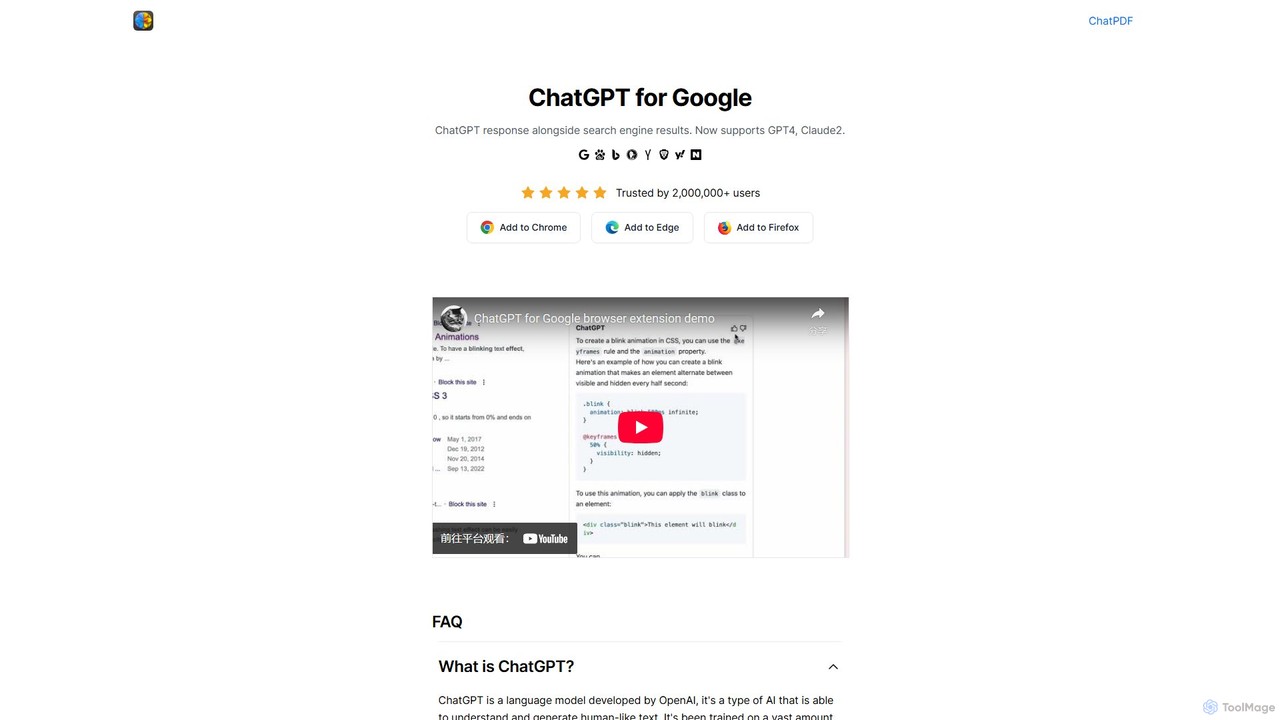
A Search Assistant is a type of browser extension that uses AI to enhance and streamline the online search experience. It integrates directly into search engine results pages (SERPs), providing concise summaries, related insights, and contextual information alongside standard search results. This helps users quickly grasp complex topics, evaluate sources, and find precise answers without opening multiple tabs. Unlike traditional searching, these assistants transform a static list of links into an interactive, knowledge-rich interface, making research more efficient.
Core Features
- AI-Powered Summaries: Generates concise summaries of web pages and videos directly on the search results page.
- Contextual Side Panel: Displays key facts, definitions, and related information in a sidebar for quick reference.
- Source Analysis: Offers insights into the credibility, bias, or key arguments of a source before you click.
- Follow-up Question Generation: Suggests relevant subsequent questions to help deepen research and explore topics further.
- Direct Answer Extraction: Pulls specific answers to questions from top-ranking pages and presents them clearly.
Use Cases
Search Assistants are ideal for students, researchers, content creators, and professionals who need to synthesize information from multiple online sources efficiently. For instance, a market analyst can use it to quickly gather competitive intelligence, or a student can accelerate their research for a term paper by getting instant summaries of academic articles.
How to Choose
When selecting a Search Assistant, consider the AI model it uses (e.g., GPT-4, Claude), the search engines it supports (Google, Bing, DuckDuckGo), and its data privacy policy. Also, evaluate the quality of its summaries and the relevance of the contextual information it provides. Some tools offer advanced features like citation generation or integration with note-taking apps, which may be important for specific workflows.