RunDiffusion
RunDiffusion is a cloud-based platform providing instant access to powerful, pre-configured Stable Diffusion environments. Launch private sessions with …
RunDiffusion is a cloud-based platform providing instant access to powerful, pre-configured Stable Diffusion environments. Launch private sessions with top-tier GPUs in seconds, without any setup. Ideal for AI artists, designers, and developers who need high-performance image generation, model training, and workflow experimentation on demand.
RunComfy
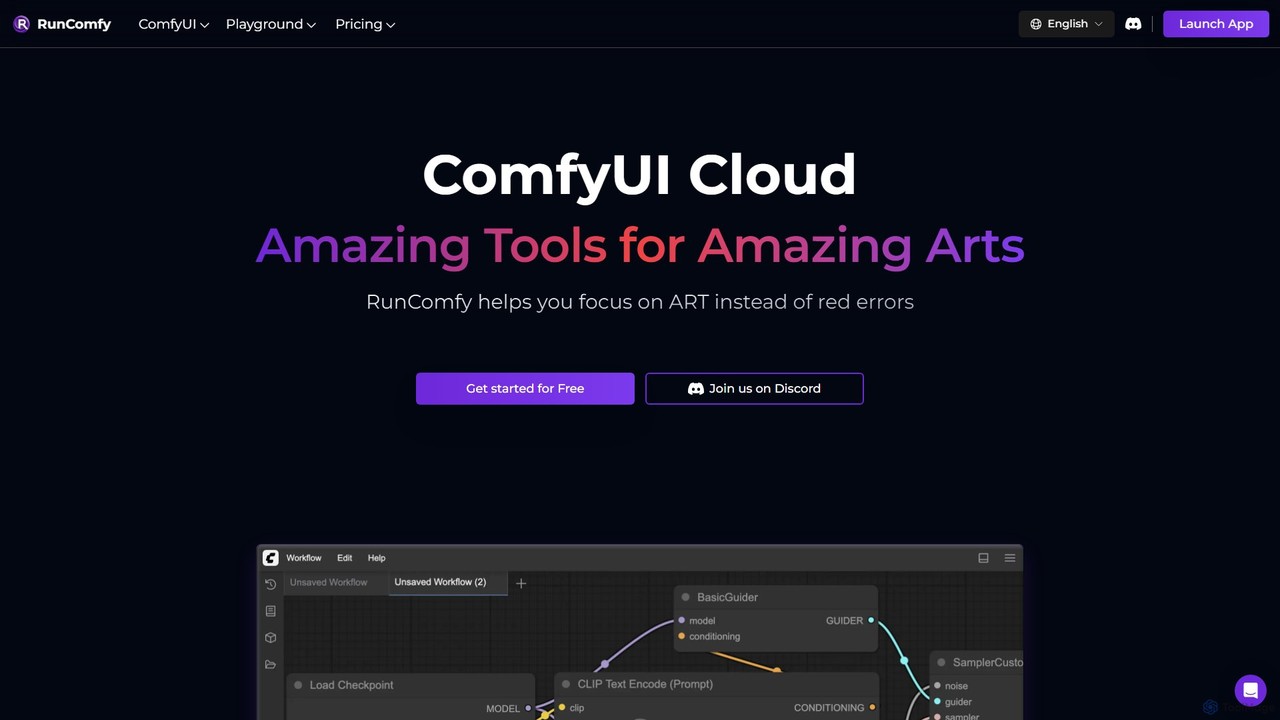
RunComfy is a leading cloud platform for ComfyUI, providing a seamless, no-setup environment for AI art and video …
RunComfy is a leading cloud platform for ComfyUI, providing a seamless, no-setup environment for AI art and video generation. It offers on-demand high-performance GPUs, pre-built workflows, and easy model management, allowing artists and creators to focus on creativity instead of technical configurations.
Modal
Modal is a high-performance, serverless infrastructure platform for AI and ML developers. It allows you to run Python …
Modal is a high-performance, serverless infrastructure platform for AI and ML developers. It allows you to run Python functions in the cloud with a single line of code, providing instant access to GPUs, automatic scaling from zero to thousands of containers, and pay-per-second pricing. Eliminate infrastructure overhead and focus on building and deploying compute-intensive applications like generative AI, batch processing, and data analysis.
ThinkDiffusion
A cloud-based platform that provides one-click access to powerful open-source generative AI tools like Stable Diffusion (AUTOMATIC1111, ComfyUI, …
A cloud-based platform that provides one-click access to powerful open-source generative AI tools like Stable Diffusion (AUTOMATIC1111, ComfyUI, Fooocus). It eliminates the need for expensive hardware and complex setups, offering dedicated GPUs, private workspaces, and complete freedom to install custom models and extensions. Ideal for artists, developers, and educators.
About Cloud Computing
AI Cloud Computing tools provide on-demand access to scalable computational resources and managed platforms specifically for developing, training, and deploying artificial intelligence models. These services leverage vast, distributed infrastructure to offer specialized hardware like GPUs and TPUs, which are essential for intensive AI workloads. They enable developers and businesses to build powerful AI applications without the significant upfront investment in physical hardware, accelerating innovation and reducing operational overhead. This approach democratizes access to high-performance computing for AI tasks.
Core Features
- Scalable Compute Instances: Provides on-demand access to powerful virtual machines equipped with GPUs and TPUs for accelerated model training.
- Managed AI/ML Platforms: Offers integrated environments (like AWS SageMaker, Google Vertex AI) that streamline the entire machine learning workflow.
- Serverless Deployment: Allows developers to deploy models as scalable APIs without managing the underlying server infrastructure.
- Optimized Data Storage: Includes high-performance storage solutions designed for large datasets typical in AI and machine learning projects.
- Pre-built AI APIs: Offers access to ready-to-use models for tasks like image recognition, natural language processing, and speech-to-text.
Use Cases
These tools are crucial for data scientists, machine learning engineers, and AI-focused startups. They are used for training large language models (LLMs), building real-time recommendation engines for e-commerce, and creating data processing pipelines for financial analysis. Enterprises also use them to scale their AI initiatives and integrate machine learning into existing business processes.
How to Choose
When selecting an AI Cloud Computing tool, consider the specific ecosystem and its integration with other services you use. Evaluate the range of supported machine learning frameworks (e.g., TensorFlow, PyTorch) and available hardware. Analyze the pricing model—pay-as-you-go, reserved instances, and data transfer costs. Finally, assess the level of management provided, from raw infrastructure (IaaS) to fully managed platforms (PaaS), based on your team's technical expertise.
Cloud ComputingUse Cases
Training a Large-Scale AI Model
A data science team at a research institute needs to train a custom natural language processing model on a massive dataset. Using a cloud computing platform, they provision a cluster of virtual machines equipped with high-performance GPUs. This allows them to distribute the training process, significantly reducing the time required from months to just a few weeks. The platform's managed environment handles software dependencies and optimizations, allowing the team to focus solely on model development and experimentation without worrying about hardware maintenance or setup.
Deploying a Real-Time Recommendation Engine
An e-commerce startup wants to provide personalized product recommendations to its users. They use a serverless cloud service to deploy their machine learning model as an API endpoint. This approach allows the application to automatically scale based on traffic, ensuring low latency even during peak shopping hours. The startup avoids the complexity of managing servers and only pays for the compute time used to process requests, making it a cost-effective solution for deploying a responsive, scalable AI feature.
Automating Data Processing Pipelines
A financial services company needs to process large volumes of market data daily for risk analysis. They build an automated data pipeline using various cloud services. The pipeline ingests raw data from multiple sources into cloud storage, uses a distributed data processing service to clean and transform the data, and then feeds it into machine learning models for prediction. The entire workflow is orchestrated and scheduled to run automatically, ensuring that analysts always have access to up-to-date insights without manual intervention, improving both efficiency and accuracy.
Developing a Computer Vision Application
A healthcare tech startup is building an application to detect anomalies in medical images. Instead of building everything from scratch, they leverage a cloud provider's pre-trained vision APIs for initial prototyping. For higher accuracy, they use the provider's managed machine learning platform to train a custom model on their proprietary dataset. The platform provides tools for data labeling, automated model tuning, and one-click deployment, drastically reducing the development time and technical resources needed to bring their innovative solution to market.
Scalable API Hosting for an AI SaaS Product
A SaaS company offers an AI-powered text summarization service via an API. They host their application on a cloud platform that provides auto-scaling capabilities. When a major news event causes a surge in usage, the platform automatically provisions more server instances to handle the increased load, ensuring consistent performance for all users. When demand subsides, it scales back down to reduce costs. This elastic scalability is a core benefit of cloud computing, allowing the company to grow its user base without needing to manually manage or over-provision infrastructure.
Collaborative ML Development with MLOps
A distributed data science team uses a cloud-based machine learning platform to collaborate on a project. The platform provides shared notebooks for interactive development, integrated version control for code and datasets, and experiment tracking to log and compare model performance. Once a model is ready, the platform's MLOps (Machine Learning Operations) features automate the process of building, testing, and deploying it to a production environment. This integrated workflow enhances productivity, ensures reproducibility, and streamlines the entire lifecycle from research to deployment.