ToolMage
Sign in

Best 2 Study Tool for Productivity

Popular Study Tool in Productivity include Roadmint and G3MS, helping you work more efficiently.

G3MS
Freemium

G3MS

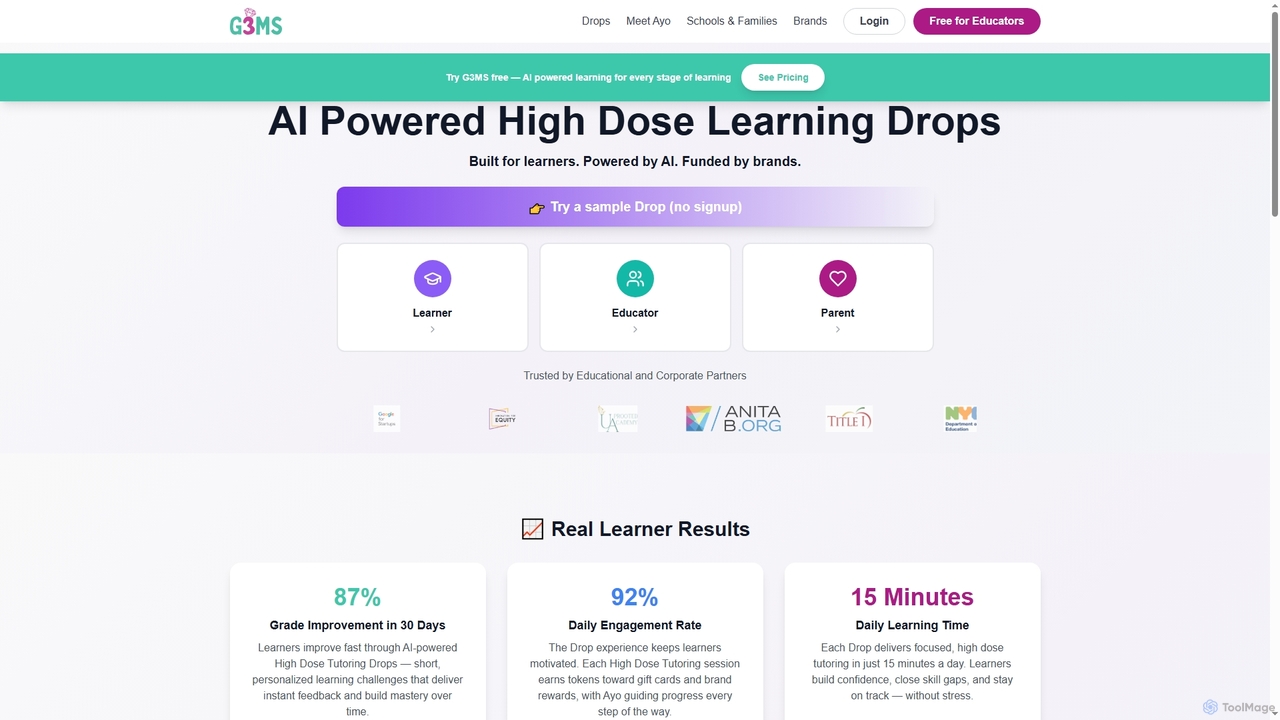
G3MS is an AI-powered learning platform designed for K-12 and college students, offering personalized "High Dose Learning Drops" for subjects like Math, ELA, and Science. Featuring Ayo, a personal AI tutor, it provides instant feedback, adaptive paths, and a unique rewards system to boost engagement and academic performance in just 15 minutes daily.

Tutor
Visits 3.7KFavorites 22Likes 20
Roadmint
Free

Roadmint

Roadmint is a free, AI-powered online tool that generates personalized learning roadmaps for any specified topic. It breaks down complex subjects into clear, daily steps, enabling users to track their progress without needing to sign up or pay. Ideal for self-learners and developers.

Learning Assistant
Visits 3.8KFavorites 83Likes 81

About Study Tool

Study Tools are AI-powered applications designed to optimize learning, research, and knowledge acquisition. They leverage artificial intelligence to process, analyze, and synthesize educational content, making complex information more accessible. These tools help students, researchers, and lifelong learners to understand difficult topics, organize notes, and prepare for exams more effectively, significantly boosting academic productivity.

Core Features

  • AI Summarization: Condenses long texts, articles, or lectures into key points and essential information.
  • Concept Explanation: Breaks down complex topics into simpler, understandable explanations with examples.
  • Smart Note-Taking: Organizes and links notes, often with AI-generated insights or questions for review.
  • Flashcard Generation: Automatically creates interactive flashcards from study materials for efficient memorization.
  • Personalized Learning Paths: Adapts content and pace based on individual progress and understanding.

Use Cases

These tools are invaluable for students preparing for exams by quickly summarizing textbooks and generating practice questions. Researchers utilize them to efficiently analyze academic papers, extracting key findings and identifying relevant concepts across multiple documents. Professionals learning new skills benefit from personalized explanations and progress tracking on complex topics, enhancing continuous professional development.

How to Choose

When selecting an AI Study Tool, consider its specific learning focus, such as summarization, note-taking, or concept explanation. Evaluate its integration capabilities with existing platforms like Notion or LMS. Assess the accuracy and reliability of its AI-generated content, which is crucial for academic integrity. Finally, prioritize a user-friendly interface and intuitive design for an efficient and engaging learning experience.

Featured tool rankings

Study Tool use cases

1

Summarize Academic Papers for Research

University students and researchers can use AI study tools to quickly condense lengthy academic papers and journals. By inputting research articles, the AI extracts key arguments, methodologies, and conclusions, saving hours of reading time. This allows for efficient literature reviews and helps in identifying relevant information for thesis writing or project development, significantly accelerating the research process.

2

Generate Flashcards for Exam Preparation

Students preparing for exams can leverage AI study tools to automatically create personalized flashcards from their lecture notes, textbooks, or online articles. The AI identifies key terms, definitions, and concepts, transforming them into interactive study aids. This automates the tedious process of manual flashcard creation, enabling more focused and efficient memorization and self-testing, leading to better retention and improved test scores.

3

Explain Complex Concepts Simply

Learners encountering difficult topics in subjects like physics, philosophy, or advanced mathematics can utilize AI study tools for simplified explanations. By inputting a concept or question, the AI provides clear, concise breakdowns, often with examples or analogies. This helps in overcoming learning barriers, fostering deeper understanding, and making challenging subjects more accessible without needing a human tutor immediately.

4

Organize and Structure Study Notes

Individuals taking extensive notes during lectures or readings can use AI study tools to automatically organize, categorize, and link their notes. The AI can identify themes, create outlines, and suggest connections between different pieces of information. This transforms raw notes into a structured, searchable knowledge base, making it easier to review, recall, and synthesize information for essays, presentations, or long-term knowledge retention.

5

Create Personalized Learning Paths

Lifelong learners or students aiming for specific skill acquisition can benefit from AI study tools that adapt to their individual learning pace and style. Based on initial assessments and ongoing progress, the AI recommends specific resources, exercises, and review schedules. This tailored approach ensures that learning is optimized for individual needs, addressing weaknesses and reinforcing strengths, leading to more effective and engaging learning experiences.

6

Aid Language Learning and Vocabulary Acquisition

Language learners can use AI study tools to enhance vocabulary acquisition and grammar understanding. These tools can generate contextual examples for new words, create personalized quizzes, or even provide feedback on pronunciation and sentence structure. By offering interactive and adaptive exercises, AI helps learners practice and retain new language elements more effectively, accelerating fluency development.

Study Tool FAQ

What are AI Study Tools?

AI Study Tools are applications that leverage artificial intelligence to enhance various aspects of learning and academic work. They are designed to automate tasks like summarization, note organization, and content explanation, making the study process more efficient and personalized. These tools help users process information faster, understand complex subjects more deeply, and retain knowledge effectively.

How do AI Study Tools differ from traditional study methods?

AI Study Tools differ from traditional methods by offering automation, personalization, and advanced analytical capabilities. While traditional methods rely on manual effort for note-taking, summarization, and review, AI tools can perform these tasks rapidly and adapt content to individual learning styles. They can generate instant explanations, create custom quizzes, and provide data-driven insights into learning progress, which manual methods cannot easily replicate.

Who can benefit most from using AI Study Tools?

Students of all levels, from high school to university, can significantly benefit from AI Study Tools for exam preparation, research, and assignment completion. Researchers and academics can use them for literature reviews and data synthesis. Professionals seeking to acquire new skills or stay updated in their field also find value in personalized learning paths and efficient content summarization. Essentially, anyone engaged in continuous learning can leverage these tools.

What are the key features to look for in an AI Study Tool?

When choosing an AI Study Tool, prioritize features like accurate AI summarization for condensing texts, robust concept explanation for simplifying complex topics, and smart note-taking capabilities for organization. Look for tools that offer personalized learning paths, flashcard generation, and integration with your existing study platforms. User-friendliness, reliability of information, and data privacy are also crucial considerations for an effective learning experience.

Can AI Study Tools help with language learning?

Yes, many AI Study Tools are highly effective for language learning. They can assist by generating vocabulary lists with contextual examples, creating interactive quizzes for grammar and pronunciation practice, and providing instant translations or explanations of difficult phrases. Some advanced tools even offer conversational practice with AI tutors, helping learners improve fluency and confidence in a new language through personalized and adaptive exercises.