ToolMage
Sign in

Best 3 Science AI tools for Research

Popular Science AI tools in Research include NVIDIA, Google Research, and Satlas, helping you work more efficiently.

NVIDIA
Freemium

NVIDIA

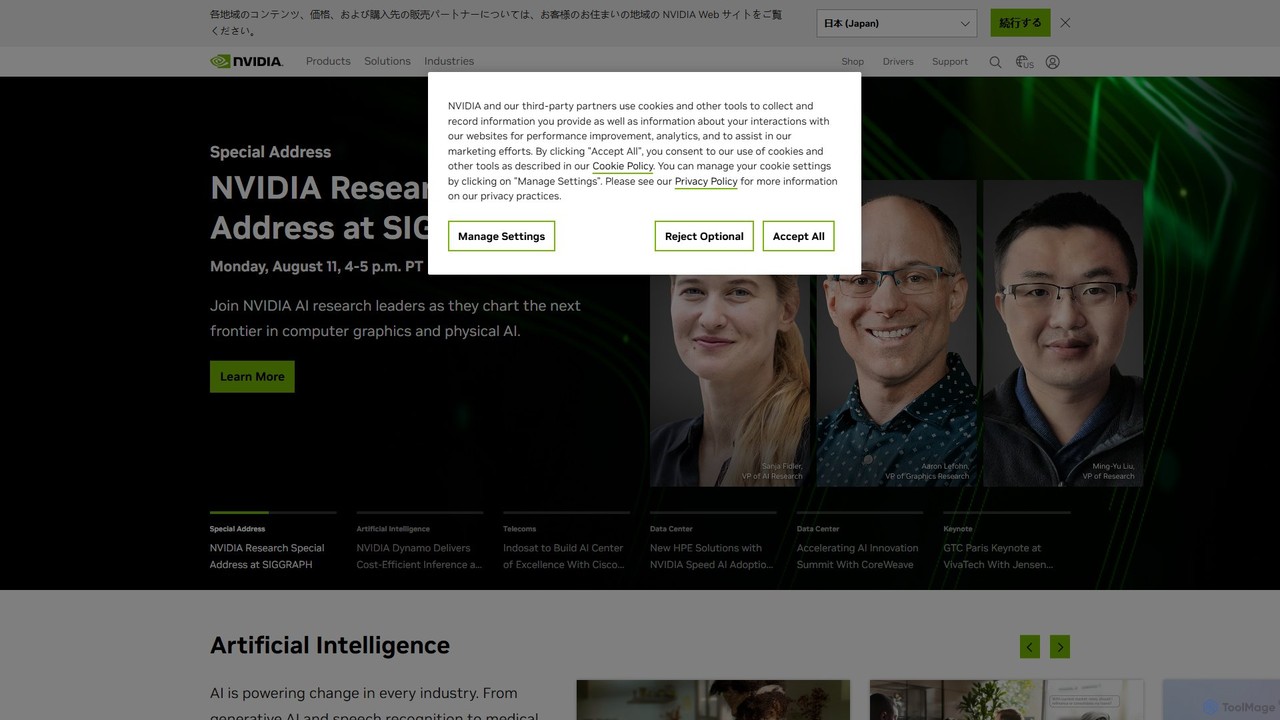
NVIDIA is a global leader in artificial intelligence computing, providing a full-stack platform of hardware, software, and services. Its solutions power everything from gaming and professional graphics with GeForce and RTX GPUs to advanced AI, data science, and high-performance computing in data centers and the cloud.

Infrastructure
Visits 39MFavorites 110Likes 99
Google Research
Free

Google Research

Google Research is a premier hub for exploring groundbreaking advancements in science and AI. It provides open access to a vast repository of research papers, project showcases, and open-source resources across diverse fields like machine learning, quantum computing, and healthcare. It's an essential platform for researchers, developers, and enthusiasts to stay at the forefront of technological innovation and understand its real-world impact.

Learning Platform
Visits 1.5MFavorites 144Likes 132
Satlas
Free

Satlas

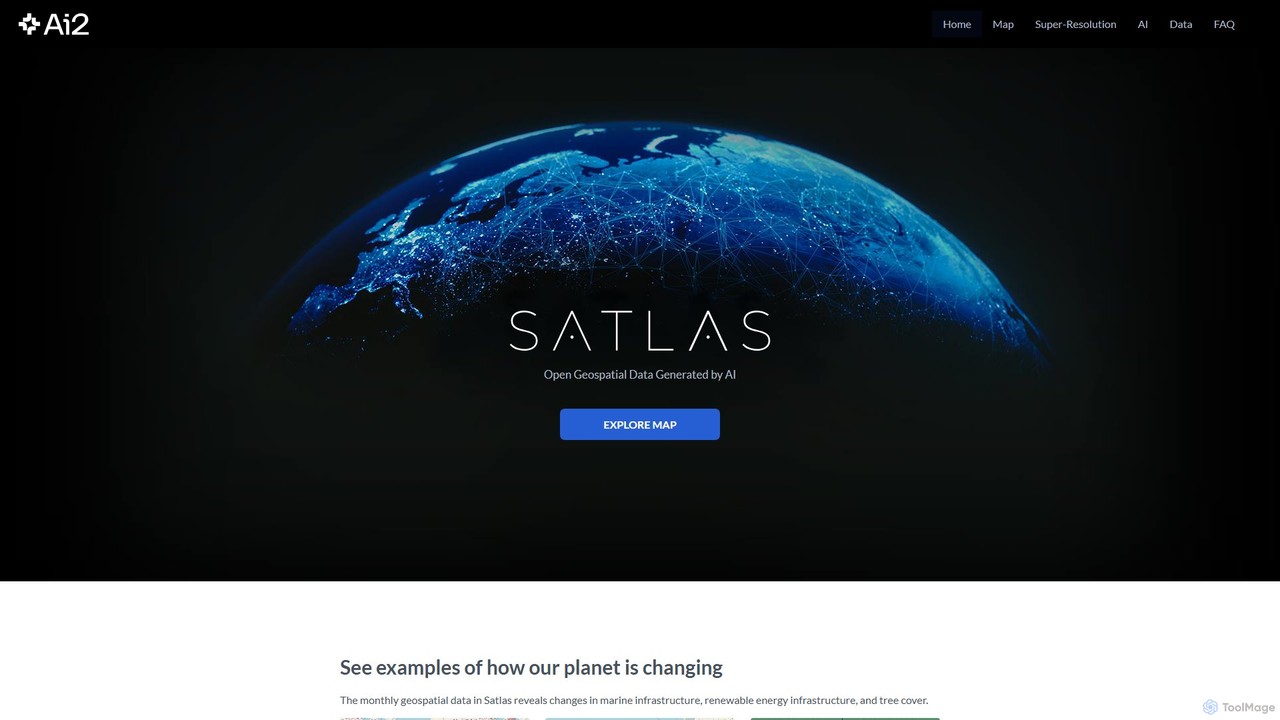
Satlas is an AI-powered platform by the Allen Institute for AI that provides open, high-resolution geospatial data. It uses advanced computer vision models to analyze global satellite imagery, tracking changes in tree cover, renewable energy, and marine infrastructure. Its key feature is Super-Resolution, which enhances low-resolution images for detailed analysis.

Geospatial
Visits 7.7KFavorites 112Likes 109

About Science

AI Science tools are a specialized category of software that leverages machine learning and complex algorithms to analyze scientific data, model natural phenomena, and accelerate research breakthroughs. These tools process vast and complex datasets—from genomic sequences to astronomical imagery—to uncover patterns that are beyond human capacity to identify. They play a critical role in modern research by enabling predictive modeling, automating data interpretation, and generating novel hypotheses. This empowers scientists in fields like biology, chemistry, and physics to tackle previously unsolvable problems.

Core Features

  • Predictive Modeling & Simulation: Creates complex models to simulate biological processes, chemical reactions, or climate systems.
  • High-Throughput Data Analysis: Processes and interprets massive datasets from sources like gene sequencers, microscopes, or particle accelerators.
  • Hypothesis Generation: Identifies correlations and patterns in data to suggest new avenues for scientific inquiry.
  • Automated Image & Signal Recognition: Analyzes scientific imagery (e.g., MRIs, cell cultures) or signals to classify and quantify features automatically.

Applicable Scenarios

These tools are essential for academic research institutions, pharmaceutical companies, and R&D departments in materials science and biotechnology. For example, a biochemist might use an AI tool to predict protein structures for drug discovery, while a climatologist could model the long-term effects of carbon emissions.

Selection Criteria

When choosing an AI Science tool, consider its specialization for your specific domain (e.g., genomics vs. astrophysics). Evaluate the tool's model accuracy and validation methods. Assess its compatibility with your existing data formats and laboratory instruments, and consider the computational resources required to run complex simulations.

Science use cases

1

Accelerating Drug Discovery with Protein Folding Prediction

A computational biologist at a pharmaceutical company is tasked with identifying promising drug candidates for a new disease target. Instead of months of physical lab experiments, they use an AI science tool to predict the 3D structures of thousands of target proteins. By inputting protein sequences, the AI generates highly accurate structural models within hours. This allows the team to quickly run virtual screenings of compound libraries against these models, identifying molecules with the highest binding affinity and significantly shortening the preclinical discovery phase.

2

Analyzing Genomic Data for Personalized Medicine

A geneticist at a research hospital works on identifying genetic markers for a rare hereditary disease. They use an AI-powered platform to analyze whole-genome sequencing data from hundreds of patients. The tool automatically aligns sequences, identifies variants, and cross-references them against massive genomic databases. The AI highlights statistically significant mutations that are common among patients but absent in the healthy population, pointing directly to the potential genetic cause of the disease and paving the way for targeted therapies.

3

Modeling Climate Change Impacts on Ecosystems

A team of environmental scientists needs to predict how rising global temperatures will affect a specific forest ecosystem. They utilize an AI simulation tool, feeding it historical climate data, satellite imagery of vegetation, and soil composition information. The AI model simulates various warming scenarios over the next 50 years, predicting changes in tree species distribution, wildfire risk, and water availability. These detailed forecasts provide crucial data for conservation planning and policy-making.

4

Discovering Novel High-Performance Materials

A materials scientist in an aerospace R&D lab is searching for a new alloy with superior heat resistance and low weight. Using an AI materials discovery platform, they define the desired properties. The AI sifts through a vast database of known elements and chemical structures, running simulations to predict the properties of millions of hypothetical combinations. It shortlists a dozen promising candidates, allowing the lab to focus its physical testing efforts on materials with the highest probability of success, drastically reducing development time and cost.

5

Automating Cellular Image Analysis in Biology

A cell biologist is studying the effects of a new compound on cancer cells, requiring the analysis of thousands of microscopy images. Manually counting and classifying cells is tedious and prone to error. They employ an AI image analysis tool trained to recognize specific cellular features. The software automatically segments images, counts the number of living versus dead cells, and measures morphological changes. This provides objective, quantitative data and frees up the researcher's time for higher-level analysis and experimental design.

6

Synthesizing Insights from Scientific Literature

A postdoctoral researcher is starting a new project and needs to quickly understand the current state of the field. Instead of manually reading hundreds of papers, they use an AI tool designed for scientific literature analysis. The tool ingests a corpus of relevant research articles, extracts key concepts, identifies prevailing methodologies, and visualizes connections between different studies. It generates a concise summary of established findings and highlights conflicting results or unexplored questions, providing a comprehensive overview in a fraction of the time.

Science FAQ

What are AI Science tools?

AI Science tools are specialized software applications that use artificial intelligence, particularly machine learning, to solve complex problems in scientific research. They excel at analyzing vast datasets, running simulations of natural systems, and identifying patterns that are not apparent to human researchers. Key functions include predictive modeling for fields like drug discovery and climate science, high-throughput data analysis for genomics, and automated image recognition for biology and medicine.

How do AI Science tools differ from general AI Research tools?

The primary difference lies in their domain and data focus. AI Science tools are built for empirical, quantitative scientific disciplines like biology, chemistry, and physics. They work with specific data types like genomic sequences, molecular structures, or sensor readings to model natural laws. General AI Research tools have a broader scope, often focusing on text analysis for literature reviews, market data for business research, or survey data for social sciences. Science tools aim to uncover objective natural phenomena, while general research tools often analyze human-generated information.

How do I choose the right AI tool for my scientific research?

Selecting the right tool depends on several key factors. First, consider your specific scientific domain; a tool for genomics will differ greatly from one for materials science. Second, evaluate the type and scale of your data. Ensure the tool is compatible with your data formats (e.g., FASTQ, PDB, FITS) and can handle the volume. Third, assess the model's accuracy and whether it has been validated against known experimental results. Finally, consider the user interface and required technical skills—some tools offer a no-code interface for experimental scientists, while others are code libraries for computational experts.

What are the main applications of AI in scientific discovery?

AI is transforming scientific discovery across numerous fields. Key applications include:

  • Drug Discovery: Predicting protein structures and identifying potential drug molecules, dramatically speeding up development.
  • Genomics: Analyzing DNA sequences to find links between genes and diseases for personalized medicine.
  • Materials Science: Simulating and predicting the properties of new materials before they are synthesized.
  • Climate Science: Building more accurate models to forecast climate change and its impacts.
  • Astrophysics: Classifying galaxies and detecting astronomical events in massive telescope datasets.

Do I need to be a programmer to use AI Science tools?

Not necessarily. The field offers a wide spectrum of tools for different skill levels. Many modern AI science platforms are designed with user-friendly graphical interfaces (GUIs) that allow experimental scientists (e.g., biologists, chemists) to upload data and run complex analyses without writing any code. However, for researchers who need to build custom models or integrate AI into unique workflows, there are powerful libraries and frameworks (like TensorFlow and PyTorch) that require programming skills in languages such as Python. The choice depends on the flexibility and customization your research requires.