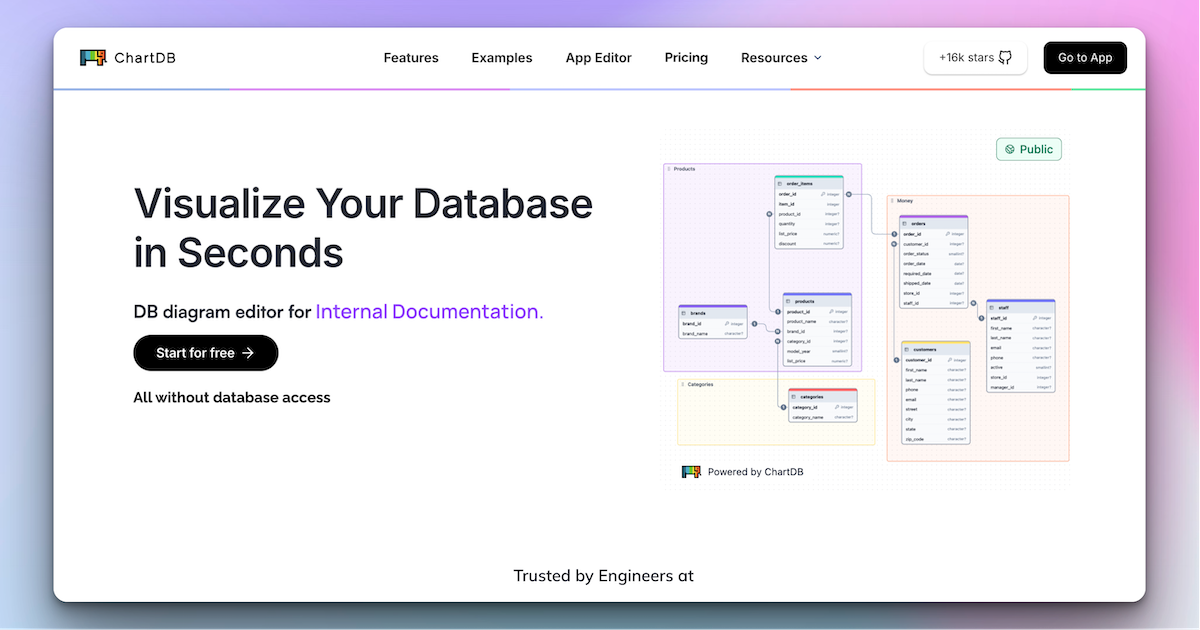
ChartDB is an AI-powered database schema visualizer that instantly generates interactive ER diagrams from a single query. It's designed for developers and teams to design, document, and collaborate on database structures. It features real-time collaboration, database synchronization, and an AI assistant to optimize schema design. Both cloud and self-hosted open-source versions are available.
ParadeDB is a modern Elasticsearch alternative built directly on Postgres. It enhances Postgres with powerful, real-time search and analytics capabilities, including full-text search, fuzzy matching, and faceting, eliminating the need for complex ETL processes and separate search engines.
Product overview
ChartDB Product overview
ChartDB is an AI-powered database schema visualizer that instantly generates interactive ER diagrams from a single query. It's designed for developers and teams to design, document, and collaborate on database structures. It features real-time collaboration, database synchronization, and an AI assistant to optimize schema design. Both cloud and self-hosted open-source versions are available.
ParadeDB Product overview
ParadeDB is a modern Elasticsearch alternative built directly on Postgres. It enhances Postgres with powerful, real-time search and analytics capabilities, including full-text search, fuzzy matching, and faceting, eliminating the need for complex ETL processes and separate search engines.
Detailed feature comparison
| Feature | ChartDB | ParadeDB |
|---|---|---|
| Primary category | Visualization | Search |
| Added | 2025-08-13 | 2025-08-06 |
| Pricing | Freemium | Freemium |
| Official website | chartdb.io | www.paradedb.com |
| Product type | Website | Website |
| Performance data | ||
| User rating | Not verified | Not verified |
| Comments | 0 | 0 |
| Monthly visits | 130K | 35.6K |
| Monthly growth | -14.6% | 8.1% |
| Favorites | 119 | 141 |
| Details | View details | View details |
ChartDB vs ParadeDB monthly traffic
Compare ChartDB and ParadeDB by monthly reach, traffic trend, visit depth, top regions, and acquisition sources.
How to interpret the traffic data
In the ChartDB vs ParadeDB monthly traffic comparison, ChartDB currently shows 130K visits and ParadeDB shows 35.6K; ChartDB has about 3.7 times the visible traffic of ParadeDB, an absolute difference of about 94.4K visits. This reflects visible reach, not feature quality or paid users.
Both tools provide verified traffic details, so monthly trends, visit depth, regions, and acquisition sources can be compared on the same basis.
ChartDB monthly traffic:
Latest traffic
Monthly traffic trend
- 2025/9: 111.6K Monthly visits
- 2026/1: 171.5K Monthly visits
- 2026/2: 138.7K Monthly visits
- 2026/3: 166.7K Monthly visits
- 2026/4: 152.2K Monthly visits
- 2026/5: 130K Monthly visits
Top regions
Top 5 countries/regions
| Country/region | Percentage | Traffic |
|---|---|---|
| 🇺🇸United States | 25.46% | 33.1K |
| 🇮🇳India | 21.92% | 28.5K |
| 🇪🇸Spain | 21.67% | 28.2K |
| 🇷🇺Russia | 15.79% | 20.5K |
| 🇮🇩Indonesia | 15.16% | 19.7K |
Traffic sources
| Source type | Percentage | Traffic |
|---|---|---|
| Direct | 73.39% | 95.4K |
| Referral | 26.45% | 34.4K |
| 0.16% | 208 |
Search keywords
ParadeDB monthly traffic:
Latest traffic
Monthly traffic trend
- 2025/9: 34K Monthly visits
- 2026/1: 36.3K Monthly visits
- 2026/2: 33.5K Monthly visits
- 2026/3: 53.2K Monthly visits
- 2026/4: 32.9K Monthly visits
- 2026/5: 35.6K Monthly visits
Top regions
Top 5 countries/regions
| Country/region | Percentage | Traffic |
|---|---|---|
| 🇺🇸United States | 36.34% | 12.9K |
| 🇧🇷Brazil | 22.37% | 8K |
| 🇮🇳India | 16.68% | 5.9K |
| 🇨🇦Canada | 12.79% | 4.6K |
| 🇹🇭Thailand | 11.82% | 4.2K |
Traffic sources
| Source type | Percentage | Traffic |
|---|---|---|
| Direct | 85.76% | 30.5K |
| Referral | 13.23% | 4.7K |
| 1.01% | 360 |
Search keywords
Usage comparison
Compare the core capabilities of ChartDB and ParadeDB
ChartDB Core features
ParadeDB Core features
Use cases
ChartDB Use cases
ParadeDB Use cases
ChartDB vs ParadeDB:In-depth comparison and selection guidance
First decide whether the products solve the same kind of need
This in-depth ChartDB vs ParadeDB comparison uses only the product records, taxonomy, audience, traffic, and community signals available on this page. ChartDB is primarily listed under “Visualization”, while ParadeDB is primarily listed under “Search”, so the first decision is whether your actual task matches their recorded scope.
The structured fields currently show these decision-relevant differences: Primary category (ChartDB: Visualization; ParadeDB: Search); Monthly visits (ChartDB: 130K; ParadeDB: 35.6K); Monthly growth (ChartDB: -14.6%; ParadeDB: 8.1%); Favorites (ChartDB: 119; ParadeDB: 141); Website (ChartDB: chartdb.io; ParadeDB: www.paradedb.com). These facts are more useful for selection than brand visibility alone.
What market visibility and monthly traffic mean
In the ChartDB vs ParadeDB monthly traffic comparison, ChartDB currently shows 130K visits and ParadeDB shows 35.6K; ChartDB has about 3.7 times the visible traffic of ParadeDB, an absolute difference of about 94.4K visits. This reflects visible reach, not feature quality or paid users.
Both tools provide verified traffic details, so monthly trends, visit depth, regions, and acquisition sources can be compared on the same basis.
If public market visibility is an important first-pass criterion, investigate ChartDB first. The final choice should still follow taxonomy, use case, and a real trial because higher traffic does not prove broader capabilities or better workflow fit.
Product positioning, use cases, and roles
ChartDB and ParadeDB currently overlap in shared categories: Database; shared tags: database, developer tools, open source, and SQL. This can place both on the same shortlist, but it does not prove equal implementation, depth, or cost.
ChartDB's unique categories/tags are Visualization, Diagramming, AI assistant, collaboration, database design, data modeling, ER diagram, and mysql; ParadeDB's are Search, Infrastructure, analytics, data infrastructure, Elasticsearch alternative, full-text search, postgres, and search engine. These unique fields are the strongest differentiators: validate the product whose recorded scope matches the task instead of following traffic alone.
What ratings, comments, and favorites can tell you
ChartDB has no verified rating, 0 comments, 119 favorites, and 126 likes;ParadeDB has no verified rating, 0 comments, 141 favorites, and 137 likes。
Neither product has enough rating or comment samples for a credible reputation ranking.
Selection guidance by actual need
When to evaluate ChartDB first
Put ChartDB on the priority trial list when the task aligns with “Visualization” and especially Visualization, Diagramming, AI assistant, collaboration, database design, and data modeling. This follows recorded positioning and does not imply unlisted capabilities are absent.
ChartDB also currently records: pricing is freemium, product type is website, 130K verified monthly visits, no verified user rating. Verify any hard requirement around price, platform, or reach before trial, and do not let sparse review data substitute for testing.
When to evaluate ParadeDB first
Put ParadeDB on the priority trial list when the task aligns with “Search” and especially Search, Infrastructure, analytics, data infrastructure, Elasticsearch alternative, and full-text search. This follows recorded positioning and does not imply unlisted capabilities are absent.
ParadeDB also currently records: pricing is freemium, product type is website, 35.6K verified monthly visits, no verified user rating. Verify any hard requirement around price, platform, or reach before trial, and do not let sparse review data substitute for testing.
How to validate the recommendation before deciding
The available data describes positioning, public visibility, and community signals, but it cannot prove output quality, speed, integration effort, privacy, or long-term cost in your workflow. Before deciding, run the same representative tasks in ChartDB and ParadeDB, then record completion time, accuracy, manual corrections, and the real paid threshold. A like-for-like trial turns this comparison into a defensible adoption decision.
Comparison FAQ
How should I choose between ChartDB and ParadeDB?
Where does this comparison data come from?
What do unknown fields mean?
Related AI tools

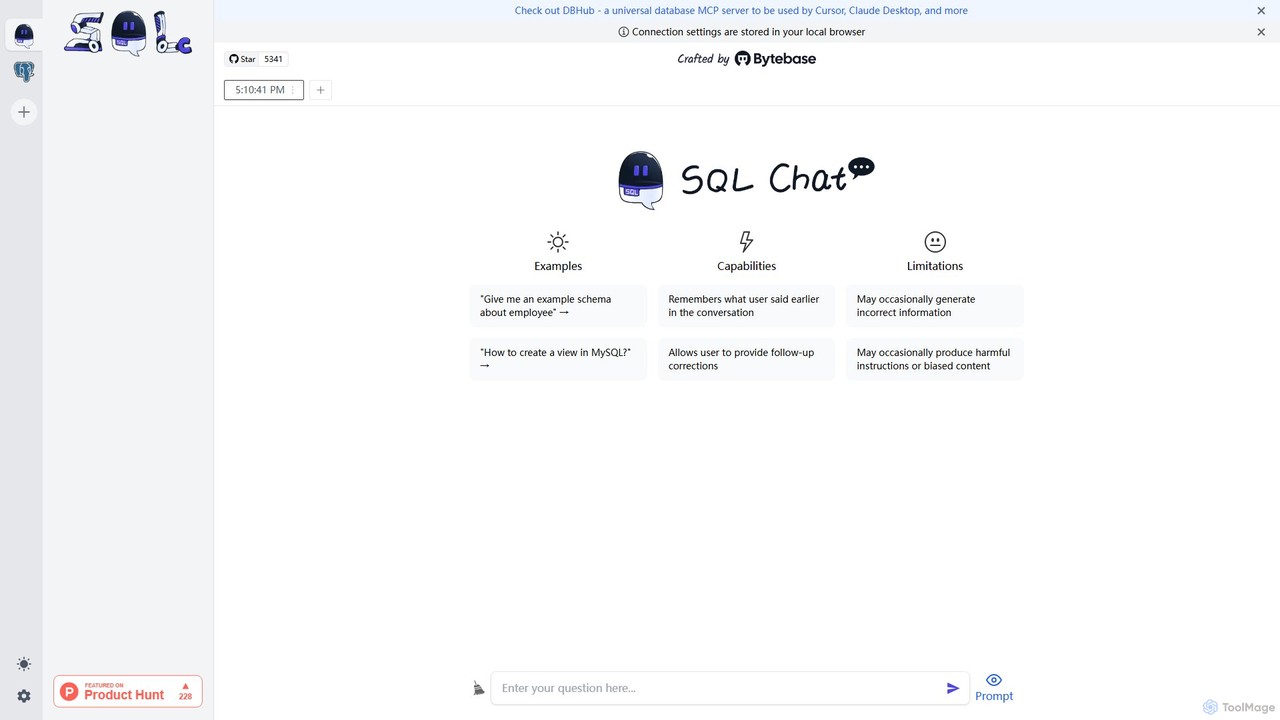
SQL Chat
SQL Chat is an open-source, chat-based SQL client and editor that uses AI to translate natural language questions into SQL queries. Connect to your database, ask questions in plain English, and get results instantly, democratizing data access for both technical and non-technical users.
Code Assistant
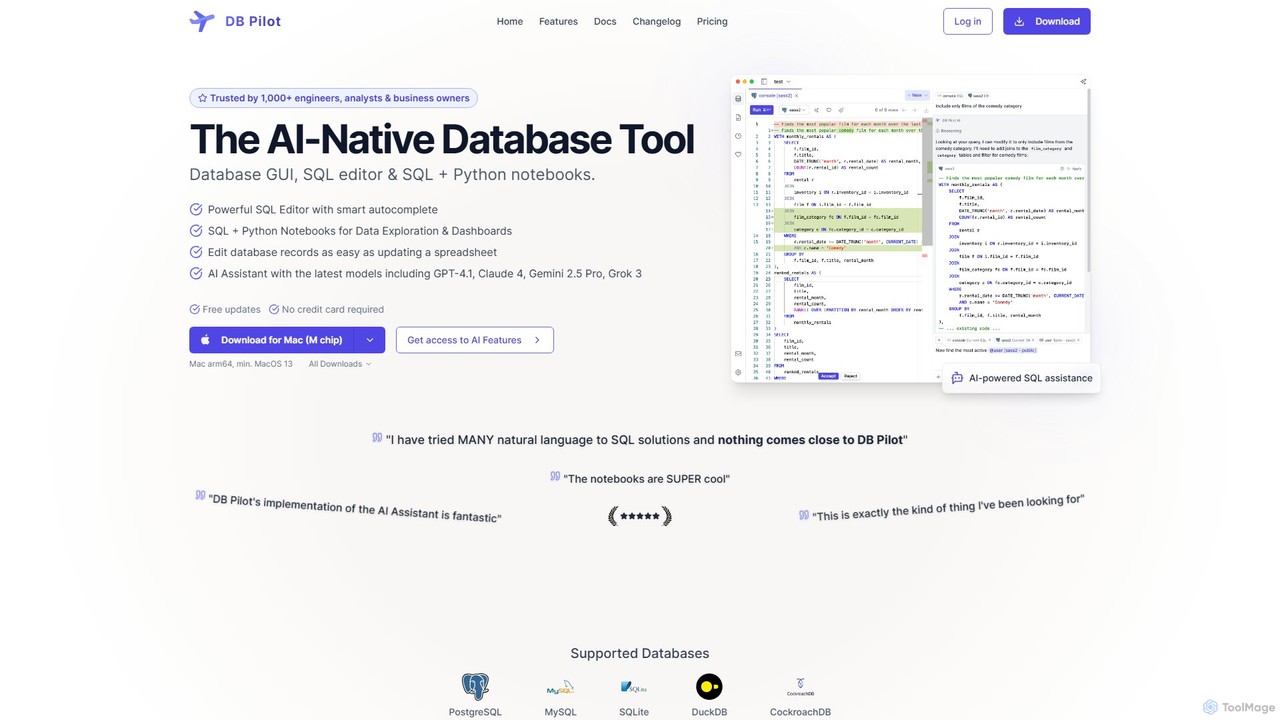
dbpilot
dbpilot is an AI-native database tool for engineers and analysts, featuring a powerful GUI, an intelligent SQL editor, and integrated SQL + Python notebooks. It leverages top AI models like GPT-4 and Claude to generate, debug, and explain queries, streamlining data exploration and dashboard creation in a secure, local-first environment.
Sql
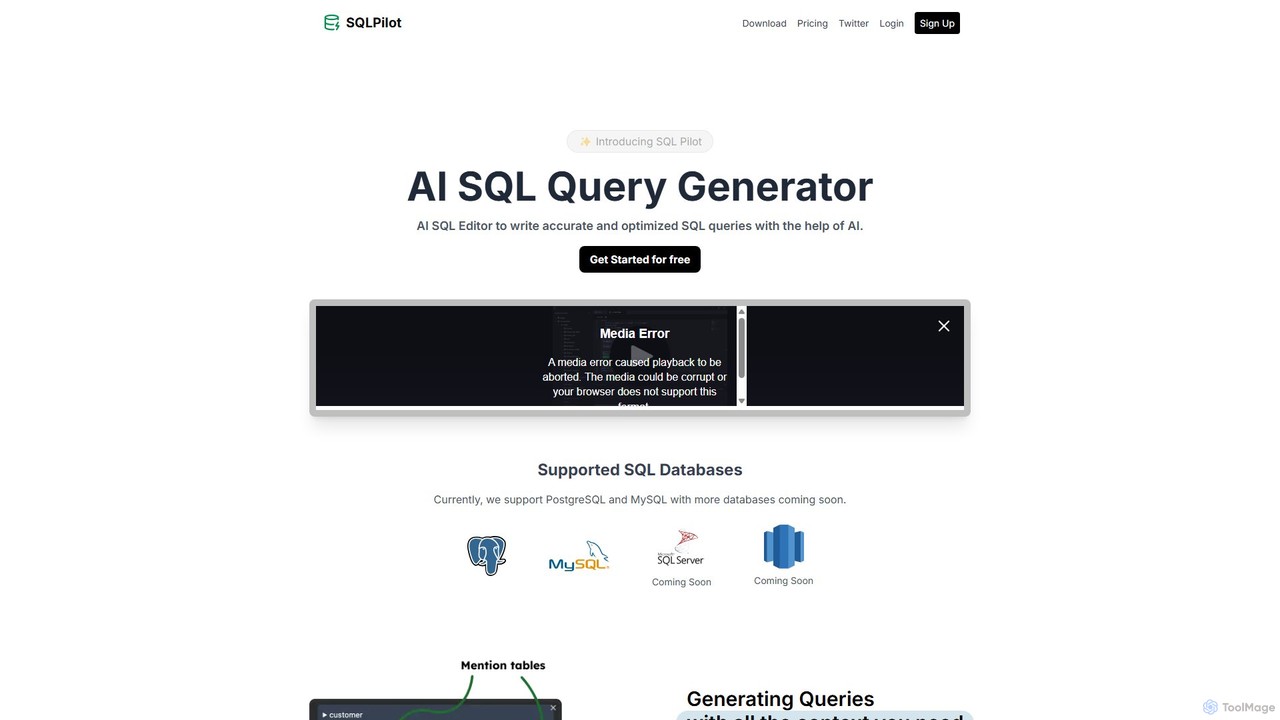
SQLPilot
SQLPilot is an AI-powered SQL query generator and editor that transforms natural language prompts into accurate, optimized SQL queries. It supports multiple databases like PostgreSQL and MySQL, various GPT models, and ensures data privacy by not storing your credentials or schemas.
Code Assistant
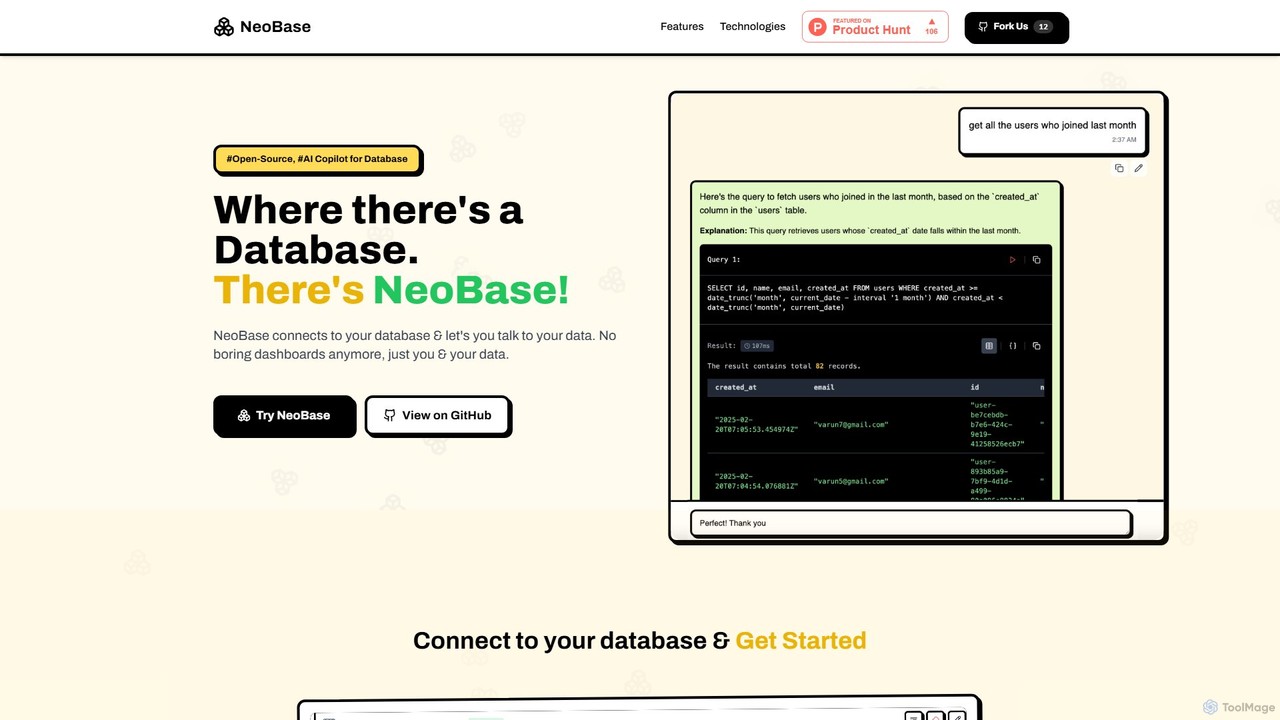
NeoBase
NeoBase is an open-source AI copilot for databases, enabling users to interact with their data using natural language. It connects to various SQL and NoSQL databases, translates plain English queries into optimized code, and visualizes the results. Designed for both technical and non-technical users, it streamlines data analysis, debugging, and reporting, eliminating the need for complex query writing and providing full data control through self-hosting.
Data Analysis
InfluxData
InfluxData offers InfluxDB, the leading time series database platform built for real-time data and AI applications. It empowers developers to ingest, store, and analyze massive volumes of high-velocity data from IoT, applications, and infrastructure. Featuring high-performance querying, superior data compression, and seamless integration with data lakes and AI/ML pipelines, InfluxData is the engine for anomaly detection, predictive maintenance, and autonomous systems.
Data Management
Vanna.AI
Vanna.AI is an open-source, personalized AI SQL agent that transforms natural language questions into accurate SQL queries. It uses a Retrieval-Augmented Generation (RAG) model trained on your specific database schema, documentation, and past queries to achieve high accuracy on complex datasets. It's designed for security, flexibility, and easy integration into any application, empowering both technical and non-technical users to gain insights from their data effortlessly.
Business Intelligence
Postgres Sandbox
An intuitive, web-based visual tool for designing, prototyping, and experimenting with PostgreSQL database schemas. Create tables, define relationships, and generate SQL code in a risk-free sandbox environment. Ideal for developers, DBAs, and students.
Database
QueryGenie
QueryGenie is an AI-powered assistant that translates natural language into SQL queries. It helps developers, data analysts, and business users to generate, optimize, and understand complex SQL code effortlessly, significantly boosting productivity and democratizing data access.
Code Assistant
sqltroughai
sqltroughai is an AI-powered assistant that translates natural language into SQL queries, optimizes existing code, and explains complex queries in plain English. It empowers developers, analysts, and business users to interact with databases effortlessly and efficiently.
Code Assistant
Meilisearch
Meilisearch is an open-source, lightning-fast, and AI-powered search engine. It's designed for developers to easily integrate advanced search capabilities, including full-text, semantic, and hybrid search, into any website or application. It offers an exceptional developer experience with powerful APIs and SDKs.
Database
nao
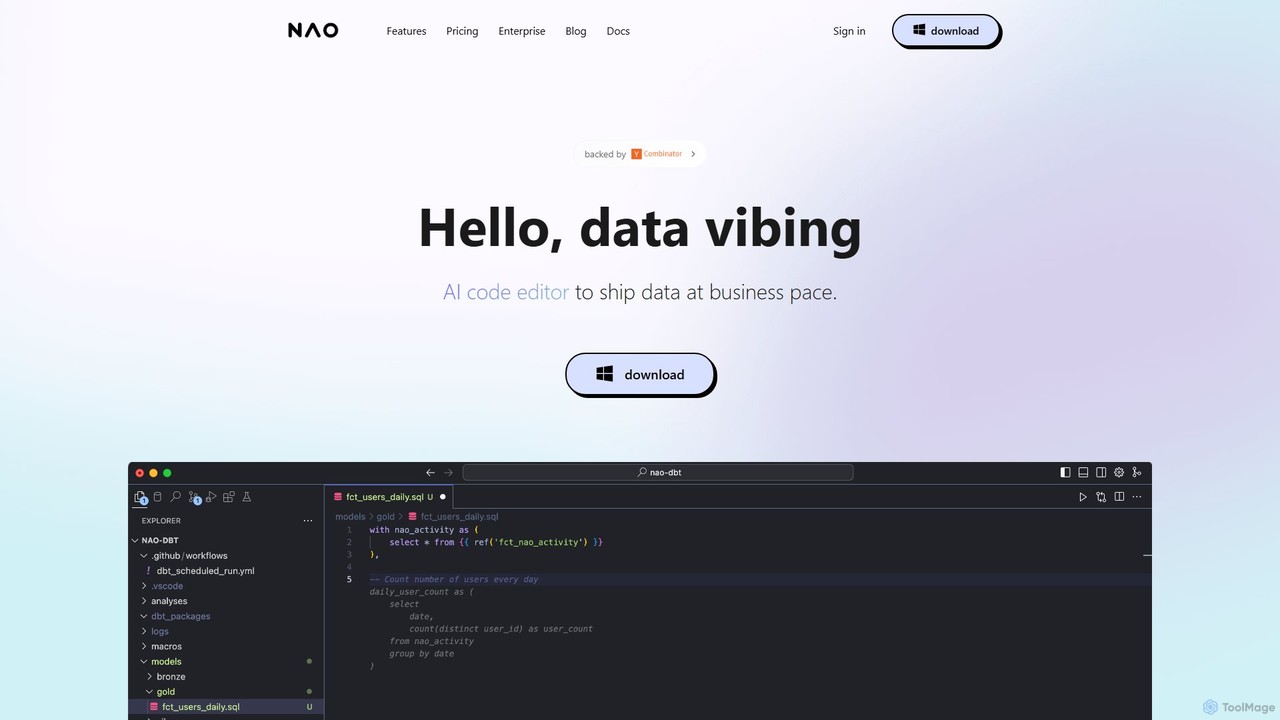
nao is an AI-powered code editor designed for data teams. It streamlines SQL and Python data pipeline creation, dbt workflows, and analytics by natively connecting to your data warehouse. Its intelligent agent provides data-aware code suggestions, quality checks, and instant diff previews to help you ship data faster and more safely.
Analytics
sherloqdata
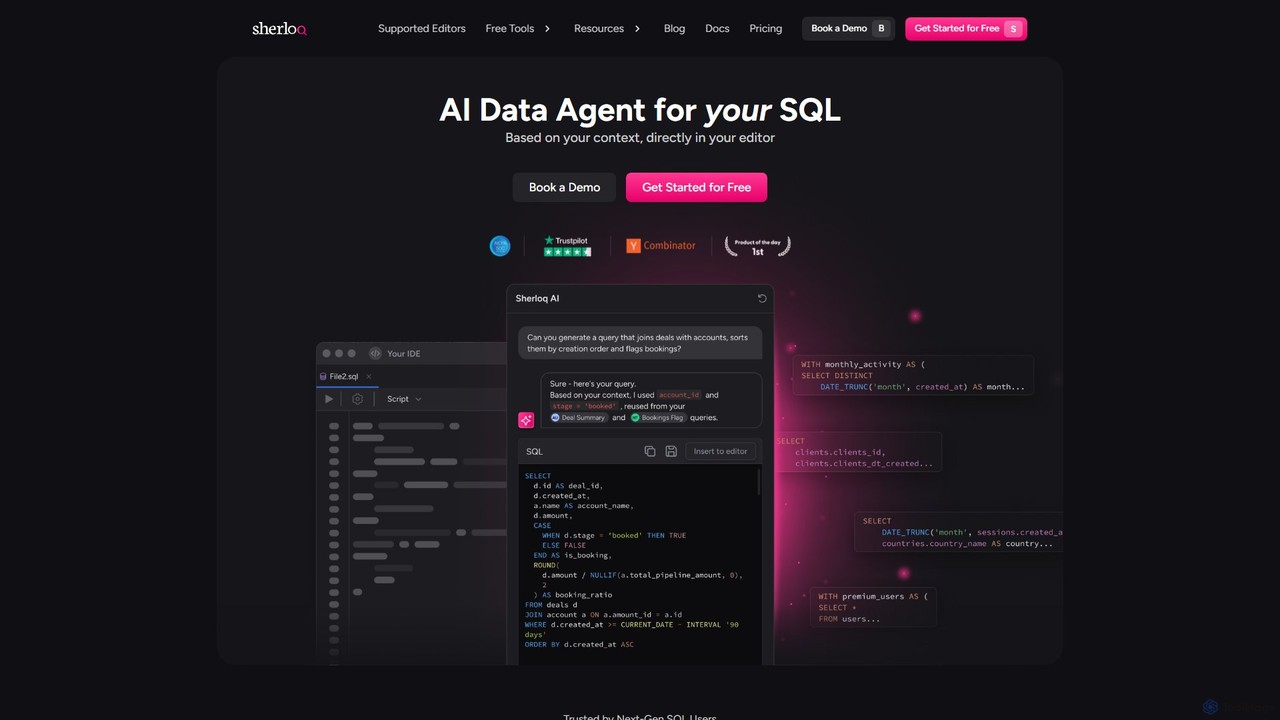
Sherloqdata is an AI-powered data agent for SQL that works directly in your editor. It helps data professionals write, fix, and manage SQL queries faster by using your existing SQL repository for context. Features include an AI SQL Chat, query management, version control, and team collaboration.
Database
AskYourDatabase
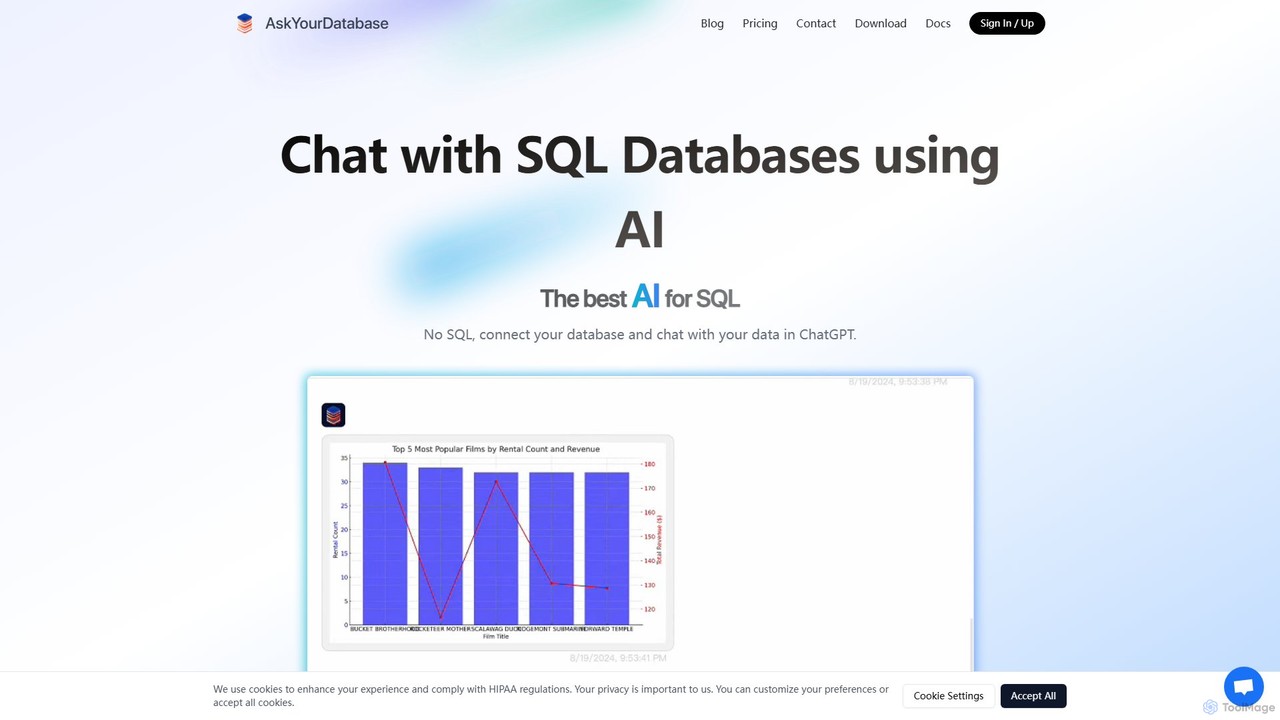
AskYourDatabase is a powerful AI SQL assistant that allows you to interact with your databases using natural language. Query data, create visualizations, and build interactive dashboards without writing a single line of SQL. It supports various databases, offers both desktop and embeddable chatbot versions, and prioritizes data security with on-premise deployment options.
Data Analysis
Avanty
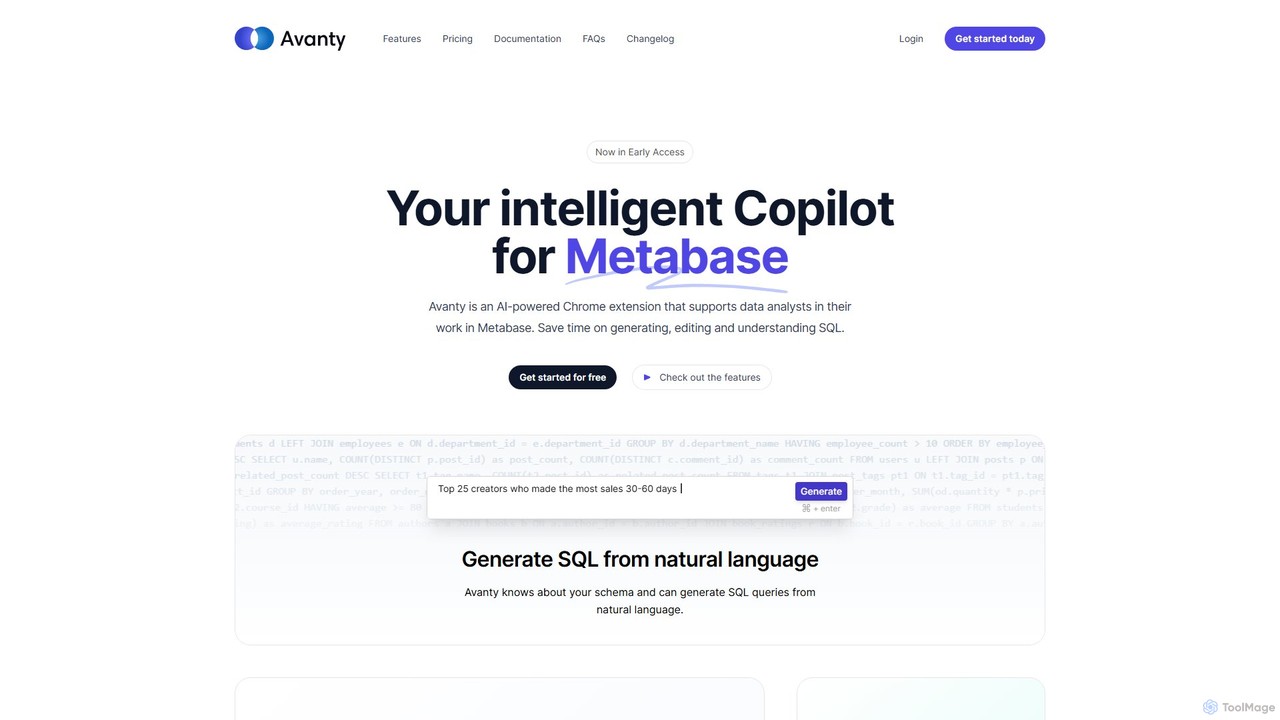
Avanty is an AI-powered Chrome extension designed as an intelligent copilot for data analysts using Metabase. It streamlines workflows by enabling users to generate, edit, explain, and format SQL queries using natural language. This tool significantly saves time, enhances productivity, and helps in understanding complex data queries, making data analysis faster and more intuitive.
Business Intelligence
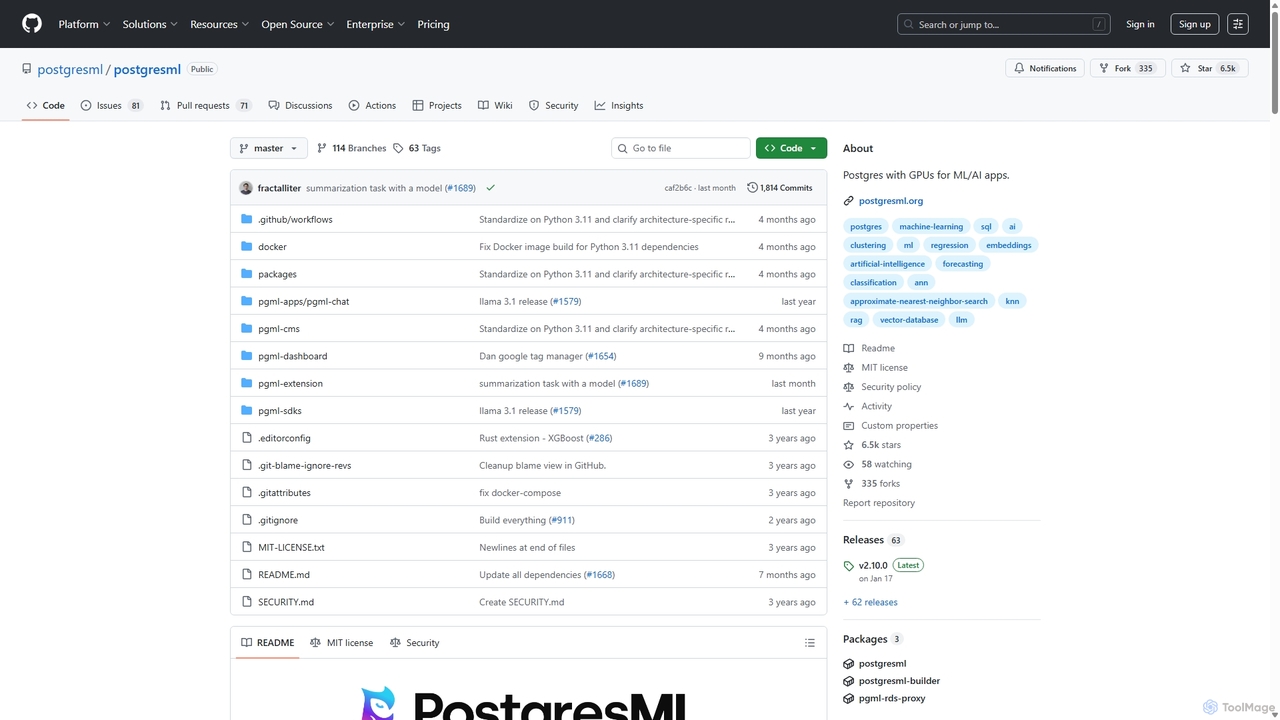
PostgresML
PostgresML is a powerful open-source extension that integrates machine learning and AI directly into your PostgreSQL database. It enables GPU-accelerated inference, vector search, and complete RAG pipelines using simple SQL commands, eliminating data movement and simplifying the MLOps stack for high-performance, scalable AI applications.
Mlops