

ParadeDB Overview
ParadeDB positions itself as a powerful, modern alternative to Elasticsearch, specifically engineered to work seamlessly within the PostgreSQL ecosystem. It transforms a standard Postgres database into a high-performance search and analytics engine, designed to handle real-time, update-heavy workloads. The core mission of ParadeDB is to free development teams from the complexities and overhead associated with scaling, managing, and synchronizing a separate Elasticsearch cluster. By integrating search and analytics capabilities directly into Postgres, it simplifies the data stack, reduces operational costs, and eliminates common data consistency issues.
As an open-source project, ParadeDB has gained significant traction within the developer community, evidenced by thousands of GitHub stars and over a hundred thousand Docker deployments. It is trusted by a wide range of companies, from fast-growing startups like Bilt Rewards and Modern Treasury to Fortune 500 enterprises like Alibaba Cloud, for powering mission-critical applications.
How to use ParadeDB
Getting started with ParadeDB is designed to be straightforward for developers familiar with Postgres. There are two primary methods for deployment:
- Docker Container: The quickest way to test and run ParadeDB is through its official Docker image. A simple command is all it takes to get a new instance running:
docker run --name paradedb -e POSTGRES_PASSWORD=password paradedb/paradedb
Once running, you can connect to it using any standard Postgres client like `psql`. - Postgres Extension: For existing, self-managed Postgres databases, ParadeDB can be installed as a standard extension. This allows you to augment your current database with ParadeDB's features without migrating data to a new system. It integrates with Postgres's internal mechanisms, such as logical replication, allowing it to act as a high-performance read replica that offloads demanding search and analytics queries from your primary database.
Once installed, you interact with ParadeDB using standard Postgres SQL. There's no need to learn a new query language like Elasticsearch's Query DSL. You can create search indexes and run complex, filtered, and faceted queries using familiar SQL syntax.
Core Features of ParadeDB
- Advanced Full-Text Search: Goes beyond Postgres's built-in search to offer features like BM25 relevance scoring, custom tokenizers, fuzzy matching, phrase queries, and complex boolean logic.
- High-Performance Analytics: Includes support for fast analytical queries and faceting, powered by a columnar index. This is ideal for building dashboards, real-time insight panels, and drill-down explorations.
- Zero ETL & Real-Time Sync: By using Postgres's native logical replication, ParadeDB stays perfectly in sync with your primary data source in real-time, eliminating the need for complex and fragile ETL pipelines (e.g., Kafka, Debezium).
- ACID Compliance: Inherits Postgres's ACID guarantees, meaning data is immediately and consistently searchable after a successful write transaction.
- Simplified Operations: Integrates with Postgres's vacuum process for automatic cleanup of stale indexes and leverages Postgres's robust ecosystem for backups, high availability, and disaster recovery.
- Standard SQL Interface: All features are accessible through the standard Postgres SQL dialect, lowering the learning curve and leveraging existing team expertise.
Use Cases for ParadeDB
ParadeDB is battle-tested in demanding production environments for various applications:
- Bilt Rewards: The housing rewards platform deployed ParadeDB as a logical replica of their primary Postgres. This offloaded their most expensive faceted and fuzzy search queries, resulting in a 95% reduction in query timeouts and a 50% drop in P95 query latency.
- Alibaba Cloud: The tech giant chose ParadeDB to integrate powerful full-text search capabilities into its Postgres-based data warehouse, handling massive datasets with high performance.
- Modern Treasury: The payment processing API uses ParadeDB to power search over financial transaction data. They benefit from its transactional safety, relational nature, and perfect synchronization, which are critical for financial applications.
- General Enterprise Applications: Any application built on Postgres that requires sophisticated search (e.g., e-commerce product catalogs, log analysis, content management systems) or real-time analytics dashboards can benefit from ParadeDB.
Advantages of ParadeDB
The primary advantage of ParadeDB is its native integration with Postgres, which leads to several key benefits:
- Simplified Data Stack: Consolidates your database and search engine into a single system, reducing infrastructure complexity and operational overhead.
- Guaranteed Data Consistency: Eliminates the risk of data loss or stale search results caused by broken synchronization between Postgres and an external search engine.
- Lower Total Cost of Ownership: Reduces costs associated with licensing, managing, and scaling a separate Elasticsearch cluster.
- Enhanced Developer Productivity: Allows developers to use a single, familiar query language (SQL) for all data operations, speeding up development cycles.
- Superior Reliability: Builds upon the proven reliability, stability, and mature ecosystem of Postgres for features like backups and high availability.
Pricing and Plans
ParadeDB operates on a freemium, open-core model. The core technology is open-source and free to use, available as a Postgres extension or a Docker image. This is ideal for developers, startups, and for self-managing the software. For enterprises requiring advanced features, dedicated support, or a fully managed cloud solution, ParadeDB offers commercial plans. Interested parties are encouraged to contact the sales team for a demo and customized pricing information.
Traffic
Latest traffic
Status
Monthly traffic trend
- 2025-9: 34.0K
- 2026-1: 36.3K
- 2026-2: 33.5K
- 2026-3: 53.2K
- 2026-4: 32.9K
- 2026-5: 35.6K
Geography
Top 5 countries / regions
- 🇺🇸United States36.3%
- 🇧🇷Brazil22.4%
- 🇮🇳India16.7%
- 🇨🇦Canada12.8%
- 🇹🇭Thailand11.8%
Traffic sources
| Source type | Percentage |
|---|---|
Direct | 85.8% |
Referral | 13.2% |
Email | 1.0% |
Top keywords
| Keyword | Cost per click |
|---|---|
| parade db | $0.00 |
| paradedb | $4.55 |
| paradedb vector search | $0.00 |
| pg search | $0.17 |
| tantivy | $0.00 |
ParadeDB Videos on YouTube

Professor Py: Information Retrieval with Python

ParadeDB Alternatives
Xata
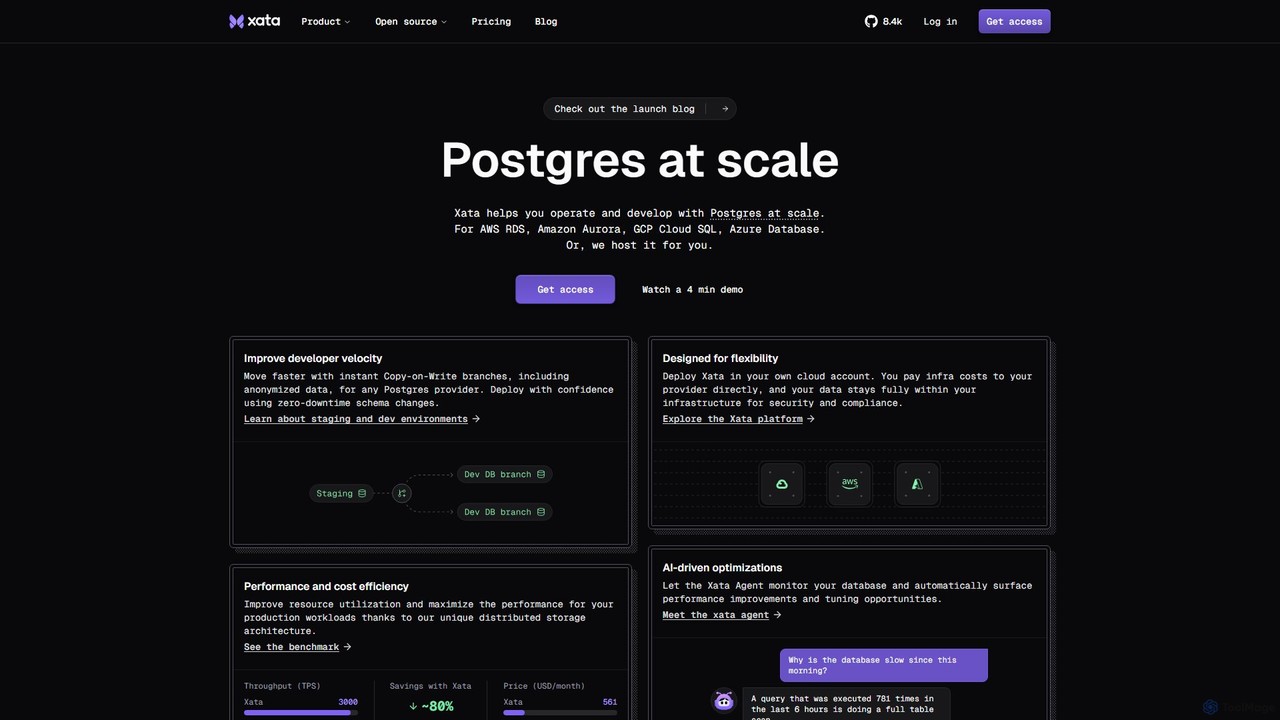
Xata is a "Postgres at scale" platform designed to enhance developer velocity and optimize database performance. It offers unique features like instant Copy-on-Write branches with PII anonymization, zero-downtime schema migrations, and an AI-powered agent for automated performance tuning. Deploy on Xata's infrastructure or within your own cloud for maximum flexibility and compliance.
Database Optimization
TiDB Cloud
TiDB Cloud is a fully managed, distributed SQL database-as-a-service (DBaaS). It offers horizontal scalability, MySQL compatibility, and Hybrid Transactional/Analytical Processing (HTAP) capabilities. Ideal for building modern, data-intensive applications and AI-powered services, it simplifies database operations and provides a powerful backend for applications that require both real-time transactions and complex analytics, including vector search for AI.
Vector Database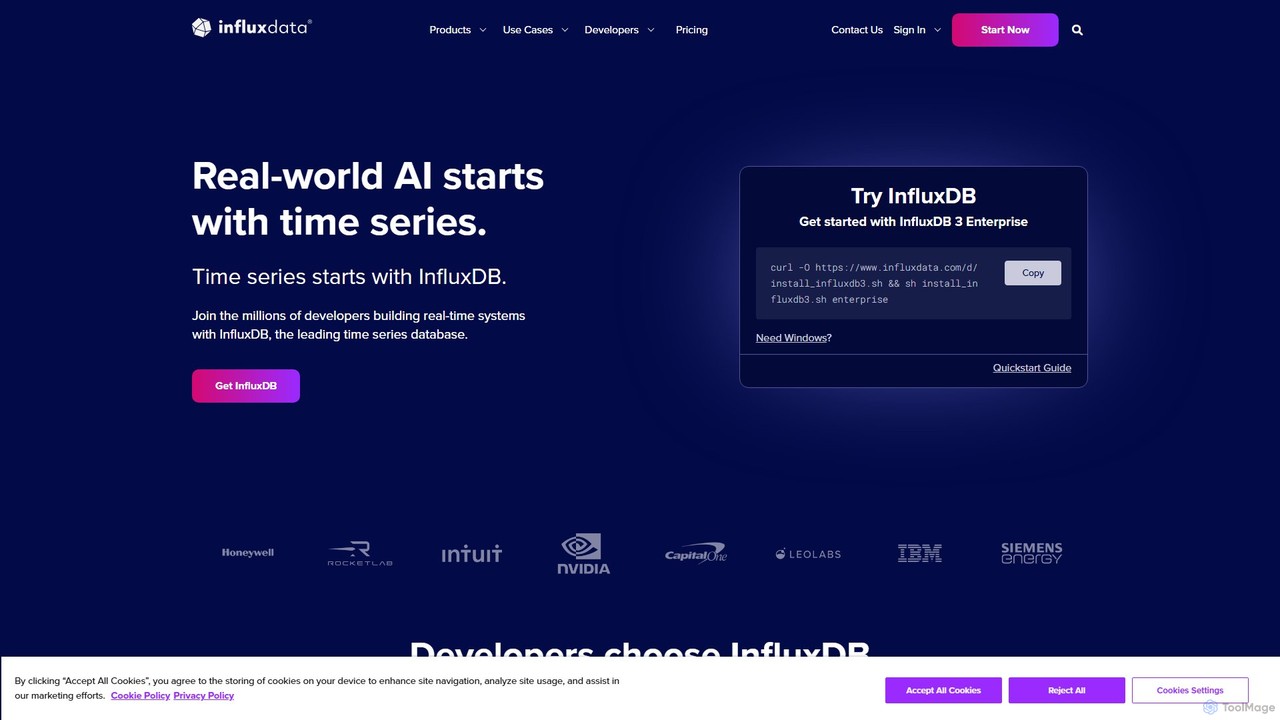
InfluxData
InfluxData offers InfluxDB, the leading time series database platform built for real-time data and AI applications. It empowers developers to ingest, store, and analyze massive volumes of high-velocity data from IoT, applications, and infrastructure. Featuring high-performance querying, superior data compression, and seamless integration with data lakes and AI/ML pipelines, InfluxData is the engine for anomaly detection, predictive maintenance, and autonomous systems.
Data Management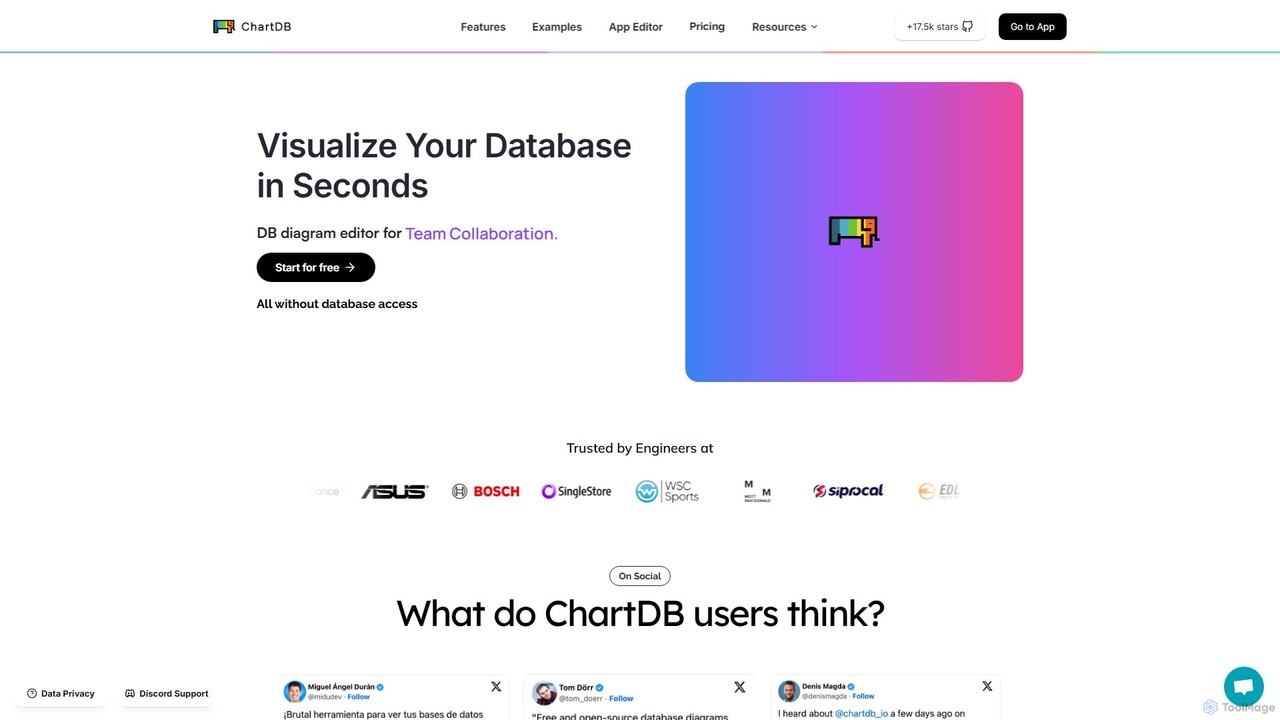
ChartDB
ChartDB is an AI-powered database schema visualizer that instantly generates interactive ER diagrams from a single query. It's designed for developers and teams to design, document, and collaborate on database structures. It features real-time collaboration, database synchronization, and an AI assistant to optimize schema design. Both cloud and self-hosted open-source versions are available.
Visualization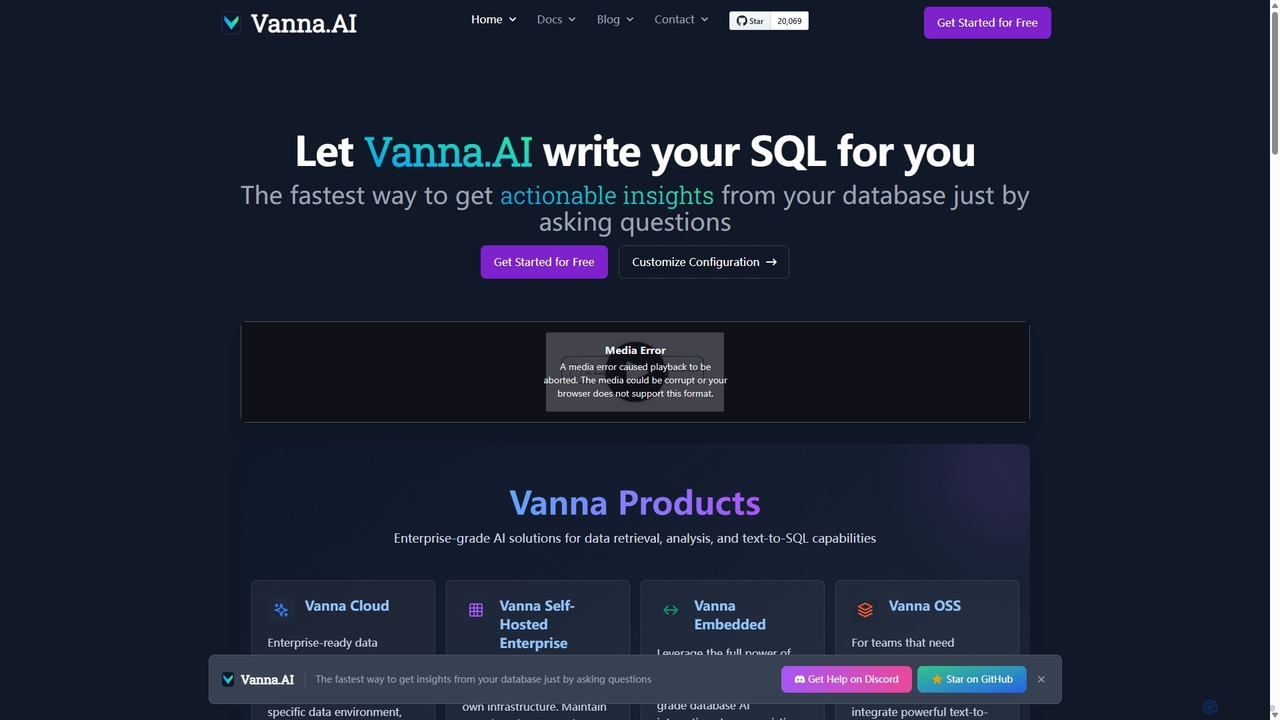
Vanna.AI
Vanna.AI is an open-source, personalized AI SQL agent that transforms natural language questions into accurate SQL queries. It uses a Retrieval-Augmented Generation (RAG) model trained on your specific database schema, documentation, and past queries to achieve high accuracy on complex datasets. It's designed for security, flexibility, and easy integration into any application, empowering both technical and non-technical users to gain insights from their data effortlessly.
Business IntelligenceParadeDB Categories
ParadeDB Embed Widget
Copy this embed code to place the badge on your blog, article, or product site and send readers directly to this ToolMage detail page.

Related AI tools
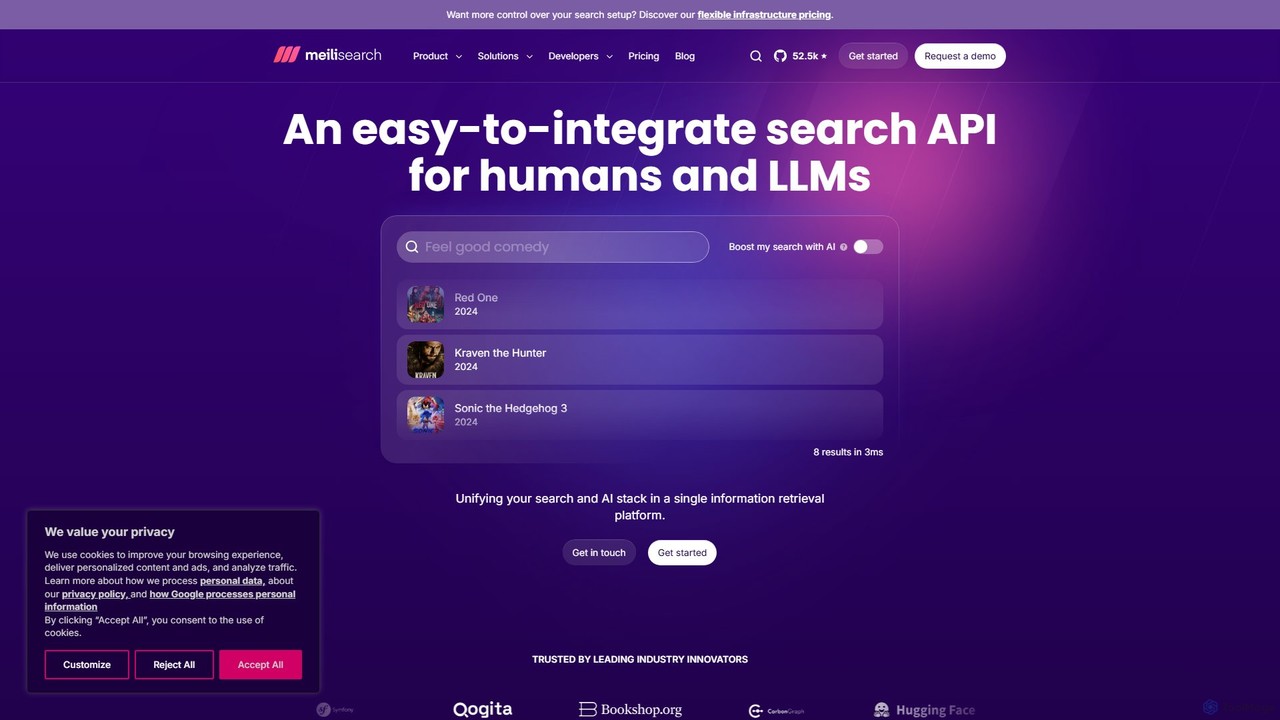
Meilisearch
Meilisearch is an open-source, lightning-fast, and AI-powered search engine. It's designed for developers to easily integrate advanced search capabilities, including full-text, semantic, and hybrid search, into any website or application. It offers an exceptional developer experience with powerful APIs and SDKs.
DatabaseInfluxData
InfluxData offers InfluxDB, the leading time series database platform built for real-time data and AI applications. It empowers developers to ingest, store, and analyze massive volumes of high-velocity data from IoT, applications, and infrastructure. Featuring high-performance querying, superior data compression, and seamless integration with data lakes and AI/ML pipelines, InfluxData is the engine for anomaly detection, predictive maintenance, and autonomous systems.
Data ManagementChartDB
ChartDB is an AI-powered database schema visualizer that instantly generates interactive ER diagrams from a single query. It's designed for developers and teams to design, document, and collaborate on database structures. It features real-time collaboration, database synchronization, and an AI assistant to optimize schema design. Both cloud and self-hosted open-source versions are available.
VisualizationVanna.AI
Vanna.AI is an open-source, personalized AI SQL agent that transforms natural language questions into accurate SQL queries. It uses a Retrieval-Augmented Generation (RAG) model trained on your specific database schema, documentation, and past queries to achieve high accuracy on complex datasets. It's designed for security, flexibility, and easy integration into any application, empowering both technical and non-technical users to gain insights from their data effortlessly.
Business Intelligence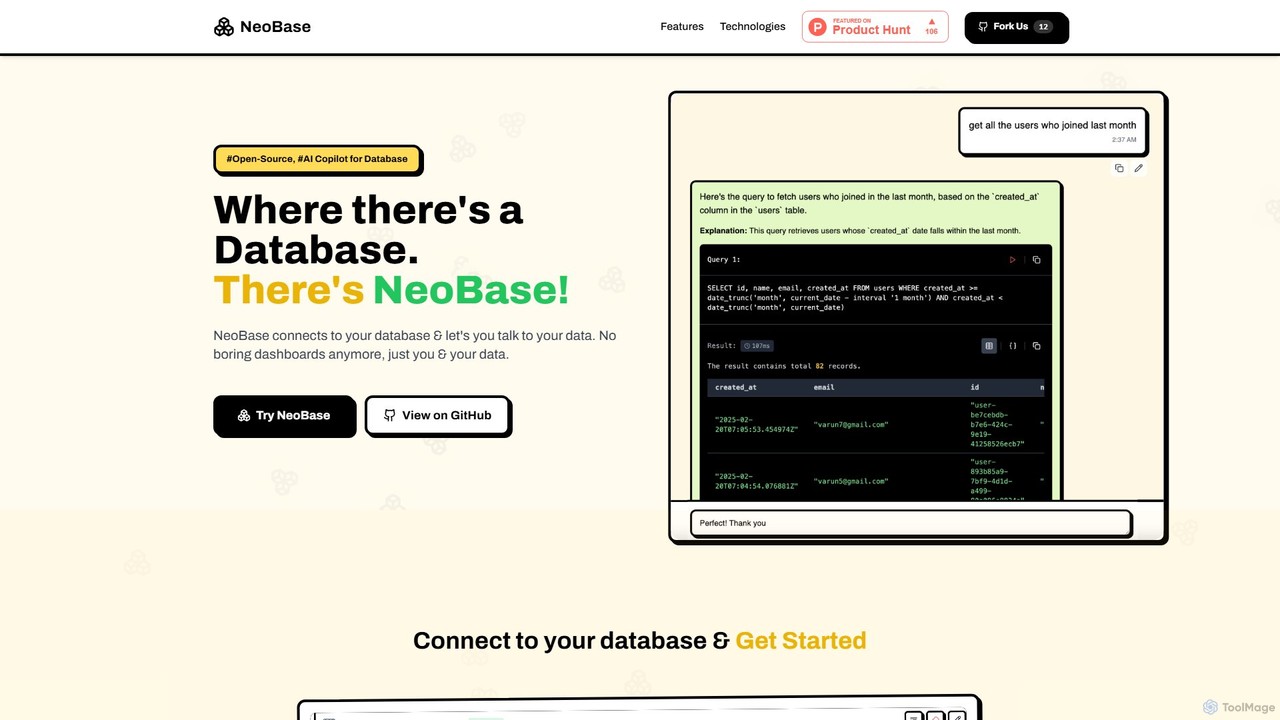
NeoBase
NeoBase is an open-source AI copilot for databases, enabling users to interact with their data using natural language. It connects to various SQL and NoSQL databases, translates plain English queries into optimized code, and visualizes the results. Designed for both technical and non-technical users, it streamlines data analysis, debugging, and reporting, eliminating the need for complex query writing and providing full data control through self-hosting.
Data Analysis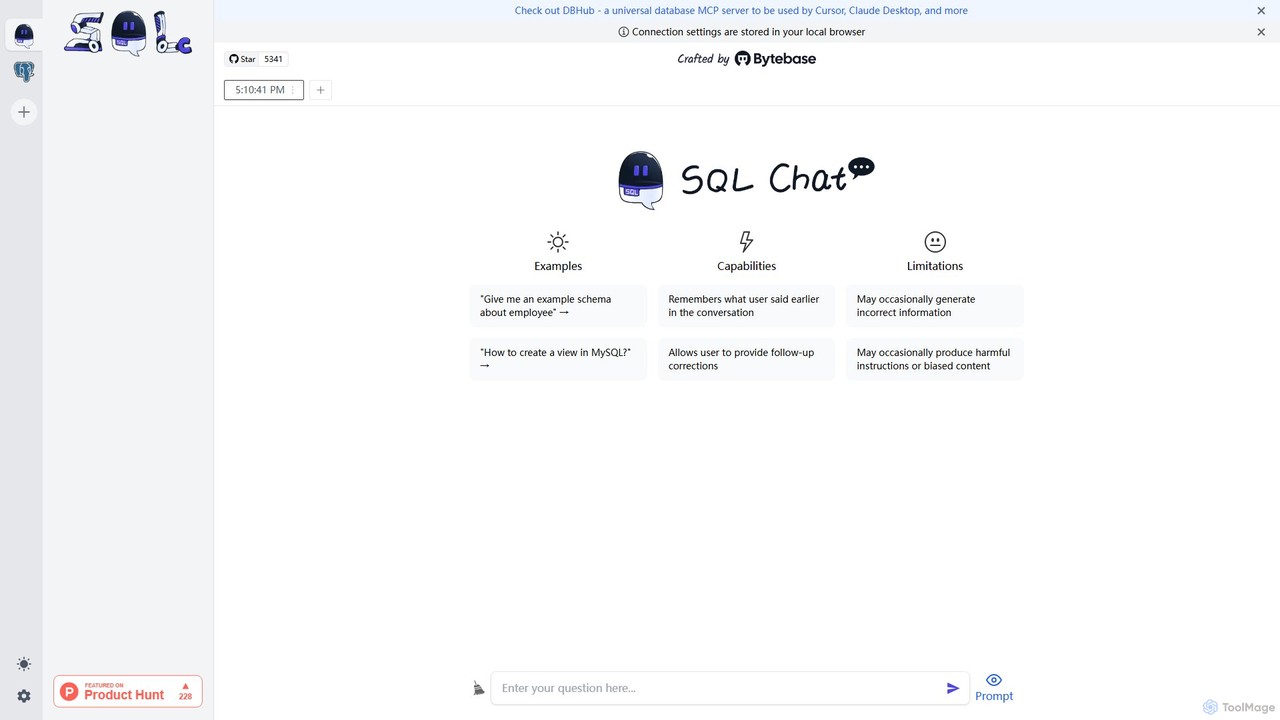
SQL Chat
SQL Chat is an open-source, chat-based SQL client and editor that uses AI to translate natural language questions into SQL queries. Connect to your database, ask questions in plain English, and get results instantly, democratizing data access for both technical and non-technical users.
Code Assistant
Supabase
Supabase is an open-source Firebase alternative, providing a complete backend solution built on Postgres. It offers a suite of tools including a database, authentication, instant APIs, edge functions, real-time subscriptions, storage, and vector embeddings to accelerate application development from prototype to production.
Backend
Milvus
Milvus is a high-performance, open-source vector database built for AI applications. It enables developers to manage and search through billions of high-dimensional vectors with minimal latency. Ideal for building scalable systems like retrieval-augmented generation (RAG), recommendation engines, and semantic search, Milvus offers flexible deployment options from local prototyping to large-scale distributed clusters.
Machine Learning
LanceDB
LanceDB is an open-source, AI-native multimodal lakehouse designed for building and scaling AI applications. It provides a unified platform for storing, searching, and managing complex data like text, images, voice, and vectors. Ideal for RAG, semantic search, and model training, LanceDB offers blazing-fast hybrid search, massive scalability to petabytes, and significant cost savings, making it a powerful foundation for enterprise-grade AI.
Vector Database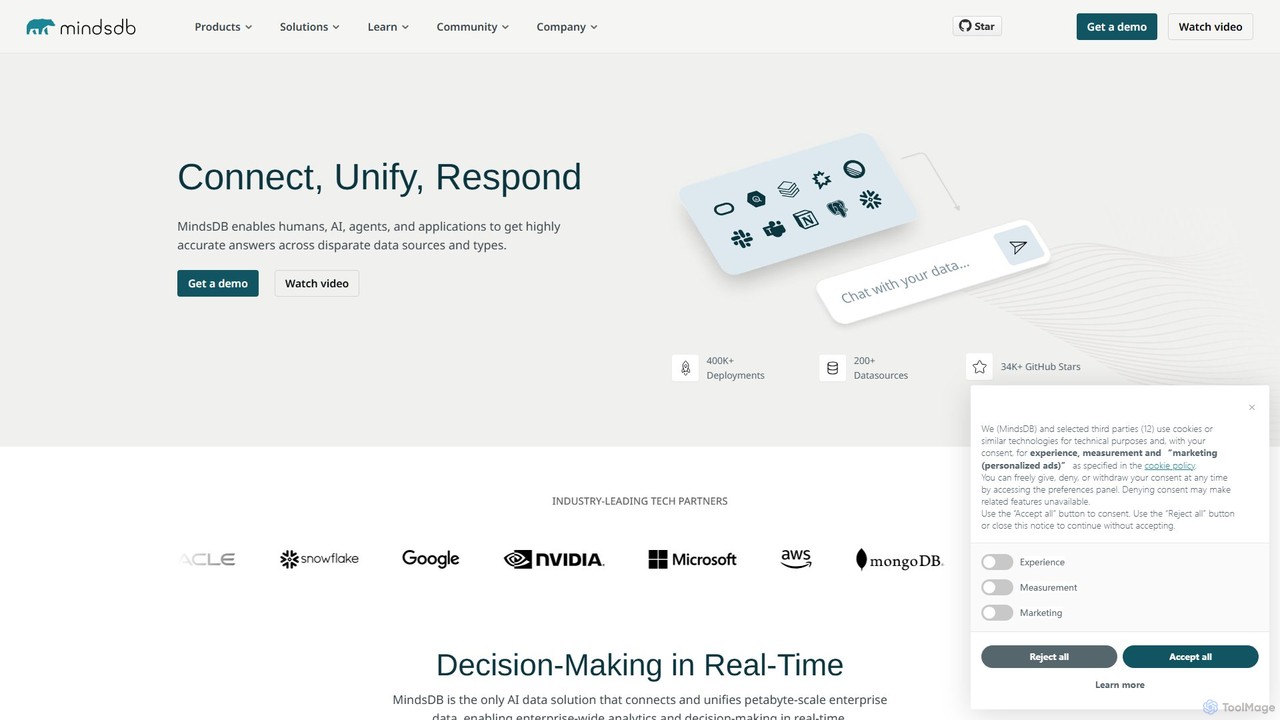
MindsDB
MindsDB is an AI data automation platform that brings machine learning into your database. It allows developers and data analysts to create, train, and deploy AI models using standard SQL queries, connecting to over 200 data sources to provide real-time predictions and analytics without complex ETL pipelines.
Business Intelligence
Spice AI
Spice AI is an open-source, portable data and AI compute engine for developers. It unifies data from any source, accelerates queries with Apache Arrow, and integrates AI model serving and vector search to simplify building high-performance, data-driven applications.
Model Deployment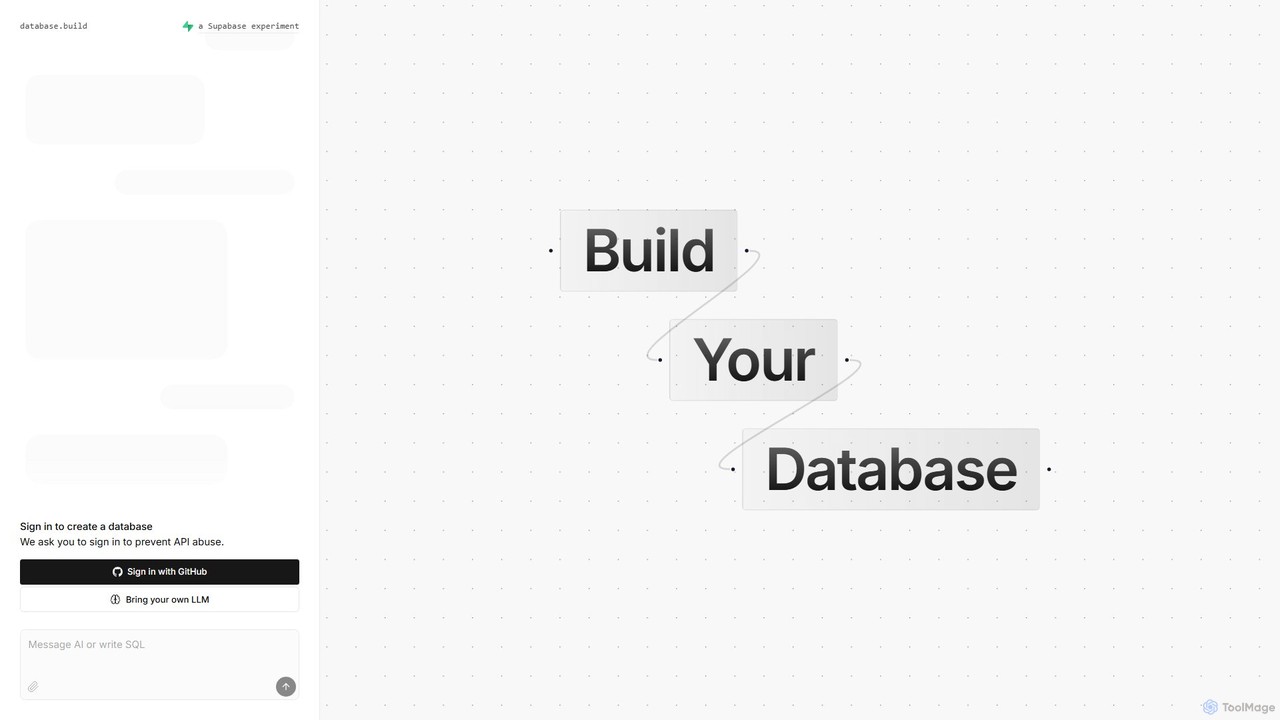
Postgres Sandbox
An intuitive, web-based visual tool for designing, prototyping, and experimenting with PostgreSQL database schemas. Create tables, define relationships, and generate SQL code in a risk-free sandbox environment. Ideal for developers, DBAs, and students.
Database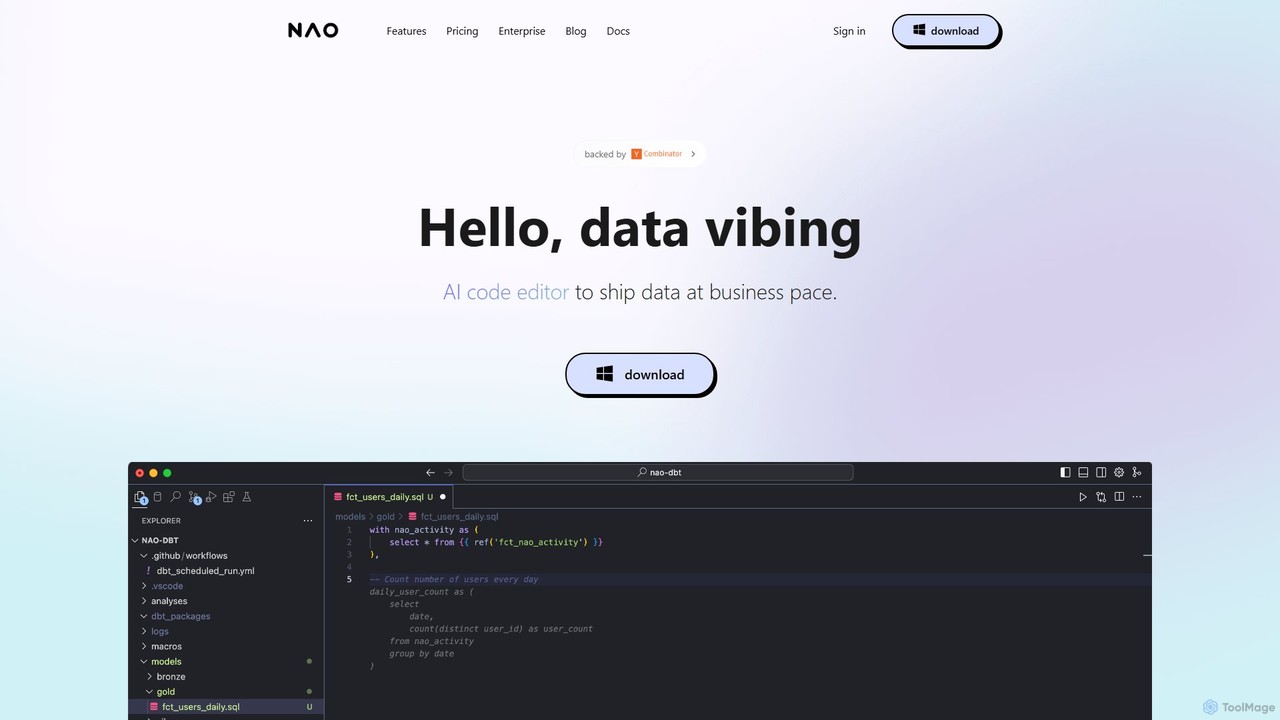
nao
nao is an AI-powered code editor designed for data teams. It streamlines SQL and Python data pipeline creation, dbt workflows, and analytics by natively connecting to your data warehouse. Its intelligent agent provides data-aware code suggestions, quality checks, and instant diff previews to help you ship data faster and more safely.
Analytics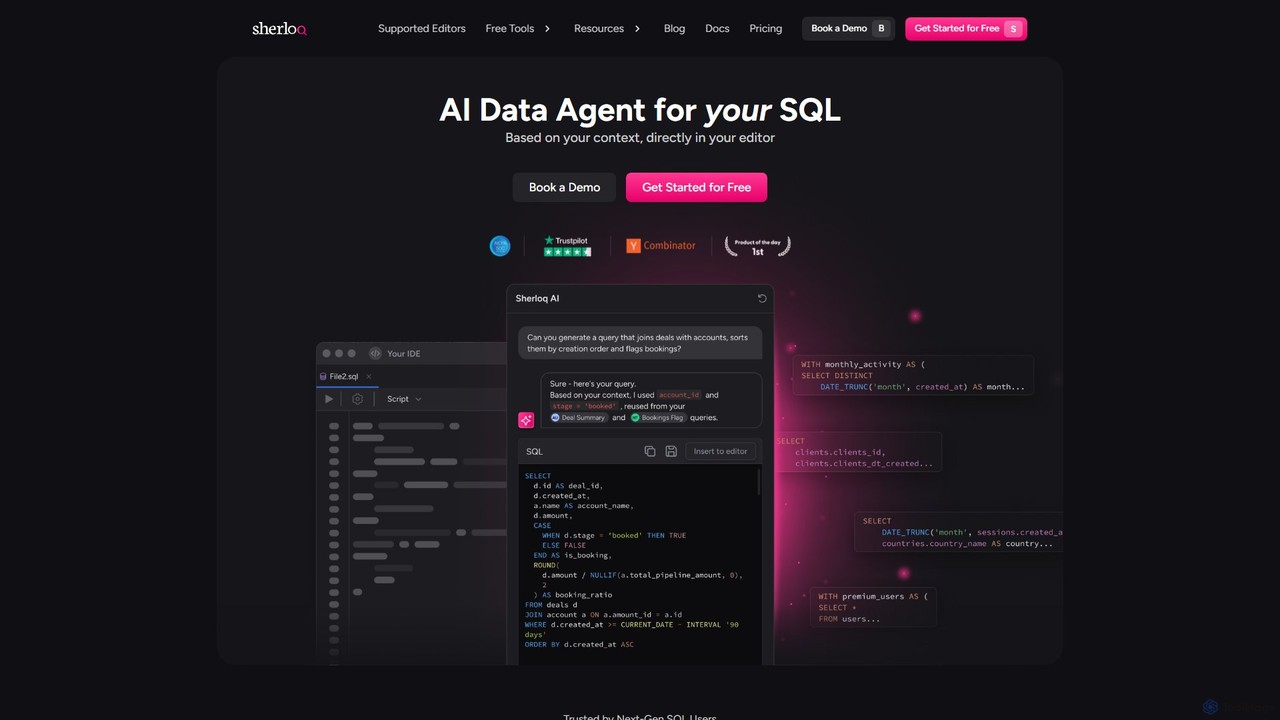
sherloqdata
Sherloqdata is an AI-powered data agent for SQL that works directly in your editor. It helps data professionals write, fix, and manage SQL queries faster by using your existing SQL repository for context. Features include an AI SQL Chat, query management, version control, and team collaboration.
Database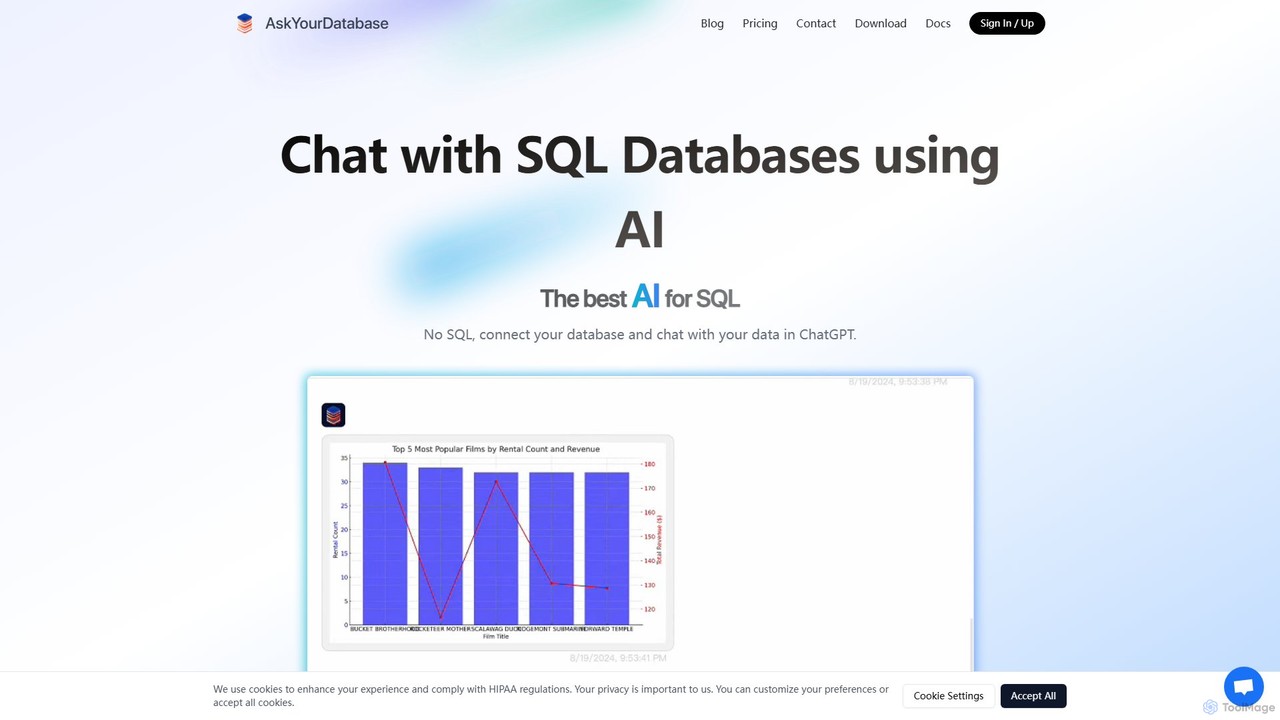
AskYourDatabase
AskYourDatabase is a powerful AI SQL assistant that allows you to interact with your databases using natural language. Query data, create visualizations, and build interactive dashboards without writing a single line of SQL. It supports various databases, offers both desktop and embeddable chatbot versions, and prioritizes data security with on-premise deployment options.
Data Analysis
ParadeDB Comments (0)
Sign in to comment.
Sign inNo comments yet.