Release.ai
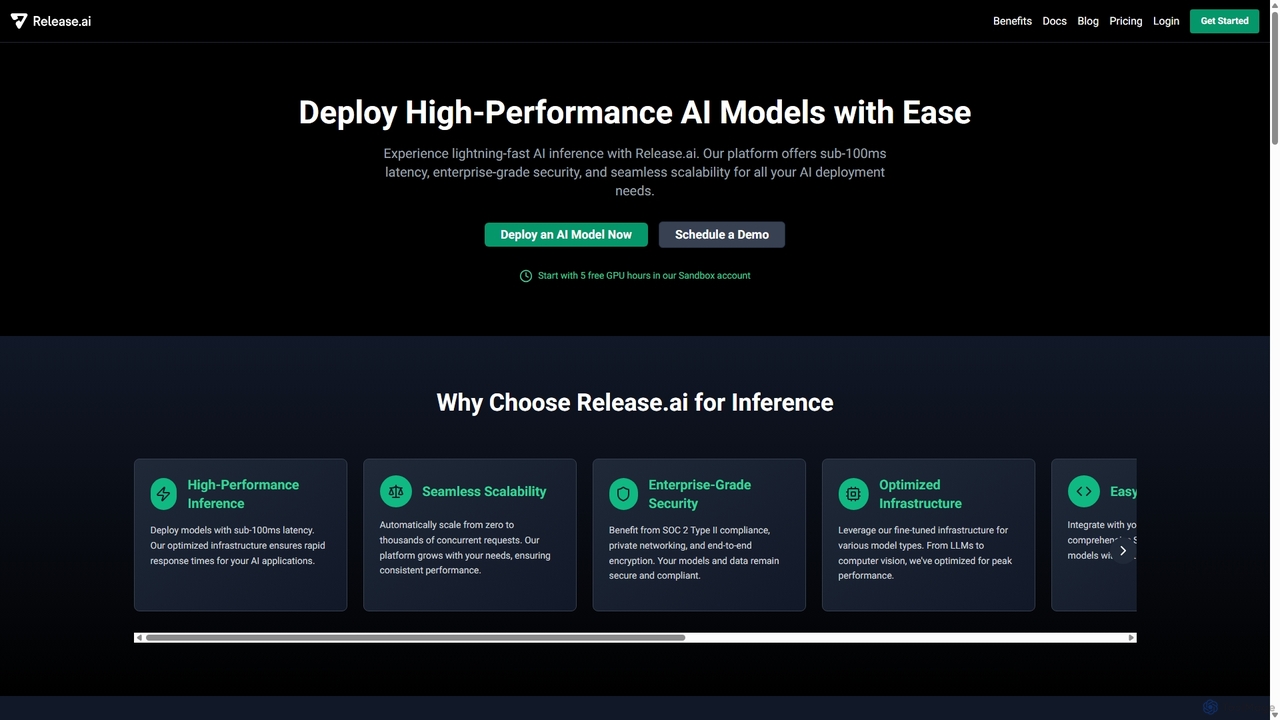
Release.ai is an enterprise-grade platform for developers to easily deploy, manage, and scale high-performance AI models. It offers …
Release.ai is an enterprise-grade platform for developers to easily deploy, manage, and scale high-performance AI models. It offers sub-100ms inference latency, seamless auto-scaling, robust security, and a vast library of pre-optimized models, enabling rapid integration into any development workflow with just a few lines of code.
TiDB Cloud
TiDB Cloud is a fully managed, distributed SQL database-as-a-service (DBaaS). It offers horizontal scalability, MySQL compatibility, and Hybrid …
TiDB Cloud is a fully managed, distributed SQL database-as-a-service (DBaaS). It offers horizontal scalability, MySQL compatibility, and Hybrid Transactional/Analytical Processing (HTAP) capabilities. Ideal for building modern, data-intensive applications and AI-powered services, it simplifies database operations and provides a powerful backend for applications that require both real-time transactions and complex analytics, including vector search for AI.
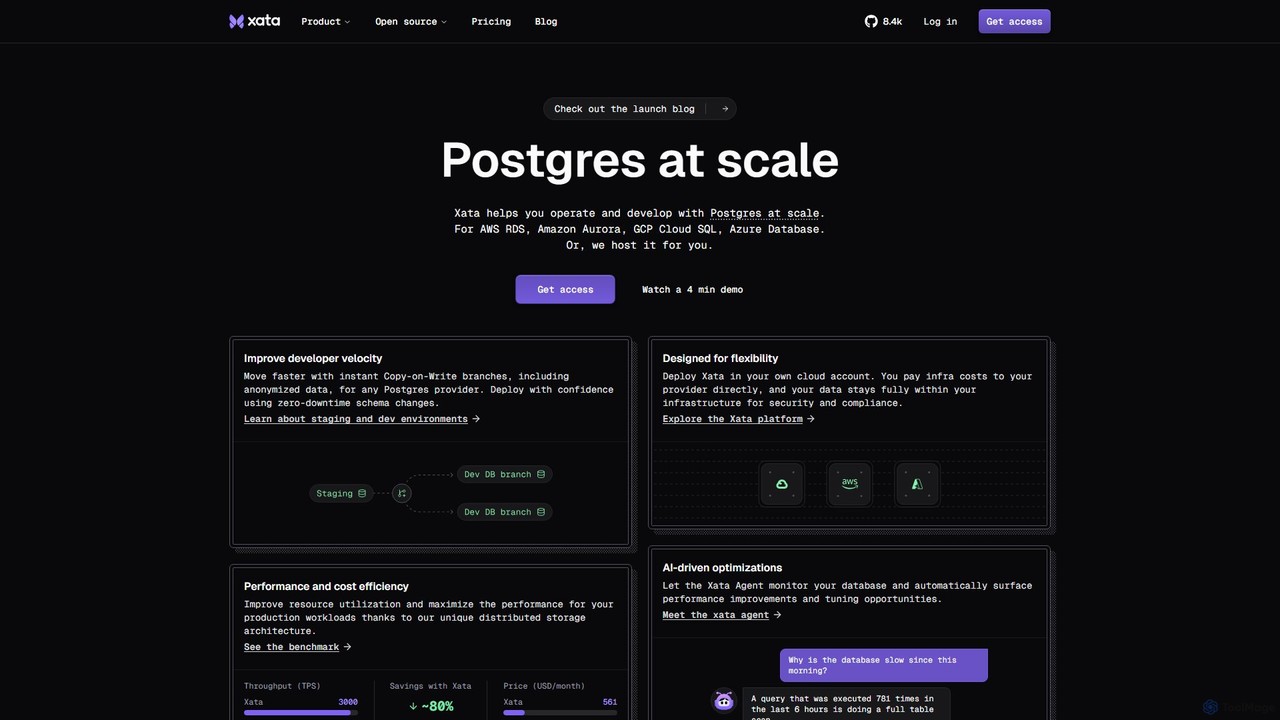
Xata
Xata is a "Postgres at scale" platform designed to enhance developer velocity and optimize database performance. It offers …
Xata is a "Postgres at scale" platform designed to enhance developer velocity and optimize database performance. It offers unique features like instant Copy-on-Write branches with PII anonymization, zero-downtime schema migrations, and an AI-powered agent for automated performance tuning. Deploy on Xata's infrastructure or within your own cloud for maximum flexibility and compliance.
PPIO
PPIO is a leading distributed cloud computing platform providing cost-effective, high-performance AI computing power, model APIs, and edge …
PPIO is a leading distributed cloud computing platform providing cost-effective, high-performance AI computing power, model APIs, and edge computing services. It offers developers and enterprises one-stop solutions for AI, video, and metaverse applications, featuring serverless GPUs, containerized instances, and access to popular large language and multi-modal models.
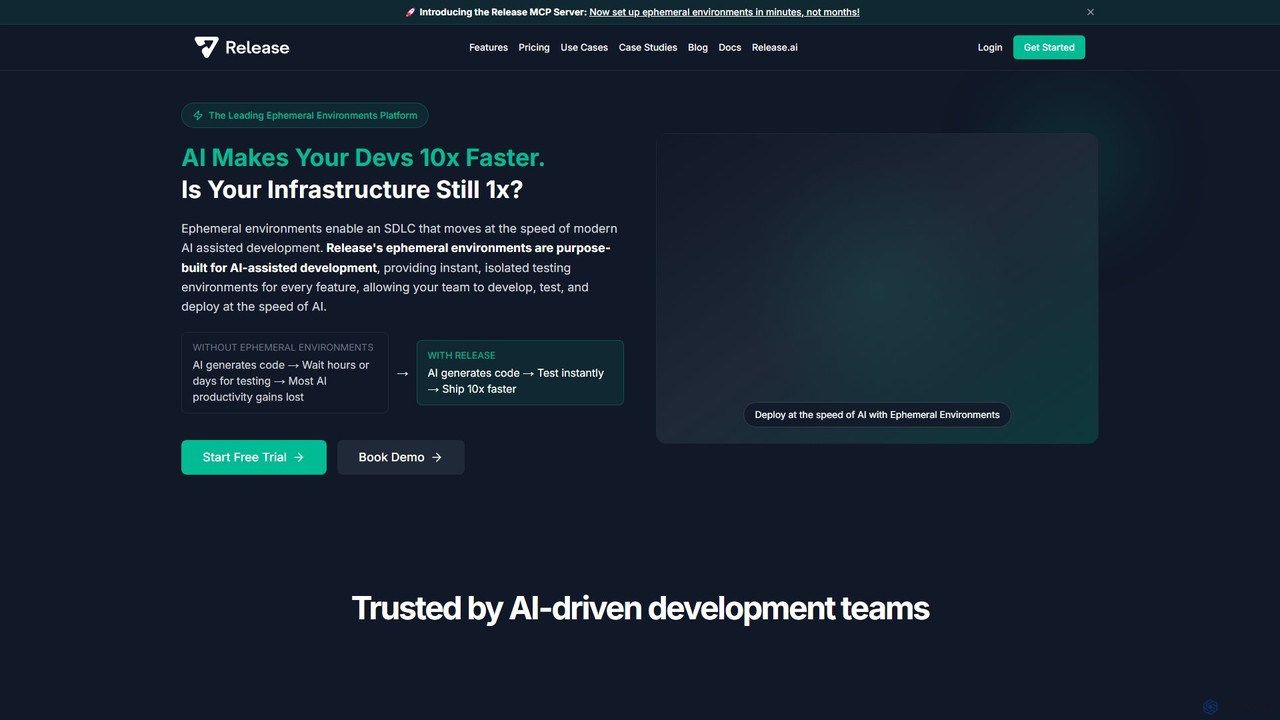
Release
Release is an AI-powered ephemeral environments platform that accelerates software development. It provides instant, isolated testing environments for …
Release is an AI-powered ephemeral environments platform that accelerates software development. It provides instant, isolated testing environments for every feature or pull request, eliminating infrastructure bottlenecks. By integrating with AI development tools and IDEs, Release enables teams to test and deploy code up to 10x faster.
ParadeDB
ParadeDB is a modern Elasticsearch alternative built directly on Postgres. It enhances Postgres with powerful, real-time search and …
ParadeDB is a modern Elasticsearch alternative built directly on Postgres. It enhances Postgres with powerful, real-time search and analytics capabilities, including full-text search, fuzzy matching, and faceting, eliminating the need for complex ETL processes and separate search engines.
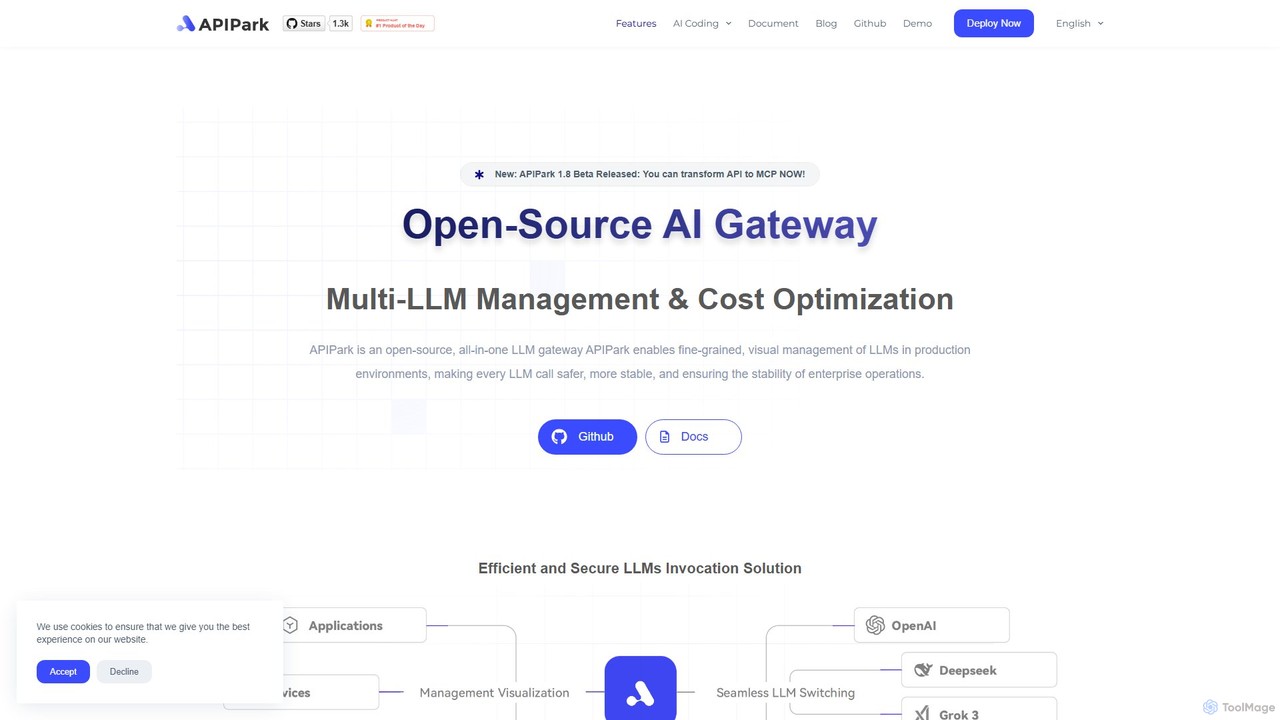
APIPark
APIPark is an open-source AI gateway and developer portal designed to help businesses manage, integrate, and deploy AI …
APIPark is an open-source AI gateway and developer portal designed to help businesses manage, integrate, and deploy AI services efficiently. It centralizes LLM calls, reduces costs, and provides tools for API sharing, monitoring, and security.
Determined AI
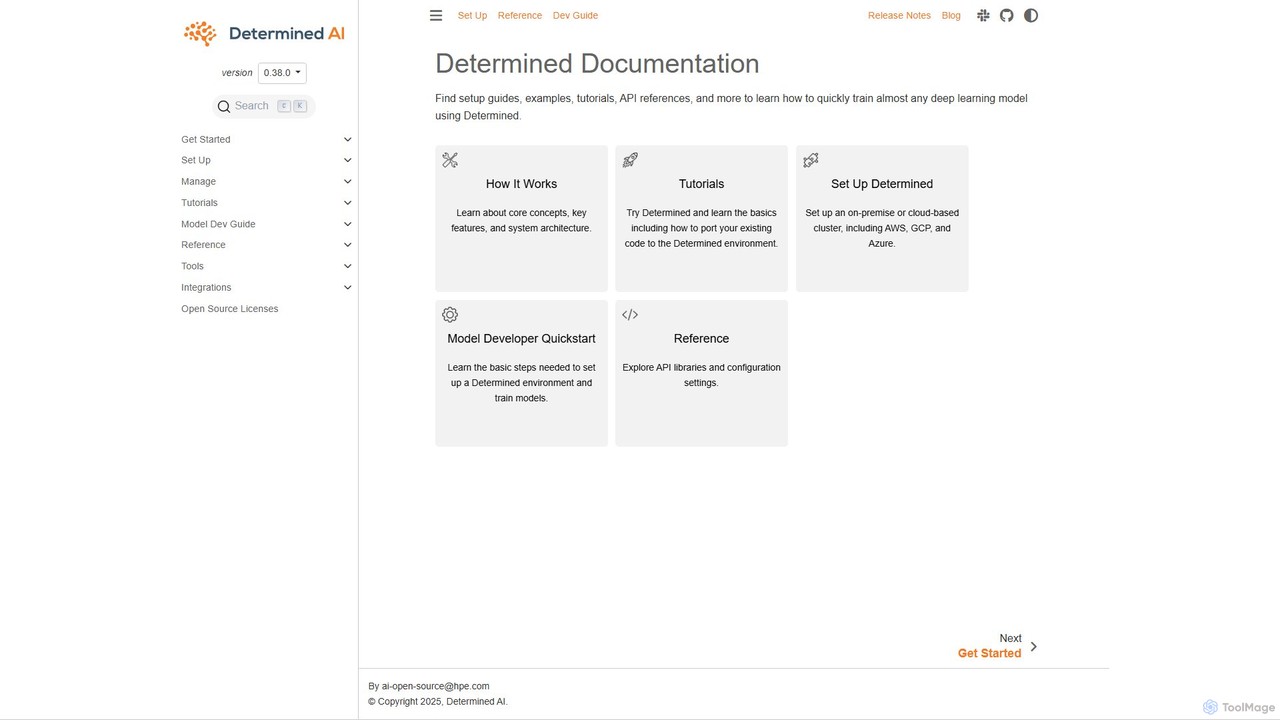
Determined AI is an open-source deep learning training platform that simplifies and accelerates model development. It offers integrated …
Determined AI is an open-source deep learning training platform that simplifies and accelerates model development. It offers integrated tools for hyperparameter tuning, distributed training, and experiment tracking, enabling data scientists to train better models faster and more efficiently.
About Infrastructure
AI Infrastructure tools are essential platforms and services that provide the foundational environment for developing, deploying, and managing artificial intelligence and machine learning applications. These tools abstract complex underlying hardware and software, enabling developers and data scientists to efficiently build, train, and scale AI models from experimentation to production. They are crucial for ensuring the reliability, performance, and scalability of AI systems, streamlining the entire AI lifecycle and enhancing overall productivity for organizations.
Core Features
- Model Training & Deployment: Provide scalable compute resources (GPUs) and frameworks for training, then facilitate seamless deployment of models into production environments.
- Data Management & Labeling: Offer tools for efficient data ingestion, storage, preprocessing, and human-in-the-loop annotation to prepare high-quality datasets for model training.
- MLOps & Lifecycle Management: Automate and streamline the entire machine learning lifecycle, including version control, experiment tracking, model monitoring, and continuous integration/delivery.
- API & SDK Access: Offer standardized interfaces and software development kits for easy integration of AI models and services into existing applications and workflows.
- Scalability & Performance: Ensure that AI workloads can scale dynamically to meet demand, providing high-performance computing resources and optimized execution environments.
Use Cases
AI Infrastructure tools are utilized across various industries by data scientists, ML engineers, and IT operations teams. They are essential for organizations building and scaling AI-powered products, from startups to large enterprises, ensuring robust and efficient AI system development and deployment.
How to Choose
When selecting AI Infrastructure tools, consider the scalability of compute resources, the breadth of MLOps capabilities, ease of integration with existing tech stacks, data management features, and security protocols. Evaluate vendor support, pricing models, and the platform's ability to support your specific AI frameworks and deployment needs.
InfrastructureUse Cases
Accelerating AI Model Development
Data scientists use AI infrastructure platforms to access pre-configured environments, scalable compute, and MLOps tools, significantly reducing the time from model prototyping to production deployment. This allows for faster iteration and experimentation with different model architectures and datasets, leading to quicker innovation cycles and improved model performance.
Managing Large-Scale Data Annotation
Companies with vast datasets utilize data labeling infrastructure to efficiently annotate images, text, or audio for supervised learning. This involves distributing tasks to human annotators, ensuring quality control, and integrating labeled data directly into training pipelines, which is crucial for building high-performing AI models.
Deploying and Monitoring Production AI Models
MLOps infrastructure enables engineering teams to deploy trained models as robust APIs, monitor their performance in real-time for drift or bias, and automatically retrain or update models as needed. This ensures continuous optimal performance of AI-powered applications, minimizing downtime and maintaining accuracy in dynamic environments.
Building Custom AI Solutions on Cloud
Developers leverage cloud AI infrastructure services (e.g., managed Kubernetes, specialized AI services) to build and host bespoke AI applications without managing underlying hardware. This provides flexibility, scalability, and access to advanced AI capabilities, allowing businesses to innovate rapidly and deploy tailored solutions.
Ensuring AI Governance and Security
Organizations use AI governance infrastructure to implement access controls, track model lineage, ensure data privacy compliance, and audit AI system decisions. This is critical for responsible AI deployment, especially in regulated industries, helping to build trust and mitigate risks associated with AI applications.
Optimizing Resource Utilization for AI Workloads
IT operations teams employ infrastructure tools to manage and optimize the allocation of expensive GPU and CPU resources across multiple AI projects and teams. This ensures cost-efficiency, maximizes the utilization of specialized hardware for training and inference, and prevents resource contention, leading to smoother project execution.