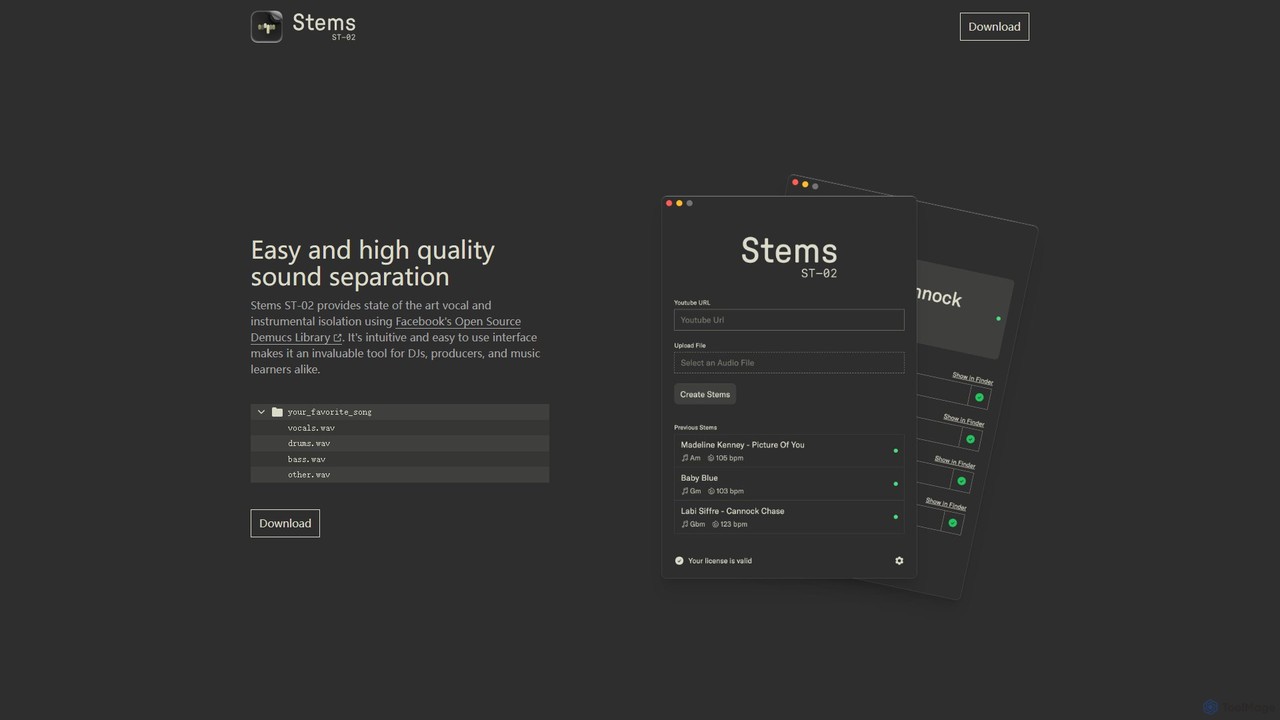
Stem Separation tools are a class of AI-powered software designed to deconstruct a mixed audio track into its individual components, known as 'stems.' Leveraging advanced deep learning models, these tools can accurately isolate specific elements such as vocals, drums, bass, and other instruments from a single audio file. This capability unlocks new creative possibilities for music producers, DJs, and musicians, enabling them to remix, sample, or practice with isolated parts of a song. Unlike traditional filtering methods, AI-based stem separation provides cleaner, higher-fidelity results with significantly fewer artifacts.
Core Features
- Multi-Stem Isolation: Separate a track into multiple distinct stems like vocals, drums, bass, and instruments.
- High-Fidelity Output: Generate clean, artifact-free stems in various audio formats such as WAV or MP3.
- Instrument-Specific Models: Utilize specialized AI models trained to recognize and extract specific instruments with high precision.
- Batch Processing: Process multiple audio files simultaneously to streamline workflows for large projects.
- Web-Based Interface: Offer accessible in-browser functionality for quick separation without installing software.
Use Cases
These tools are widely used in music production, DJing, audio post-production, and music education. For instance, a DJ can extract an acapella to create a live mashup, a music student can isolate a bassline to practice along with it, or an audio engineer can remove unwanted noise from a dialogue track.
How to Choose
When selecting a Stem Separation tool, consider the separation quality and the presence of artifacts. Evaluate the number of stems it can generate (e.g., 2, 4, 5) and the specific instruments it supports. Also, check processing speed, limitations on file length or quantity, and its support for high-quality input and output formats like WAV or FLAC.