

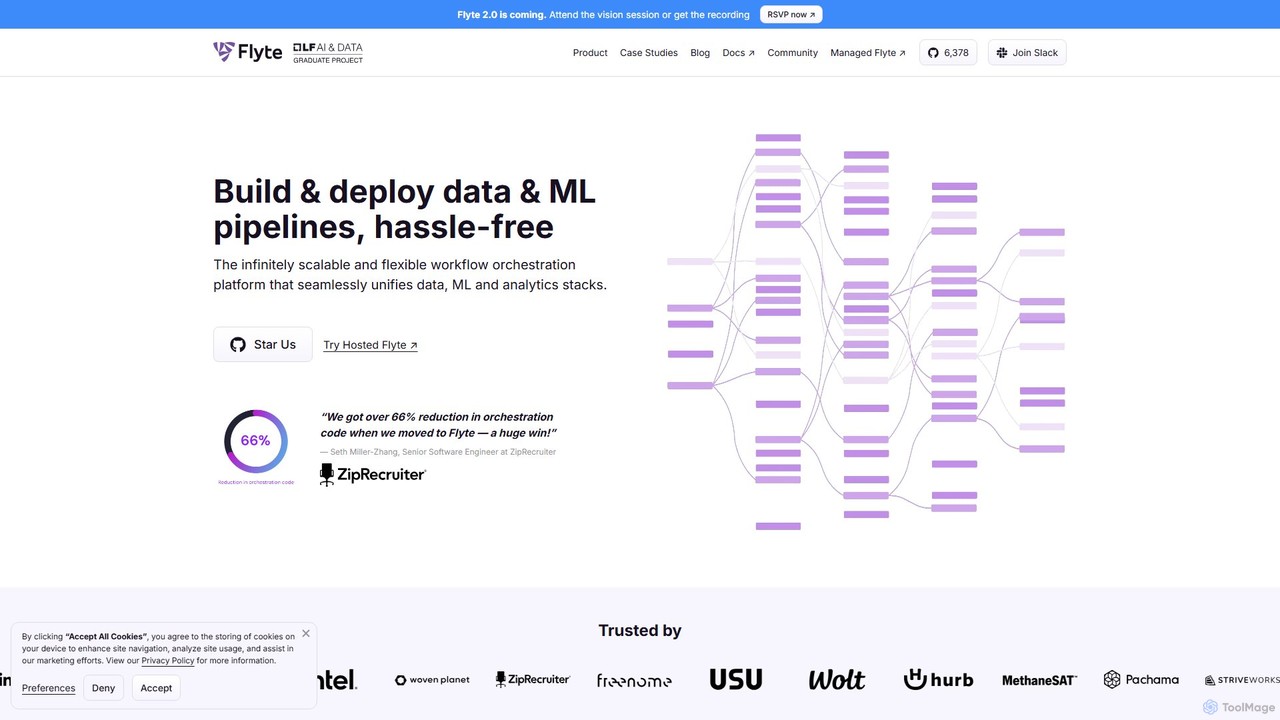
Flyte Overview
Flyte is a production-grade, open-source, and cloud-native workflow orchestration platform specifically engineered for complex data, machine learning, and analytics pipelines. As a graduated project of the Cloud Native Computing Foundation (CNCF), Flyte provides a robust and reliable backbone for MLOps, bridging the gap between local development and large-scale production environments. It allows data scientists and ML engineers to focus on their logic, while the platform handles scalability, reproducibility, fault tolerance, and infrastructure management.
How to use Flyte
Using Flyte involves a structured, code-first approach to defining and managing workflows:
- Define Tasks: A task is the fundamental unit of execution. Using the Python SDK, you define a task with the `@task` decorator. Within the task, you specify its inputs, outputs, resource requirements (e.g., CPU, memory, GPU), and container image.
- Build Workflows: A workflow, defined with the `@workflow` decorator, chains tasks together to form a Directed Acyclic Graph (DAG). You define the data flow between tasks, creating a complete pipeline.
- Local Iteration: Flyte provides tools like `pyflyte run` to execute and debug your workflows on your local machine. This allows for rapid iteration and a tight feedback loop before deploying.
- Register to Production: Once your workflow is ready, you register it with a Flyte cluster using `pyflyte register`. This action versions your entire workflow, including its code and dependencies, ensuring reproducibility.
- Launch and Monitor: You can trigger workflow executions via the Flyte UI, a scheduled cron job, or the API. The UI provides a comprehensive view for monitoring executions, inspecting logs, visualizing outputs with FlyteDecks, and analyzing data lineage.
- Scale with Advanced Features: For large-scale processing, you can leverage features like `map_task` to run a task in parallel over a list of inputs, or use dynamic workflows to adjust the pipeline's structure at runtime.
Core Features of Flyte
- Reproducibility & Versioning: Every task and workflow is versioned and immutable. Flyte automatically tracks data lineage, allowing you to trace any output back to the exact code and data that produced it.
- Scalability & Performance: Built on Kubernetes, Flyte is inherently scalable. It supports dynamic resource allocation, GPU acceleration, spot/preemptible instances for cost savings, and massive parallelism through map tasks.
- Developer-Centric Experience: Features a Python-first SDK that is intuitive for data scientists. It abstracts away infrastructure complexities with features like `ImageSpec`, which builds container images without requiring Dockerfile knowledge.
- Language Agnostic: While the primary SDK is Python, Flyte supports writing tasks in any language (Java, Scala, R, etc.) by running them in their own containers.
- Robust Data Handling: Provides strongly typed interfaces to catch data errors at compile time. `FlyteFile`, `FlyteDirectory`, and `StructuredDataset` types simplify data I/O between tasks and cloud storage.
- Advanced Orchestration Logic: Supports dynamic workflows, conditional branching, intra-task checkpointing for long-running tasks, and caching to avoid re-computing expensive steps.
- Enterprise-Ready: Offers multi-tenancy for team isolation, secrets management for secure access to credentials, and notifications via Slack, PagerDuty, or email.
Use Cases for Flyte
Flyte is versatile and used across various industries for mission-critical pipelines:
- Large-Scale Data Processing (ETL): Building and scheduling robust ETL pipelines to process terabytes of data for analytics and data warehousing.
- Machine Learning Model Training: Orchestrating end-to-end ML pipelines, from data preprocessing and feature engineering to distributed model training, hyperparameter optimization, and evaluation.
- LLM & Generative AI: Fine-tuning Large Language Models (LLMs), building Retrieval-Augmented Generation (RAG) systems, and managing complex inference graphs.
- Bioinformatics & Genomics: Running computationally intensive bioinformatics workflows, such as DNA sequence alignment and analysis, at scale.
- Geospatial Analysis: Processing massive satellite imagery datasets to create data products like mosaics and digital elevation models, as demonstrated by its use with Xarray and GDAL.
Advantages of Flyte
Flyte offers significant advantages over other orchestrators:
- Production-Grade from Day One: Its focus on typing, versioning, and immutability ensures that workflows are reliable and reproducible.
- Unifies Data & ML Stacks: Provides a single platform for data engineers, ML scientists, and analytics professionals, breaking down silos and promoting collaboration.
- Reduces Infrastructure Overhead: Automates many of the challenging aspects of MLOps, such as containerization, resource management, and scaling.
- Cost-Efficient: The open-source core is free, while features like caching, failure recovery, and spot instance support significantly reduce computational costs.
- Vibrant Ecosystem: As a CNCF project, it has a strong community and integrates seamlessly with a wide range of tools like Spark, Ray, Pandera, Great Expectations, and more.
Pricing and Plans
Flyte is an open-source project licensed under Apache 2.0, making it completely free to download, use, and self-host on your own infrastructure. For organizations that prefer a fully managed, enterprise-grade solution, Union.ai (the company that originally created Flyte) offers a hosted cloud platform. This commercial offering handles all the infrastructure setup, maintenance, and scaling, and includes enterprise support and additional features.
Traffic
Latest traffic
Status
Monthly traffic trend
- 2025-9: 37.5K
- 2026-1: 29.4K
- 2026-2: 32.2K
- 2026-3: 30.0K
- 2026-4: 31.0K
- 2026-5: 26.6K
Geography
Top 5 countries / regions
- 🇺🇸United States46.7%
- 🇮🇳India15.2%
- 🇻🇳Vietnam14.3%
- 🇨🇦Canada13.4%
- 🇩🇪Germany10.3%
Traffic sources
| Source type | Percentage |
|---|---|
Direct | 54.6% |
Referral | 32.1% |
Email | 13.3% |
Top keywords
| Keyword | Cost per click |
|---|---|
| flyte | $1.01 |
| flyte lyft | $0.00 |
| graphviz | $2.08 |
| graphviz online | $1.53 |
| lyft flyte | $0.00 |
Flyte Alternatives
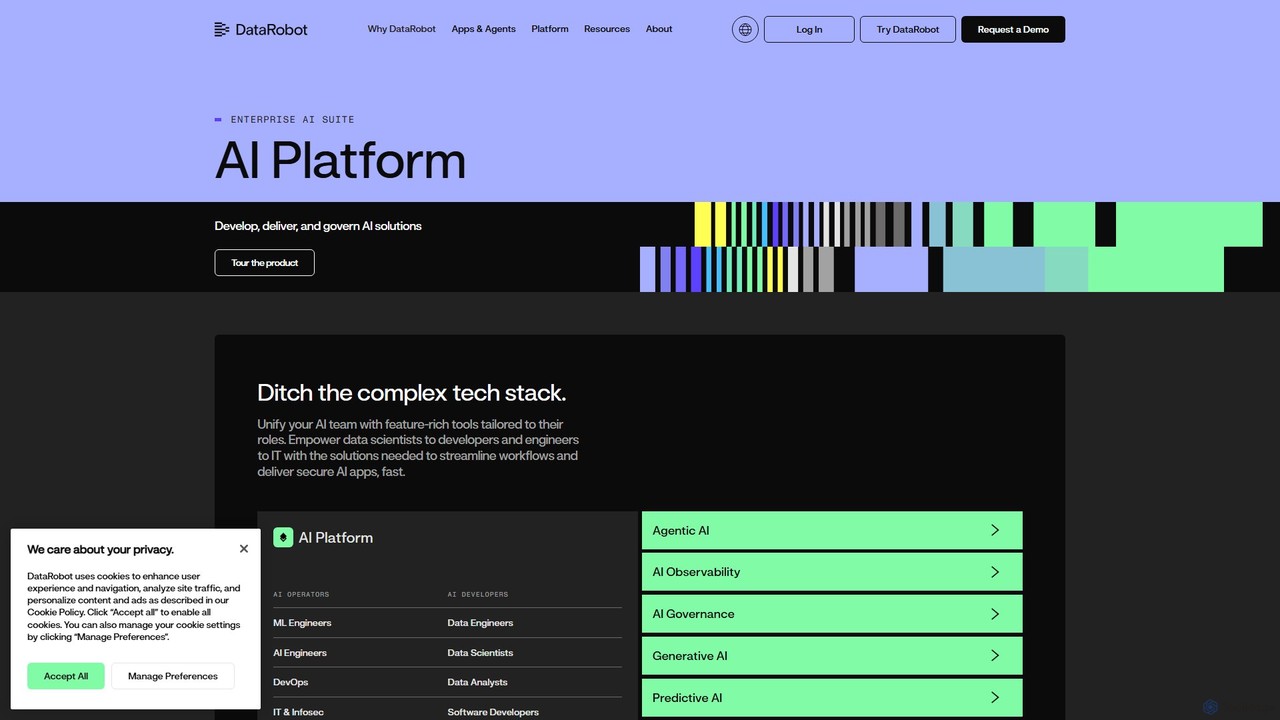
DataRobot AI Platform (formerly Algorithmia)
DataRobot AI Platform, which has integrated Algorithmia's powerful MLOps technology, is an end-to-end enterprise solution for the entire AI lifecycle. It enables organizations to rapidly build, deploy, manage, and govern machine learning models and generative AI applications at scale, accelerating the journey from data to value.
Enterprise Solutions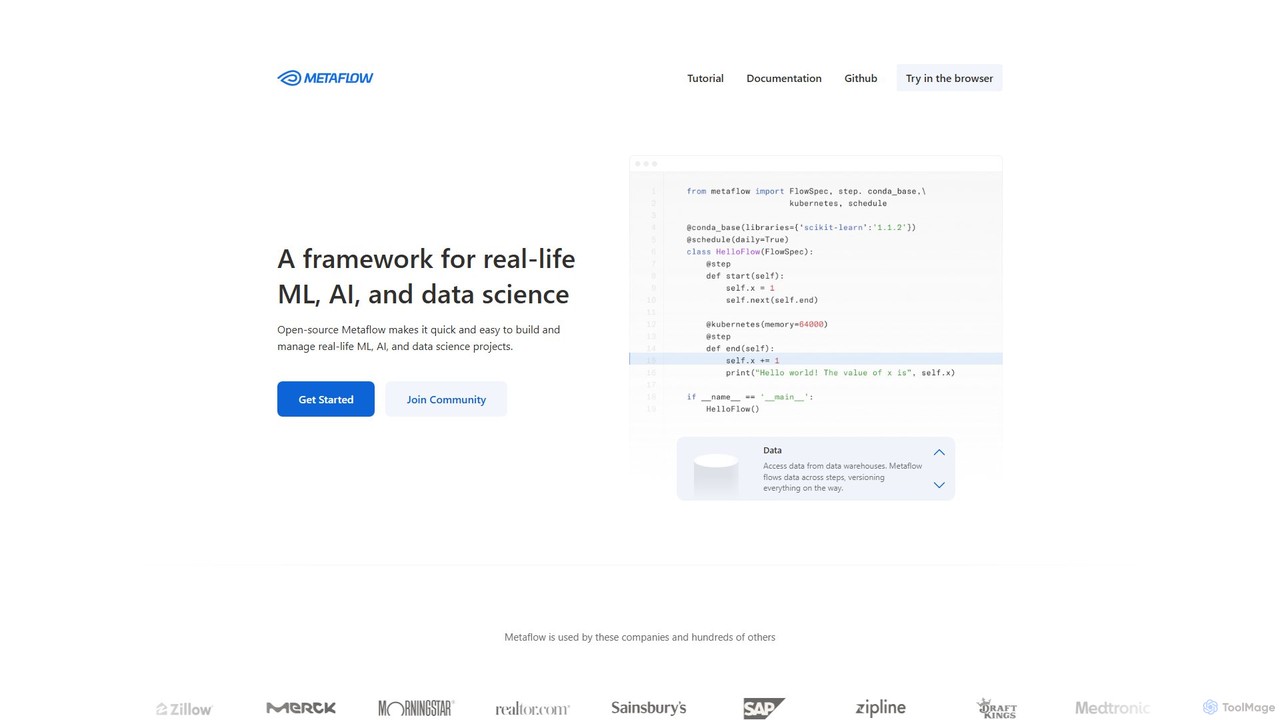
Metaflow
A human-centric Python framework, originally from Netflix, for building and managing real-life data science, ML, and AI projects. It simplifies workflow orchestration, data management, and model deployment, enabling rapid prototyping and scalable production pipelines.
Mlops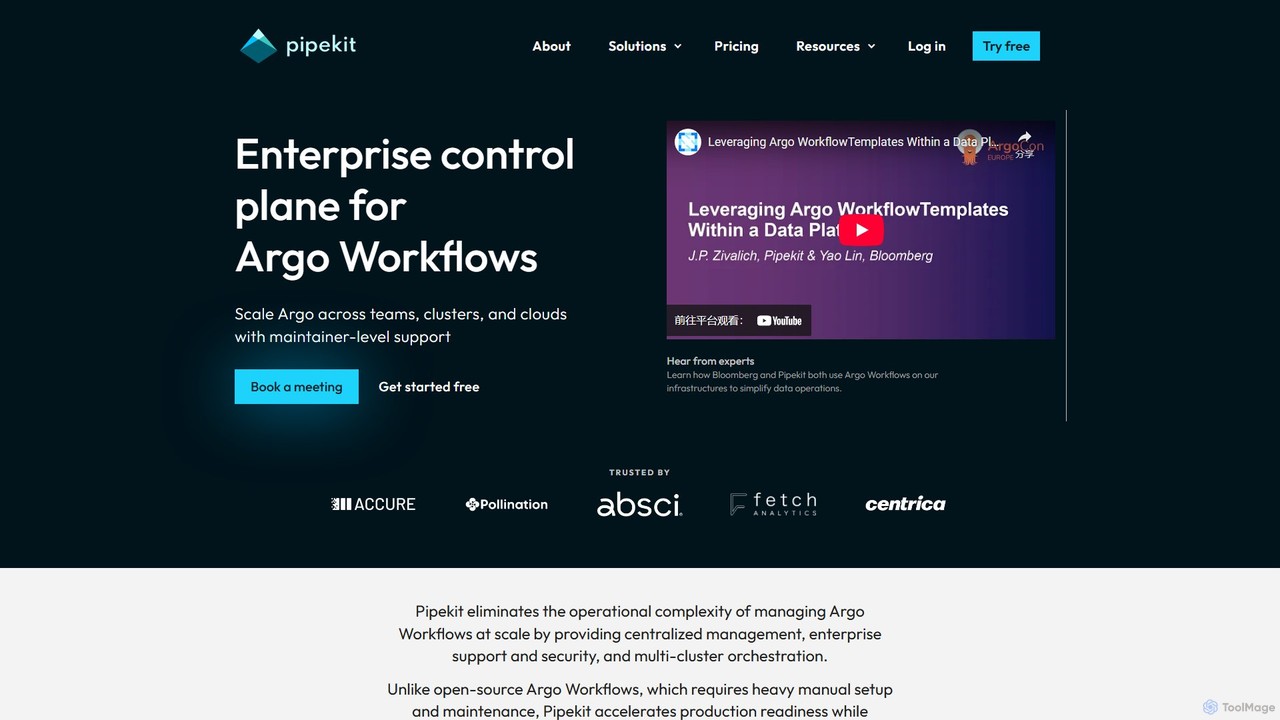
Pipekit
Pipekit is an enterprise-grade control plane and support service for Argo Workflows. It empowers platform and data teams to run, monitor, and govern large-scale data, MLOps, and CI/CD pipelines on Kubernetes across multiple clusters and clouds.
Orchestration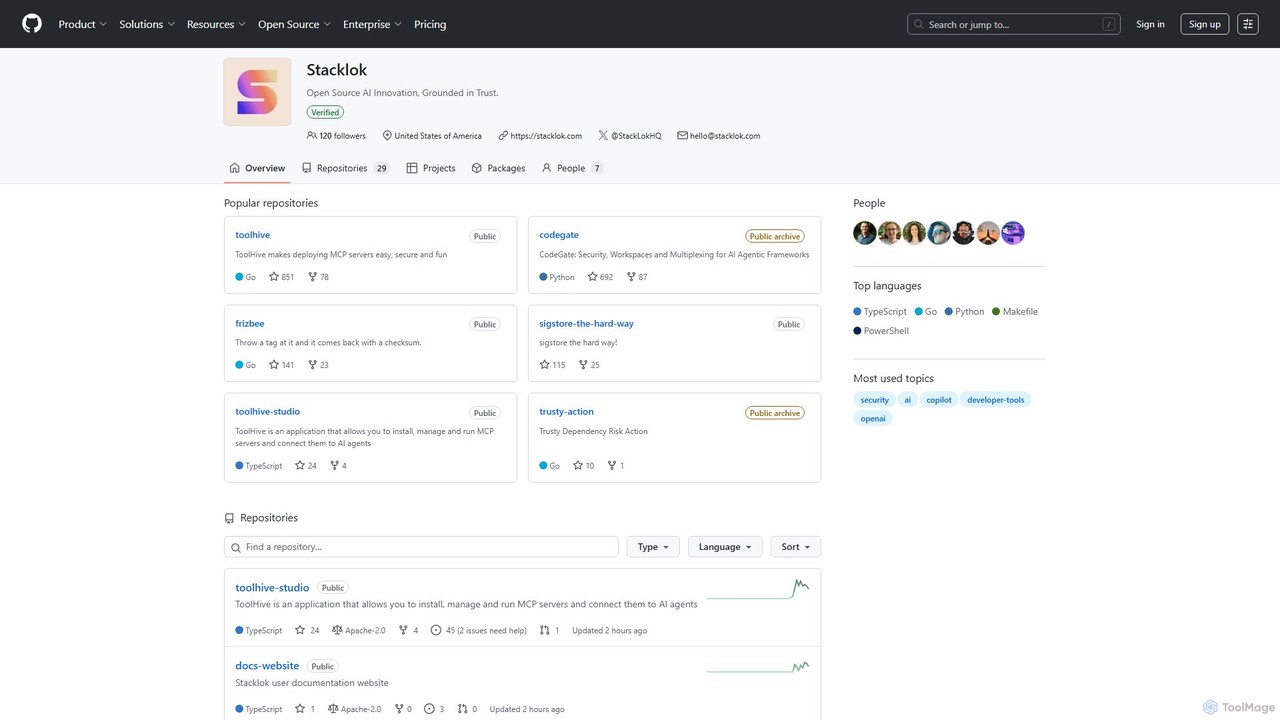
codegate
Codegate is an open-source security gateway and multiplexing framework for AI agentic systems. Developed by Stacklok, it provides secure workspaces and policy-based access control, enabling developers to build and manage complex multi-agent applications safely and efficiently.
Agentic Frameworks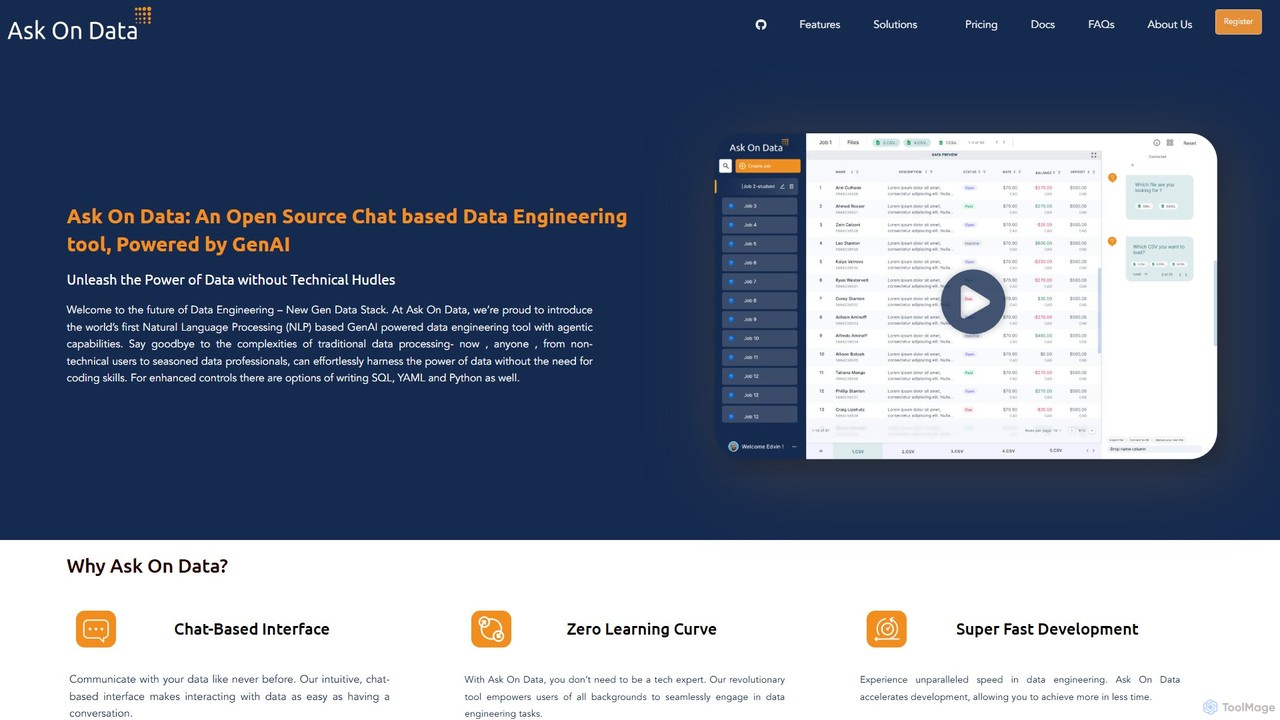
Ask On Data
Ask On Data is an open-source, GenAI-powered data engineering tool that lets you build and manage data pipelines using a simple chat interface. By translating natural language commands into complex data operations, it eliminates the need for coding, making data engineering accessible to everyone. It supports various data sources, offers real-time previews, and provides both cloud-hosted and self-hosted options.
EtlFlyte Categories
Flyte Embed Widget
Copy this embed code to place the badge on your blog, article, or product site and send readers directly to this ToolMage detail page.

Related AI tools
Metaflow
A human-centric Python framework, originally from Netflix, for building and managing real-life data science, ML, and AI projects. It simplifies workflow orchestration, data management, and model deployment, enabling rapid prototyping and scalable production pipelines.
Mlops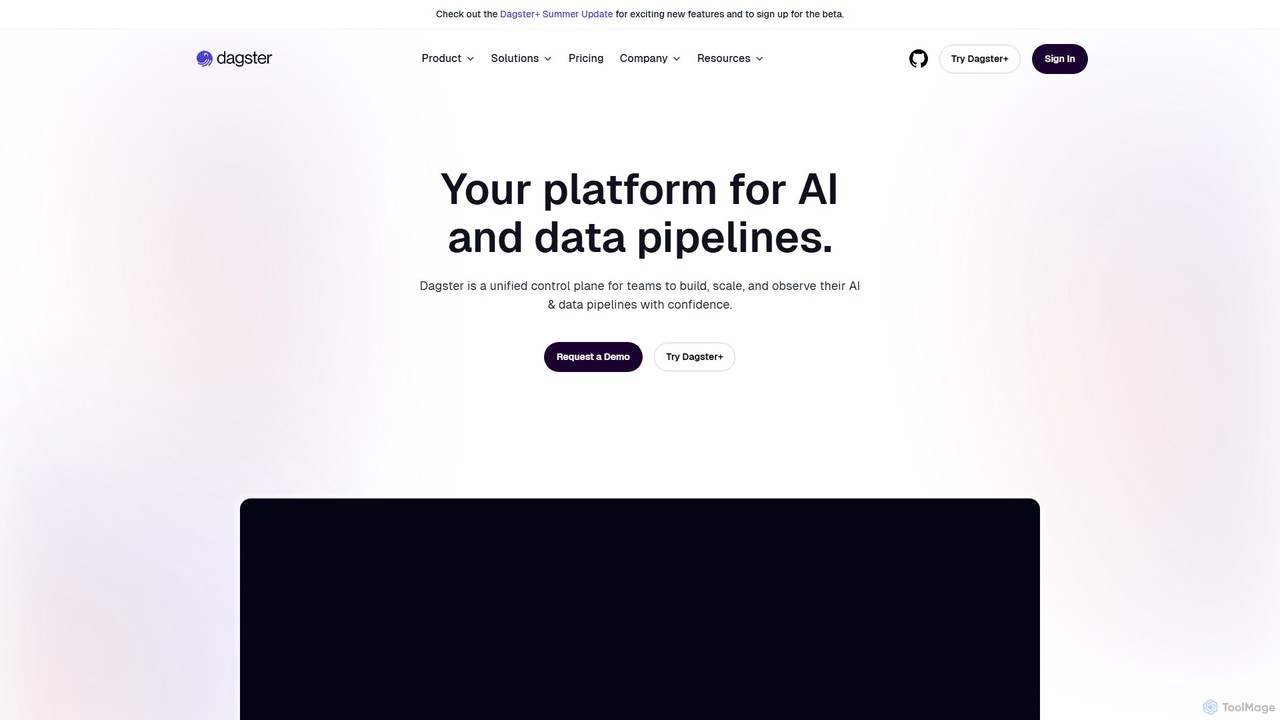
Dagster
Dagster is a modern, open-source data orchestrator designed for building, scaling, and observing AI and data pipelines. It acts as a unified control plane, allowing teams to model data assets, track lineage, and ensure data quality with confidence. By integrating software engineering best practices like local testing and reusable components, Dagster helps data engineers and ML teams ship products faster and more reliably.
Machine Learning Operations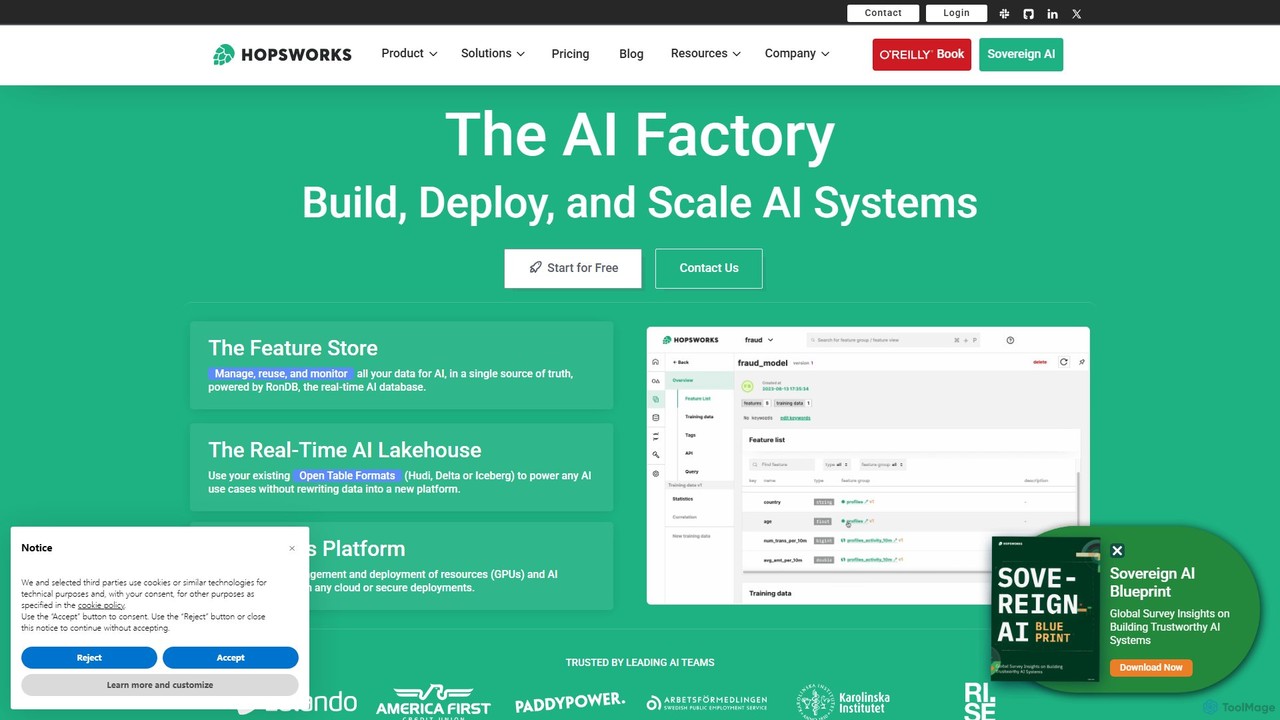
Hopsworks
Hopsworks is a real-time AI Lakehouse and the industry's most advanced Feature Store. It's designed for MLOps, unifying data and compute to build and operate reliable, real-time AI systems. It supports any framework, cloud, or on-premises environment, enabling faster model development and significant cost reduction.
DatabasePipekit
Pipekit is an enterprise-grade control plane and support service for Argo Workflows. It empowers platform and data teams to run, monitor, and govern large-scale data, MLOps, and CI/CD pipelines on Kubernetes across multiple clusters and clouds.
Orchestration
MLflow
MLflow is an open-source platform for managing the end-to-end machine learning lifecycle. It enables developers and data scientists to track experiments, package code into reproducible runs, version and share models, and deploy them to production, supporting both traditional ML and modern GenAI applications.
Data Science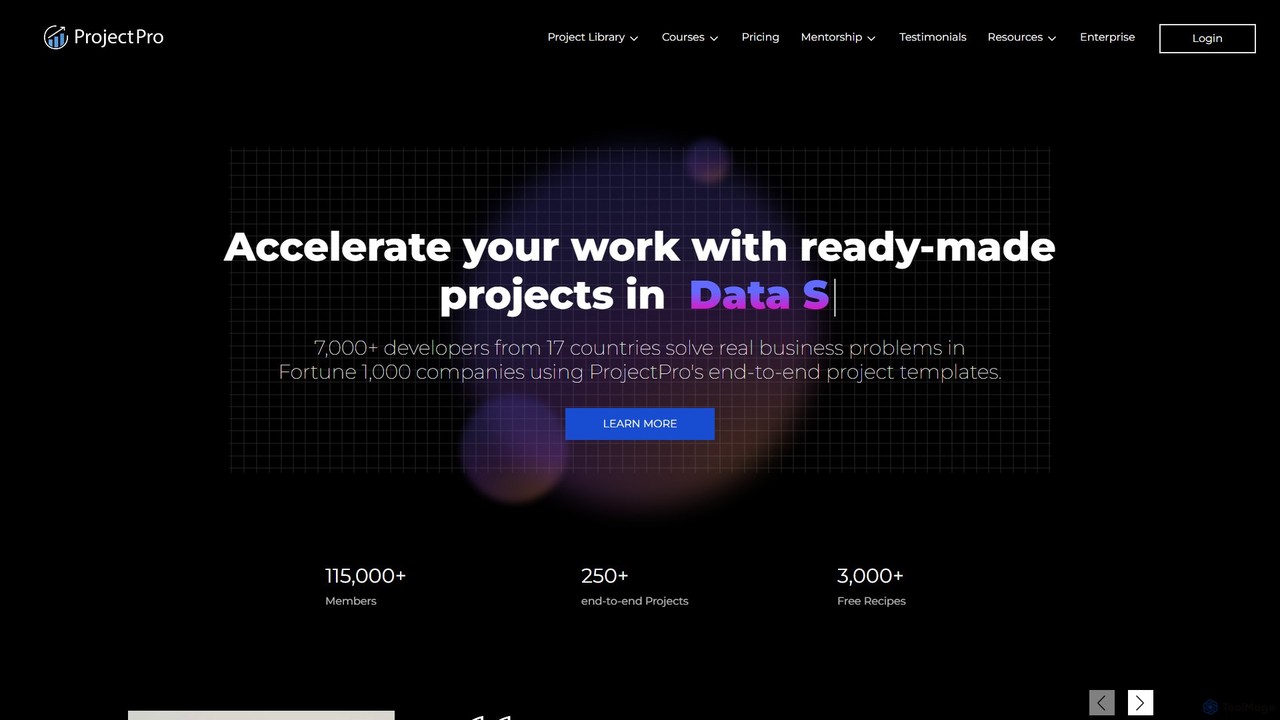
ProjectPro
ProjectPro is a project-based learning platform designed to help data professionals accelerate their careers. It offers a vast library of over 250 end-to-end, industry-grade projects in Data Science, Big Data, AI, and MLOps. Each project includes verified solution code, detailed explainer videos, a cloud lab environment, and expert support, enabling users to gain practical, hands-on experience with real-world business problems and cutting-edge technologies.
Data Science
Jyek
Jyek is an AI agent platform that understands objectives, creates execution plans, uses tools, and delivers verifiable results for complex, multi-step tasks.
Automation
Anyscale
Anyscale is a fully-managed compute platform for scaling AI and Python workloads. Built on the open-source Ray framework by its original creators, it empowers developers to build, run, and scale distributed applications, from LLM training to data processing, with optimized performance and cost-efficiency on any cloud.
Mlops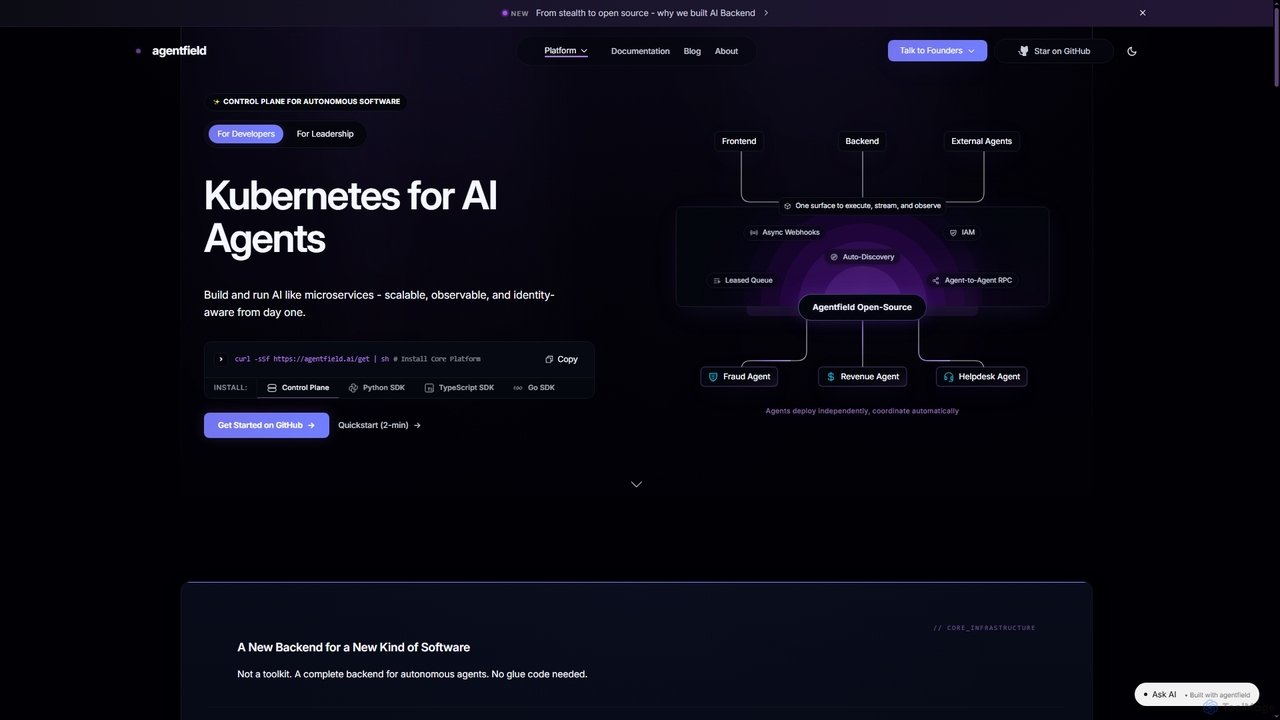
Agentfield
Agentfield is an open-source control plane designed for building and running autonomous AI agents as scalable, observable, and identity-aware microservices. It provides Kubernetes-like orchestration, cryptographic identity management, and production-ready infrastructure to bridge the gap between AI prototypes and robust, trustworthy production deployments.
Orchestration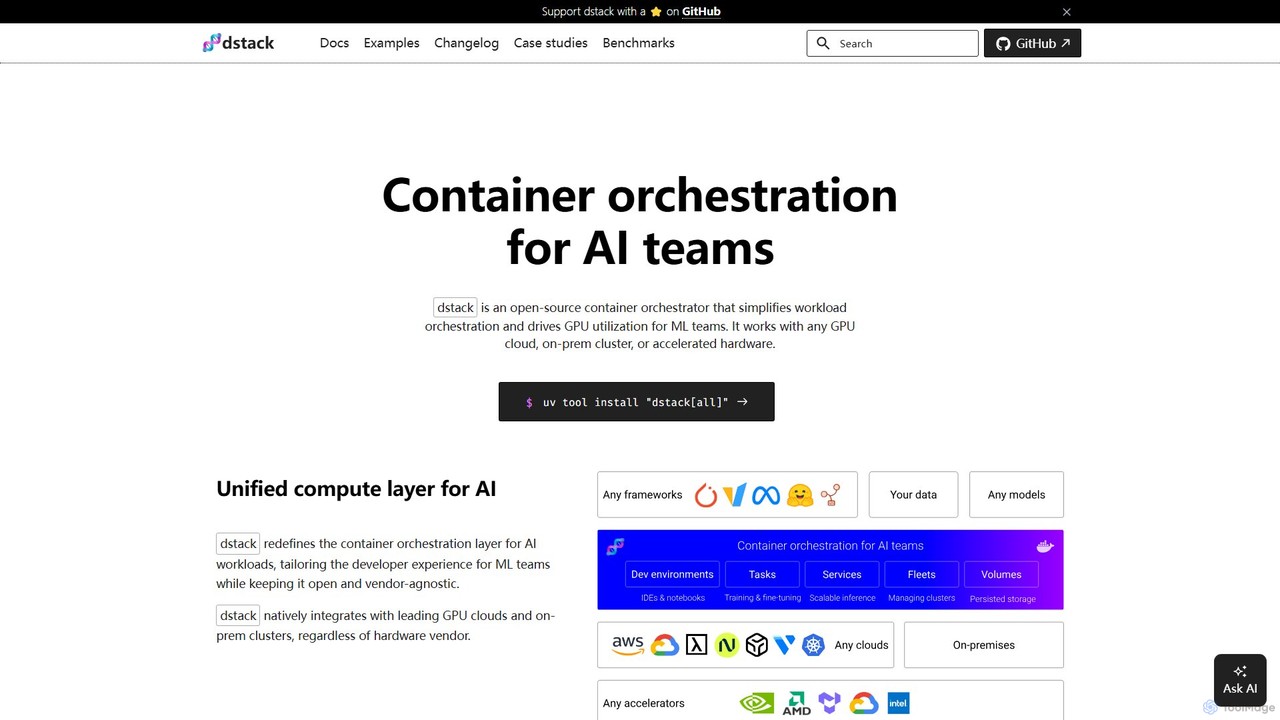
dstack
dstack is an open-source container orchestrator designed for AI and ML teams. It simplifies workload orchestration and maximizes GPU utilization across any cloud provider, on-premise cluster, or accelerated hardware. It provides a unified compute layer, streamlining development, training, and model deployment.
Orchestration
Eventual
Eventual is building the future of data infrastructure with Daft, a high-performance, open-source query engine for multimodal data. It enables engineers to process petabyte-scale images, video, audio, and text with the simplicity of SQL, drastically accelerating AI and ML workflows without the need for deep distributed systems expertise.
Machine Learning
DataChain
DataChain is a developer-first platform for managing "Heavy Data"—large-scale, unstructured, multimodal datasets. It enables teams to curate, enrich, and version data like videos, images, audio, and PDFs for AI applications, featuring Python-based ETL pipelines, full data lineage, and scalable processing from local IDE to cloud.
Database
dagworks
Dagworks provides a suite of open-source developer tools, Hamilton and Burr, designed to build, debug, and observe reliable AI applications. Hamilton standardizes ML and data pipelines for faster iteration and clear lineage, while Burr simplifies the creation of complex, stateful RAG and agentic systems with built-in observability.
Mlops
DevBlogs
DevBlogs is a curated library indexing engineering case studies, tech blogs, and conference talks from leading global teams. It organizes content by meaning and specific technical topics, providing a valuable resource for developers and engineers to discover insights and best practices.
Infrastructure
cometcore
CometCore is an end-to-end MLOps platform designed for AI developers and data science teams. It streamlines the entire machine learning lifecycle, from experiment tracking and hyperparameter optimization to model versioning and production monitoring. By providing a centralized hub for collaboration and reproducibility, CometCore accelerates the development and deployment of robust, high-performance AI models.
Data Science
Flyte Comments (0)
Sign in to comment.
Sign inNo comments yet.