ToolMage
Sign in

Best 2 Desktop Enhancement AI tools for Productivity

Popular Desktop Enhancement AI tools in Productivity include AquaSnap and Yack, helping you work more efficiently.

Yack
Free

Yack

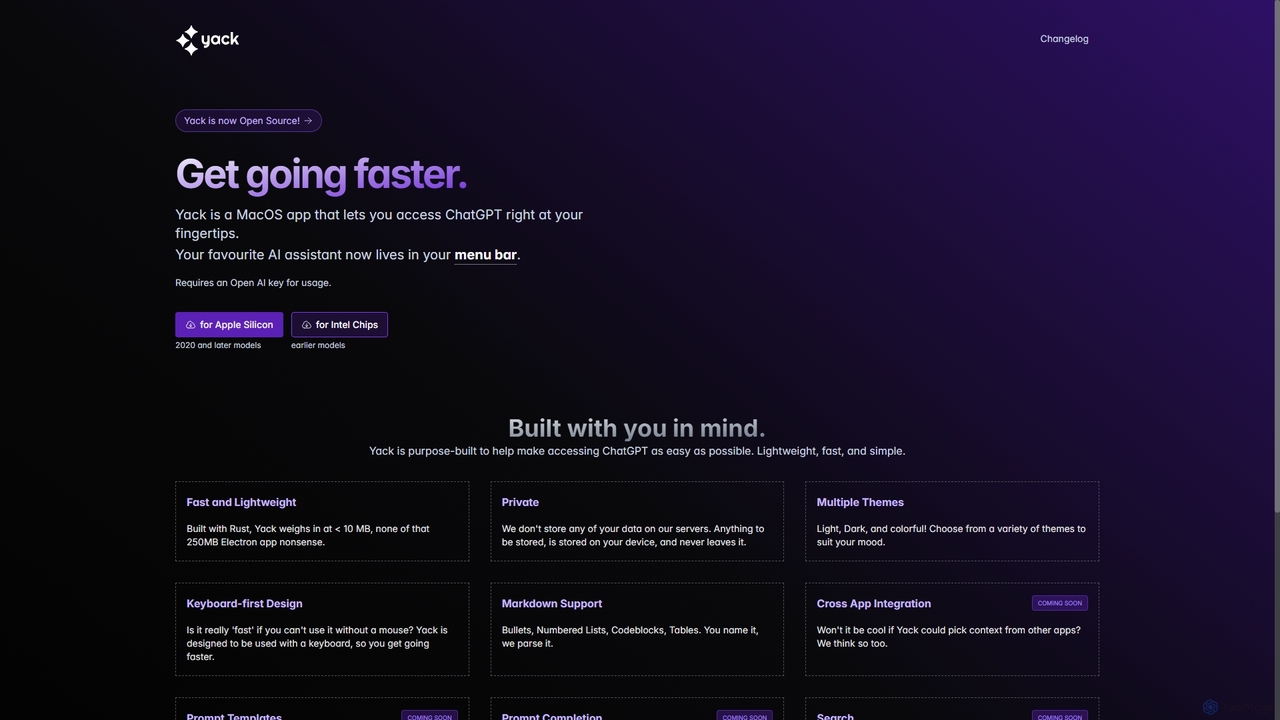
Yack is a lightweight, fast, and private open-source native macOS application that provides instant access to ChatGPT directly from your menu bar. Built with Rust, it's designed for efficiency with a keyboard-first approach, ensuring you can interact with AI without disrupting your workflow.

Api Client
Visits 7.9KFavorites 139Likes 137
AquaSnap
Freemium

AquaSnap

AquaSnap is a powerful window management utility for Windows that dramatically enhances productivity. It allows users to efficiently snap, dock, tile, and organize application windows using simple drag-and-drop actions, mouse shortcuts, and keyboard hotkeys. It is especially useful for large or multiple monitor setups, making multitasking seamless and organized.

Workflow
Visits 22.2KFavorites 107Likes 114

About Desktop Enhancement

AI Desktop Enhancement tools are applications that integrate deeply with your operating system to supercharge its native functions with artificial intelligence. They operate as a system-wide layer, providing instant access to AI capabilities like universal search, command execution, and context-aware text manipulation from anywhere on your desktop. This approach minimizes context switching and embeds AI assistance directly into your existing workflows, making you more efficient across all your applications. These tools transform the standard desktop experience into an intelligent, interactive, and highly automated environment.

Core Features

  • Universal AI Search: Instantly find local files, web pages, and app commands using natural language queries.
  • Context-Aware Assistant: Select text or files anywhere and invoke an AI to summarize, translate, rewrite, or explain.
  • System-Wide Automation: Create and run simple workflows or scripts using plain English to control apps and automate repetitive tasks.
  • Intelligent Clipboard: An enhanced clipboard history that can automatically organize, format, or process copied content.
  • AI-Powered OCR & Screen Capture: Capture any part of your screen and instantly extract text, translate it, or send it to an AI for analysis.

Use Cases

These tools are ideal for developers, writers, researchers, and power users who frequently switch between applications. For instance, a developer can use a universal command palette to run Git commands and ask for code explanations, while a writer can instantly rephrase a sentence in any text editor without opening a separate AI tool.

How to Choose

When selecting a tool, consider its operating system compatibility (macOS, Windows), performance impact, and the breadth of its integration ecosystem. Also evaluate the power and flexibility of its AI features, its level of customization for workflows, and its privacy policy, as these tools often require significant system permissions.

Desktop Enhancement use cases

1

Streamline Development Workflows

For software developers, these tools act as a central nervous system. They can invoke a universal command palette to instantly search for project files, run terminal commands, or access API documentation without leaving their code editor. By selecting a code snippet, they can ask the integrated AI to explain the logic, suggest optimizations, or generate unit tests. This eliminates the need to constantly switch between the IDE, terminal, browser, and a separate AI chat interface, keeping them in a state of flow.

2

Accelerate Content Creation and Editing

Writers, marketers, and content creators can significantly speed up their process. While working in a document, email client, or CMS, they can highlight any text and use a keyboard shortcut to trigger AI actions. This allows for on-the-fly rewriting for tone, summarizing long passages for social media, translating text for international audiences, or brainstorming ideas based on the current context. The entire editing loop happens in place, preserving the original workflow.

3

Enhance Research and Data Collection

Students and researchers can use AI-powered screen capture to grab text from non-selectable sources like academic PDFs, images, or videos. The tool's OCR instantly converts the image to text, which can then be sent to the AI assistant to be summarized, explained in simpler terms, or formatted as a citation. This transforms passive information consumption into an active, interactive process of knowledge gathering and synthesis.

4

Unify Cross-Application Task Management

Project managers and team leads often work across multiple platforms like Slack, Asana, Jira, and email. A desktop enhancement tool provides a single interface to interact with all of them. They can type a command like "Create a new task in Asana about the Q3 report" or "Find my recent conversation with Jane on Slack" from anywhere on their desktop, centralizing control and reducing the mental overhead of app juggling.

5

Automate Repetitive Desktop Chores

Power users can automate routine tasks without writing complex code. Using natural language prompts, they can create simple workflows such as "When a screenshot is saved to the desktop, upload it to Imgur and copy the link." or "Clean up my Downloads folder by moving all images to the Pictures folder." This brings the power of automation to everyday users, saving cumulative hours on manual, repetitive actions.

6

Overcome Language Barriers in Real-Time

Professionals working in international teams can use system-wide translation features to communicate more effectively. When they receive an email or message in a foreign language, they can simply select the text and press a hotkey to see an instant translation overlay. They can also type a reply in their native language and have the tool translate it before sending, facilitating seamless multilingual communication across any application.

Desktop Enhancement FAQ

What are AI Desktop Enhancement tools?

AI Desktop Enhancement tools are applications that add a layer of artificial intelligence directly onto your computer's operating system. Instead of being a standalone program you work inside, they provide system-wide functionalities, like an AI-powered search or a context-aware assistant, that can be accessed from any application via keyboard shortcuts. Their main purpose is to reduce context switching and embed AI capabilities into your natural workflow.

How do Desktop Enhancement tools differ from apps like Notion or ChatGPT?

The key difference is integration versus destination. Apps like Notion or ChatGPT are "destination" applications where you must go to perform a task. AI Desktop Enhancement tools are "integration" tools that bring AI to you, wherever you are working. You don't need to open a new window or tab; you can select text in your browser, code in your IDE, or a file on your desktop and immediately apply AI actions to it, making them feel like a native OS feature.

How to choose the right AI Desktop Enhancement tool?

When choosing a tool, consider these four factors:

  • Platform Compatibility: Ensure it works smoothly on your OS (macOS or Windows).
  • Performance: Look for a lightweight tool that doesn't slow down your system.
  • Integrations: Check if it connects with the apps you use daily (e.g., Slack, Figma, Notion).
  • AI Features & Customization: Evaluate the specific AI capabilities offered and whether you can create custom workflows or commands to suit your needs.

What are the main benefits of using these tools?

The primary benefits are speed and efficiency gained by reducing friction. By providing a universal interface for search and commands, they save you from navigating menus and switching between apps. The context-aware AI allows for in-place text manipulation, eliminating the copy-paste cycle to and from a separate AI tool. This results in a more fluid and uninterrupted workflow, allowing you to stay focused on your primary task.

Are AI Desktop Enhancement tools safe for my data?

This is a critical consideration as these tools often require broad system access. Reputable tools prioritize privacy with clear policies. Look for tools that perform processing locally on your machine whenever possible. For cloud-based features, check their data handling policies, whether they use your data for training, and if they offer enterprise-grade security features. Always choose tools from trusted developers with a transparent approach to privacy.