Data Best in category 12 results Data Labeling AI Tool

Popular AI tools in the Data Labeling field of Data include DefinedCrowd、Roboflow、Surge AI、Revelo、Datacurve、Label Your Data、Sapien、Innovatiana、Superb AI、UBIAI, etc., helping you quickly improve efficiency.

DefinedCrowd

DefinedCrowd

DefinedCrowd is a leading provider of high-quality AI training data. It leverages a global crowd to collect, annotate, …

1.9B
Label Your Data

Label Your Data

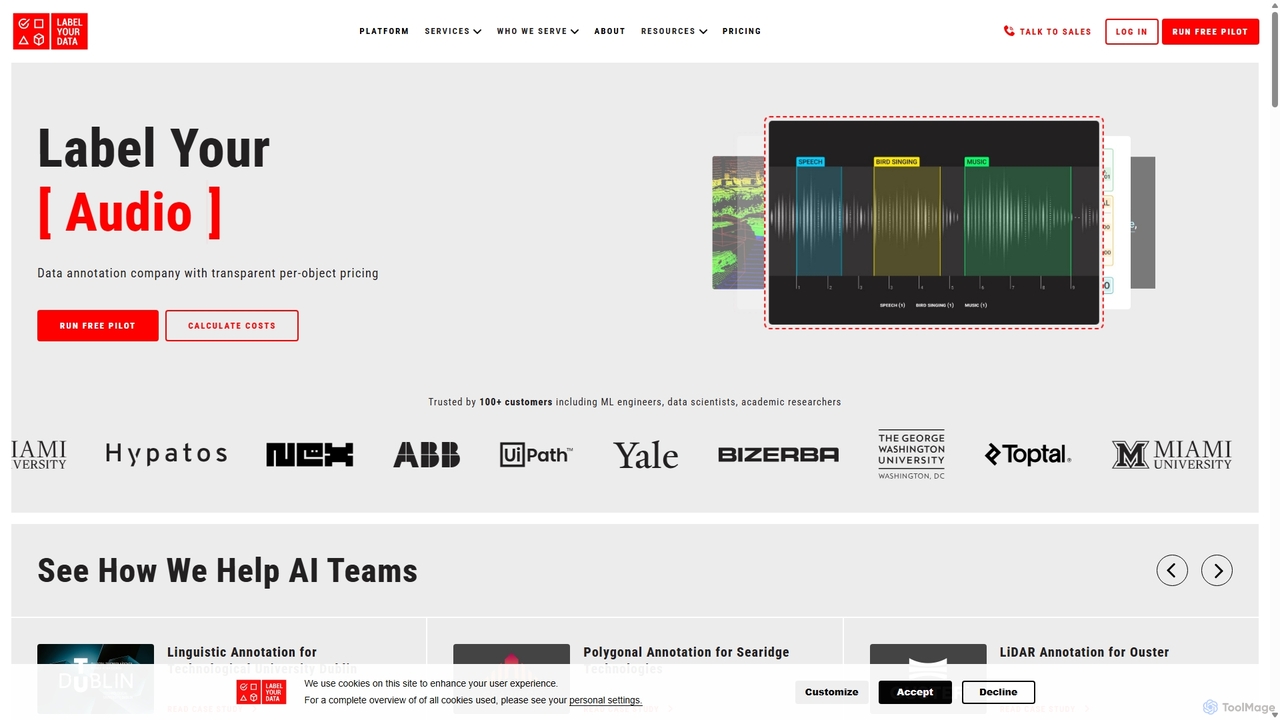
A professional data annotation service and platform providing high-quality, accurate labeled datasets for machine learning. It supports diverse …

78.4K
Datacurve

Datacurve

Datacurve provides high-quality, complex coding data for training and evaluating advanced AI foundation models. Specializing in formats like …

97.3K
People For AI

People For AI

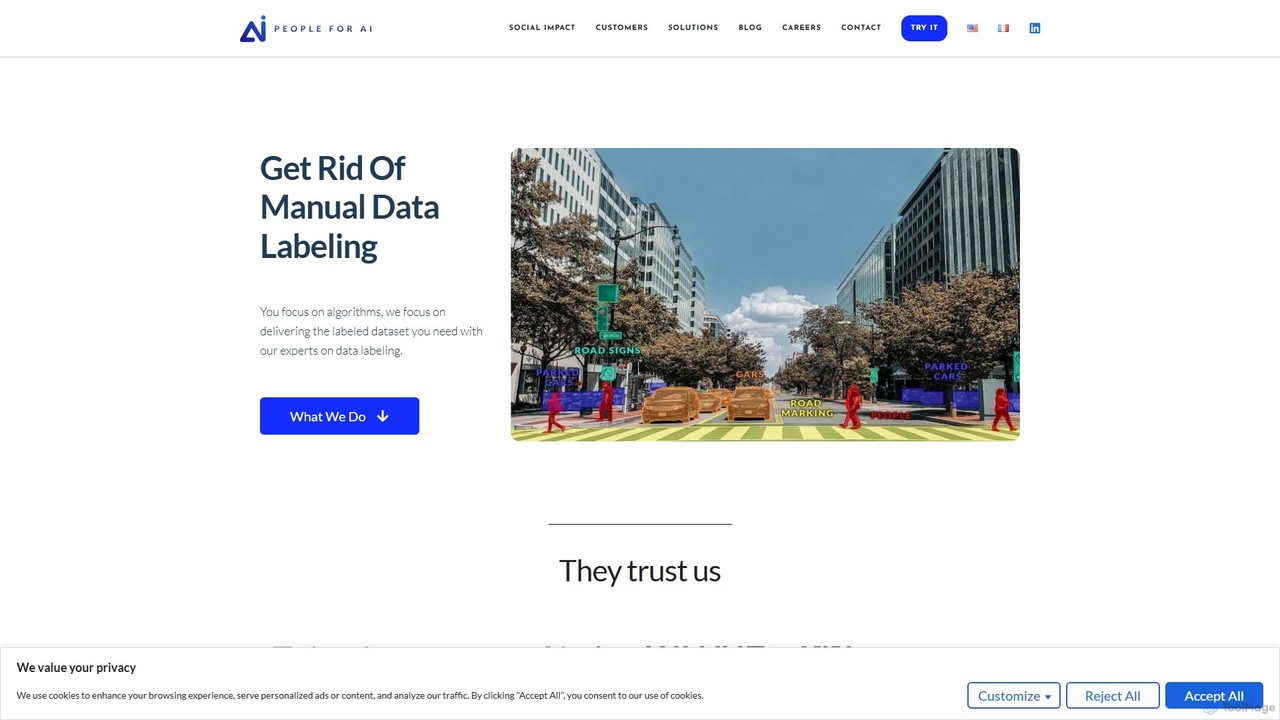
People For AI provides expert-driven data labeling services for machine learning projects. They specialize in high-quality, secure annotation …

4.6K
Innovatiana

Innovatiana

Innovatiana is a specialized service providing high-quality, ethically-sourced training data for AI models. They offer custom dataset creation …

64.4K
Sapien

Sapien

Sapien is a decentralized data foundry that provides enterprise-grade AI training data. It leverages a global network of …

66.2K
Surge AI

Surge AI

Surge AI is a premier data labeling platform that provides elite human intelligence to power the development of …

221.7K
Alaya AI

Alaya AI

Alaya AI is a decentralized AI data platform that connects a global community with AI training tasks. It …

6.0K
Revelo

Revelo

Revelo is a premier talent platform connecting companies with the top 2% of pre-vetted software developers from Latin …

191.8K
UBIAI

UBIAI

UBIAI is an end-to-end platform for building, fine-tuning, and deploying custom Large Language Models (LLMs). It integrates advanced …

12.9K
Superb AI

Superb AI

Superb AI is an end-to-end MLOps platform for computer vision, enabling businesses to build, manage, and deploy custom …

36.7K
Roboflow

Roboflow

Roboflow is an end-to-end computer vision platform for developers and enterprises. It provides a comprehensive suite of tools …

1.4M

About Data Labeling

Data Labeling tools are AI-powered platforms designed to annotate raw data, such as images, text, audio, or video, with meaningful tags or labels. These tools are crucial for training and validating machine learning models, transforming unstructured data into structured formats that AI can understand and learn from. They significantly enhance the accuracy and performance of AI systems across various applications.

Core Features

  • Image/Video Annotation: Tools for bounding boxes, polygons, keypoints, and semantic segmentation.
  • Text Labeling: Categorization, sentiment analysis, named entity recognition (NER), and intent detection.
  • Audio Transcription & Tagging: Converting speech to text and identifying specific sounds or speakers.
  • Data Quality Control: Features for review, consensus, and validation to ensure high label accuracy.
  • Workflow Management: Project creation, task assignment, progress tracking, and team collaboration.

Use Cases

Data Labeling tools are indispensable for AI development teams, data scientists, and researchers. They are used in autonomous driving for object detection, in healthcare for medical image analysis, and in e-commerce for product categorization and recommendation systems. These tools streamline the process of preparing large datasets for model training.

How to Choose

When selecting a Data Labeling tool, consider the types of data you need to label (e.g., images, text), the annotation techniques required (e.g., bounding boxes, NER), scalability for large datasets, integration capabilities with existing MLOps pipelines, and the level of automation offered. Evaluate also the quality control features and pricing model.

Data LabelingUse Cases

1

Training Autonomous Driving Models

Automotive AI engineers use data labeling tools to precisely annotate vast amounts of lidar, radar, and camera sensor data. This involves drawing bounding boxes around objects, segmenting road surfaces, and identifying traffic signs to train perception models, enabling vehicles to accurately understand their environment and make safe driving decisions.

2

Enhancing Medical Image Diagnosis

Radiologists and medical researchers utilize data labeling platforms to outline anomalies, tumors, or specific anatomical structures within X-ray, MRI, or CT scans. This meticulously labeled data is then used to train AI models that can assist in early disease detection, improve diagnostic accuracy, and personalize treatment plans, reducing human error and workload.

3

Improving E-commerce Product Categorization

E-commerce data analysts employ data labeling tools to tag product images with attributes like color, material, and style, and categorize product descriptions into hierarchical structures. This structured data enhances product search relevance, powers personalized recommendation engines, and improves inventory management, leading to a better customer shopping experience and increased sales.

4

Developing Conversational AI (Chatbots)

AI developers and NLP engineers use data labeling to annotate customer service chat logs or voice interactions. They identify user intents (e.g., "check order status," "reset password") and extract key entities (e.g., order numbers, product names). This labeled data is crucial for training natural language understanding (NLU) models, enabling chatbots to accurately comprehend user queries and provide relevant responses.

5

Building Computer Vision for Quality Control

Manufacturing quality control teams leverage data labeling tools to annotate images of products on assembly lines, highlighting defects such as scratches, cracks, or misalignments. This labeled dataset trains computer vision models to automatically inspect products, ensuring consistent quality, reducing waste, and improving efficiency by detecting flaws that might be missed by human inspection.

6

Personalizing Content Recommendation Systems

Media companies and content platforms use data labeling to tag articles, videos, or music with relevant topics, genres, keywords, and even sentiment. This detailed metadata allows AI algorithms to understand user preferences more deeply, leading to highly personalized content recommendations that increase user engagement, retention, and overall platform usage.

Data LabelingFrequently Asked Questions