Colab (Google Colaboratory) is a free, browser-based interactive environment that allows you to write and execute Python code. It requires no setup and provides free access to powerful computing resources like GPUs and TPUs. Ideal for students, data scientists, and AI researchers, Colab facilitates machine learning, data analysis, and education, with seamless collaboration and Google Drive integration.
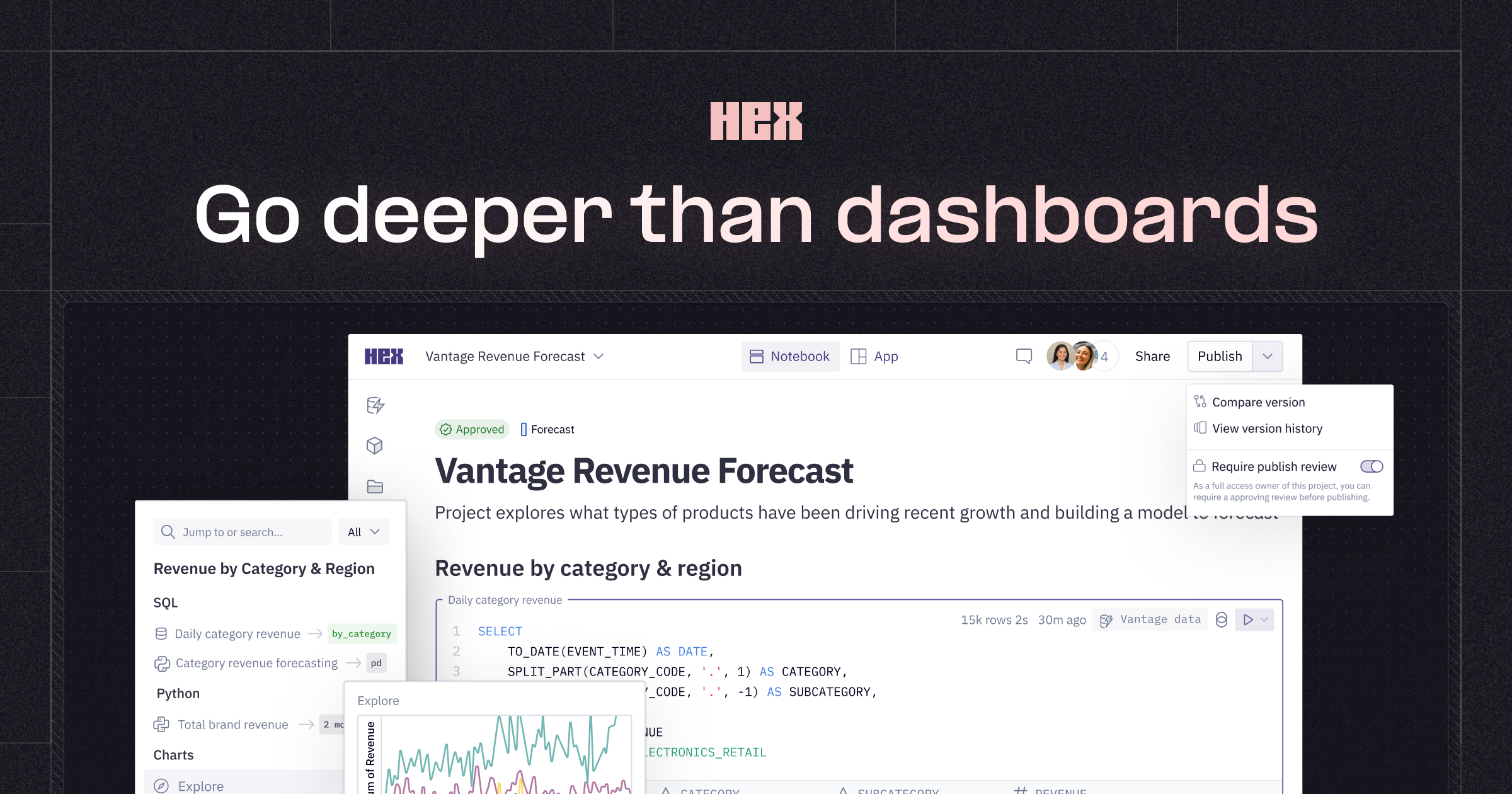
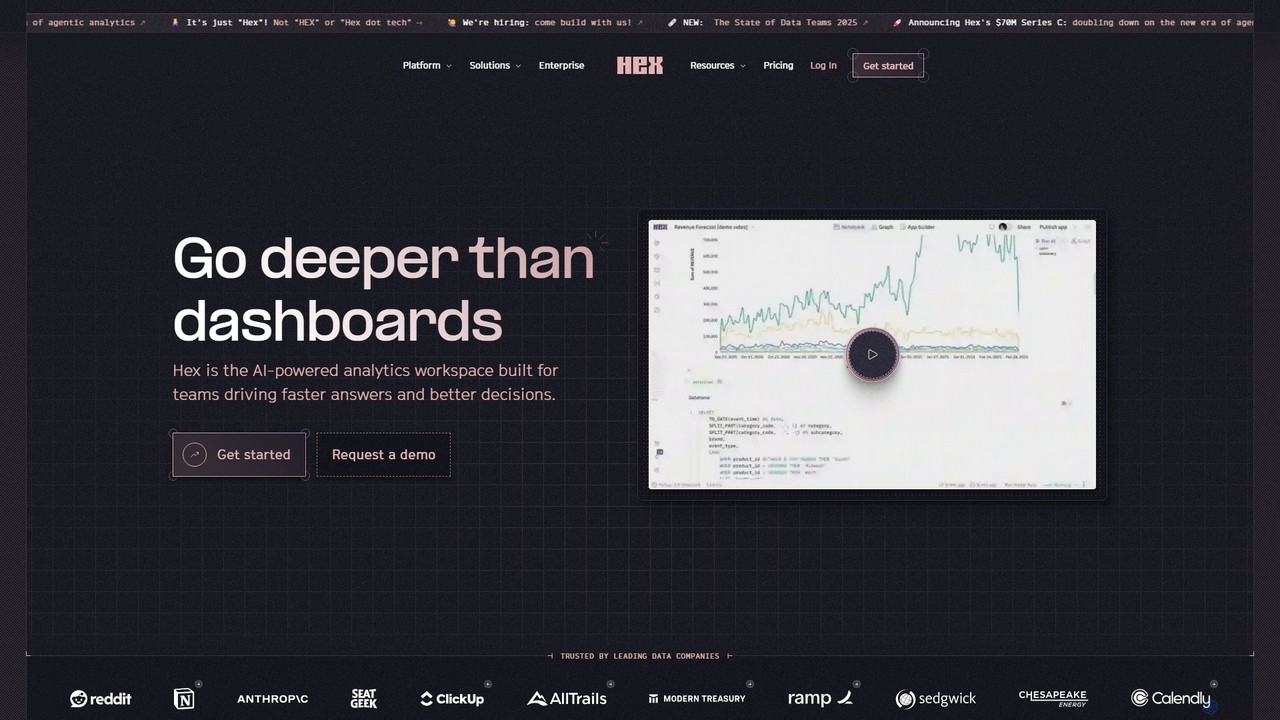
Hex is an AI-powered analytics workspace designed for teams. It integrates notebooks for Python and SQL, interactive data apps, and self-serve exploration into a single collaborative platform, enabling faster, data-driven decision-making.
Product overview
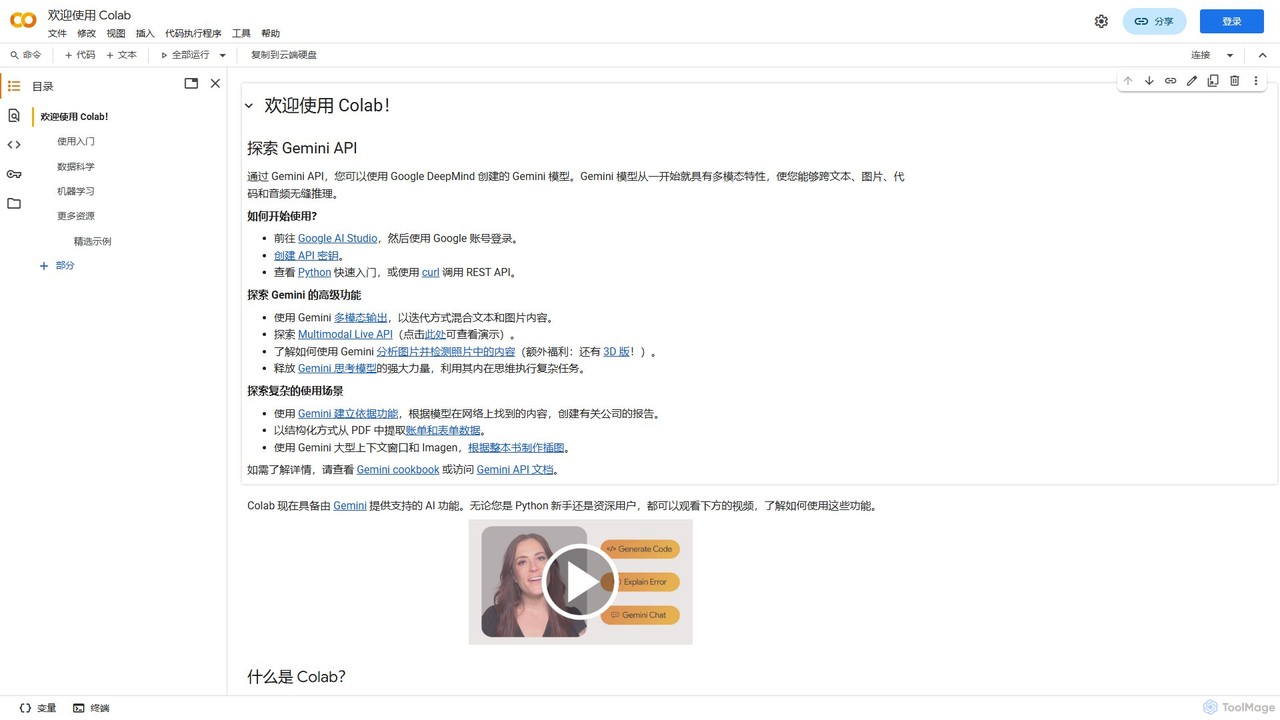
Colab Product overview
Colab (Google Colaboratory) is a free, browser-based interactive environment that allows you to write and execute Python code. It requires no setup and provides free access to powerful computing resources like GPUs and TPUs. Ideal for students, data scientists, and AI researchers, Colab facilitates machine learning, data analysis, and education, with seamless collaboration and Google Drive integration.
Hex Product overview
Hex is an AI-powered analytics workspace designed for teams. It integrates notebooks for Python and SQL, interactive data apps, and self-serve exploration into a single collaborative platform, enabling faster, data-driven decision-making.
Detailed feature comparison
| Feature | Colab | Hex |
|---|---|---|
| Primary category | Data Science | Data Science |
| Added | 2025-08-15 | 2025-08-11 |
| Pricing | Freemium | Freemium |
| Official website | colab.research.google.com | hex.tech |
| Product type | Website | Website |
| Performance data | ||
| User rating | Not verified | Not verified |
| Comments | 0 | 0 |
| Monthly visits | 3.5K | 600.6K |
| Monthly growth | Not verified | 2.6% |
| Favorites | 113 | 128 |
| Details | View details | View details |
Colab vs Hex monthly traffic
Compare Colab and Hex by monthly reach, traffic trend, visit depth, top regions, and acquisition sources.
How to interpret the traffic data
In the Colab vs Hex monthly traffic comparison, Colab currently shows 3.5K visits and Hex shows 600.6K; Hex has about 172 times the visible traffic of Colab, an absolute difference of about 597.2K visits. This reflects visible reach, not feature quality or paid users.
Only Hex has complete third-party traffic details; Colab uses visits recorded inside ToolMage. These scopes cannot estimate market share directly, and on-site views should not be treated as the product’s total website traffic.
Colab monthly traffic:
Latest traffic
Hex monthly traffic:
Latest traffic
Monthly traffic trend
- 2025/9: 522K Monthly visits
- 2026/1: 602.8K Monthly visits
- 2026/2: 579.1K Monthly visits
- 2026/3: 660.6K Monthly visits
- 2026/4: 585.6K Monthly visits
- 2026/5: 600.6K Monthly visits
Top regions
Top 5 countries/regions
| Country/region | Percentage | Traffic |
|---|---|---|
| 🇺🇸United States | 77.44% | 465.1K |
| 🇨🇦Canada | 8.61% | 51.7K |
| 🇬🇧United Kingdom | 6.11% | 36.7K |
| 🇪🇸Spain | 4.14% | 24.9K |
| 🇲🇽Mexico | 3.7% | 22.2K |
Traffic sources
| Source type | Percentage | Traffic |
|---|---|---|
| Direct | 88.79% | 533.3K |
| Referral | 8.56% | 51.4K |
| 2.65% | 15.9K |
Search keywords
Usage comparison
Compare the core capabilities of Colab and Hex
Colab Core features
Hex Core features
Use cases
Colab Use cases
Hex Use cases
Colab vs Hex:In-depth comparison and selection guidance
First decide whether the products solve the same kind of need
This in-depth Colab vs Hex comparison uses only the product records, taxonomy, audience, traffic, and community signals available on this page. Colab is primarily listed under “Data Science”, while Hex is primarily listed under “Data Science”, so the first decision is whether your actual task matches their recorded scope.
The structured fields currently show these decision-relevant differences: Primary category (Colab: Data Science; Hex: Data Science); Monthly visits (Colab: 3.5K; Hex: 600.6K); Favorites (Colab: 113; Hex: 128); Website (Colab: colab.research.google.com; Hex: hex.tech); Added (Colab: 2025-08-15; Hex: 2025-08-11). These facts are more useful for selection than brand visibility alone.
What market visibility and monthly traffic mean
In the Colab vs Hex monthly traffic comparison, Colab currently shows 3.5K visits and Hex shows 600.6K; Hex has about 172 times the visible traffic of Colab, an absolute difference of about 597.2K visits. This reflects visible reach, not feature quality or paid users.
Only Hex has complete third-party traffic details; Colab uses visits recorded inside ToolMage. These scopes cannot estimate market share directly, and on-site views should not be treated as the product’s total website traffic.
The current traffic scope is not sufficient for a reliable product ranking. Treat monthly visits as a market-interest signal, then decide using taxonomy, use cases, pricing, and a like-for-like trial rather than reading exposure as product capability.
Product positioning, use cases, and roles
Colab and Hex currently overlap in shared categories: Collaboration; shared tags: collaboration, data science, machine learning, and python. This can place both on the same shortlist, but it does not prove equal implementation, depth, or cost.
Colab's unique categories/tags are Data Science, Notebook, AI development, code editor, deep learning, google, GPU, and jupyter notebook; Hex's are Data Science, Low Code No Code, AI assistant, business intelligence, dashboard, data analysis, data visualization, and notebook. These unique fields are the strongest differentiators: validate the product whose recorded scope matches the task instead of following traffic alone.
What ratings, comments, and favorites can tell you
Colab has no verified rating, 0 comments, 113 favorites, and 117 likes;Hex has no verified rating, 0 comments, 128 favorites, and 130 likes。
Neither product has enough rating or comment samples for a credible reputation ranking.
Selection guidance by actual need
When to evaluate Colab first
Put Colab on the priority trial list when the task aligns with “Data Science” and especially Data Science, Notebook, AI development, code editor, deep learning, and google. This follows recorded positioning and does not imply unlisted capabilities are absent.
Colab also currently records: pricing is freemium, product type is website, 3.5K on-site monthly views, no verified user rating. Verify any hard requirement around price, platform, or reach before trial, and do not let sparse review data substitute for testing.
When to evaluate Hex first
Put Hex on the priority trial list when the task aligns with “Data Science” and especially Data Science, Low Code No Code, AI assistant, business intelligence, dashboard, and data analysis. This follows recorded positioning and does not imply unlisted capabilities are absent.
Hex also currently records: pricing is freemium, product type is website, 600.6K verified monthly visits, no verified user rating. Verify any hard requirement around price, platform, or reach before trial, and do not let sparse review data substitute for testing.
How to validate the recommendation before deciding
The available data describes positioning, public visibility, and community signals, but it cannot prove output quality, speed, integration effort, privacy, or long-term cost in your workflow. Before deciding, run the same representative tasks in Colab and Hex, then record completion time, accuracy, manual corrections, and the real paid threshold. A like-for-like trial turns this comparison into a defensible adoption decision.
Comparison FAQ
How should I choose between Colab and Hex?
Where does this comparison data come from?
What do unknown fields mean?
Related AI tools

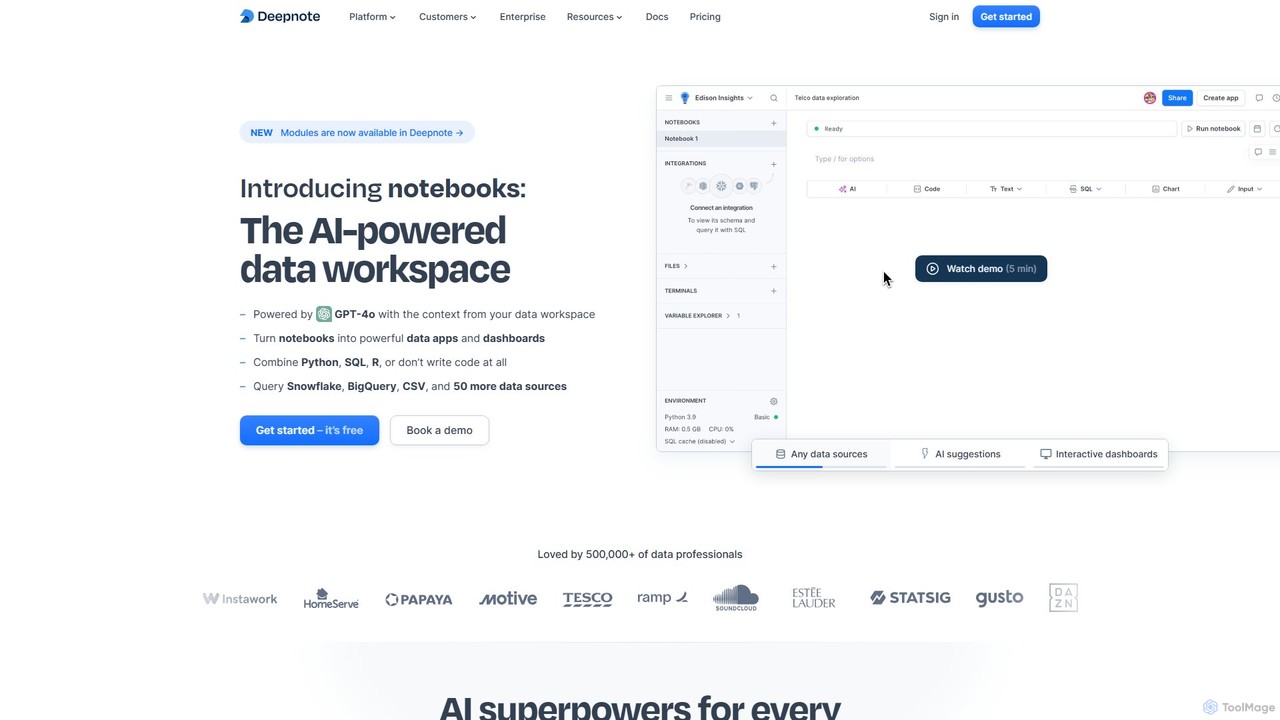
Deepnote
Deepnote is an AI-powered, collaborative data science notebook for teams. It unifies Python, SQL, and R in a single cloud-based workspace, enabling users to explore data, build machine learning models, and create interactive dashboards and apps with ease. Powered by GPT-4o, it automates analysis and code generation, making data science accessible to all skill levels.
Business Intelligence
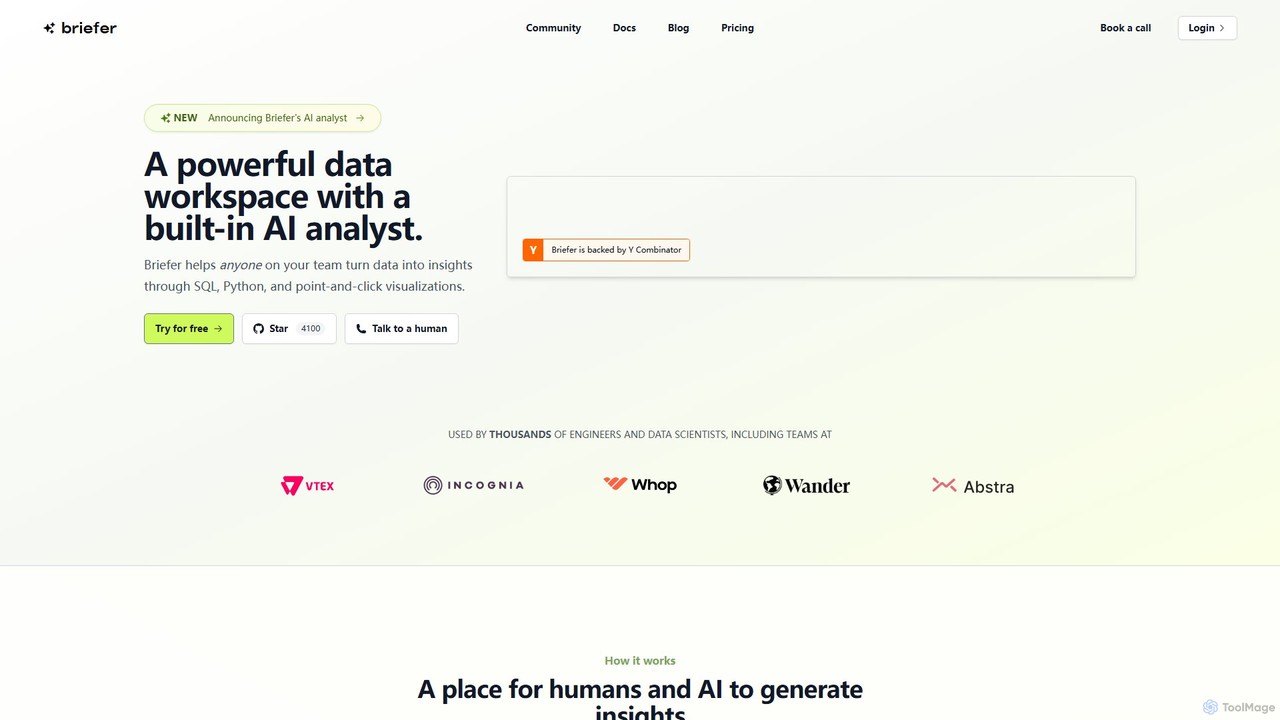
Briefer
Briefer is a collaborative data platform featuring a built-in AI analyst. It empowers teams to transform data into actionable insights using SQL, Python, and interactive visualizations within a unified workspace. Designed for both technical and non-technical users, it streamlines data analysis, reporting, and real-time collaboration, accelerating data-driven decision-making. It is backed by Y Combinator and offers both cloud-hosted and self-hosted open-source versions.
Database
cometcore
CometCore is an end-to-end MLOps platform designed for AI developers and data science teams. It streamlines the entire machine learning lifecycle, from experiment tracking and hyperparameter optimization to model versioning and production monitoring. By providing a centralized hub for collaboration and reproducibility, CometCore accelerates the development and deployment of robust, high-performance AI models.
Data Science
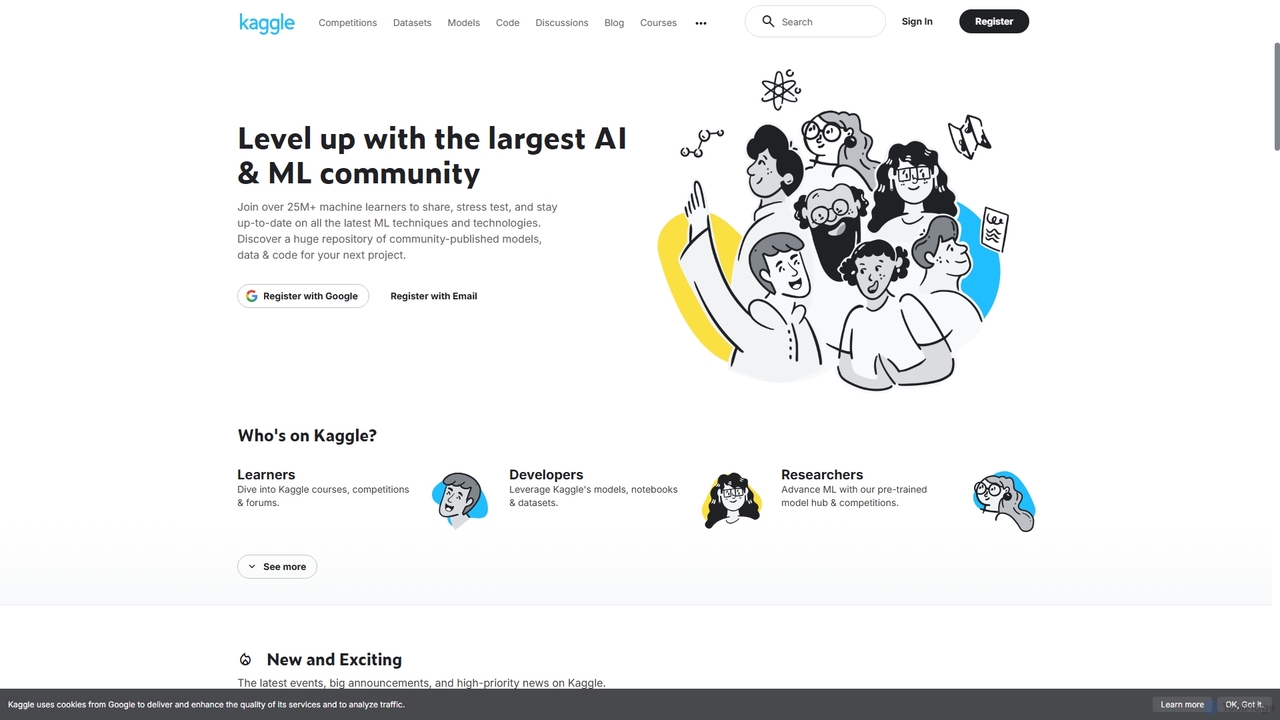
Kaggle
Kaggle is the world's largest online community for data scientists and machine learning practitioners. Owned by Google, it provides a platform to explore datasets, build models in a web-based environment, compete in machine learning challenges, and access educational resources. It offers free access to powerful computational resources, including GPUs and TPUs, making it an essential tool for anyone from beginners to seasoned experts in the AI and data science fields.
Datasets
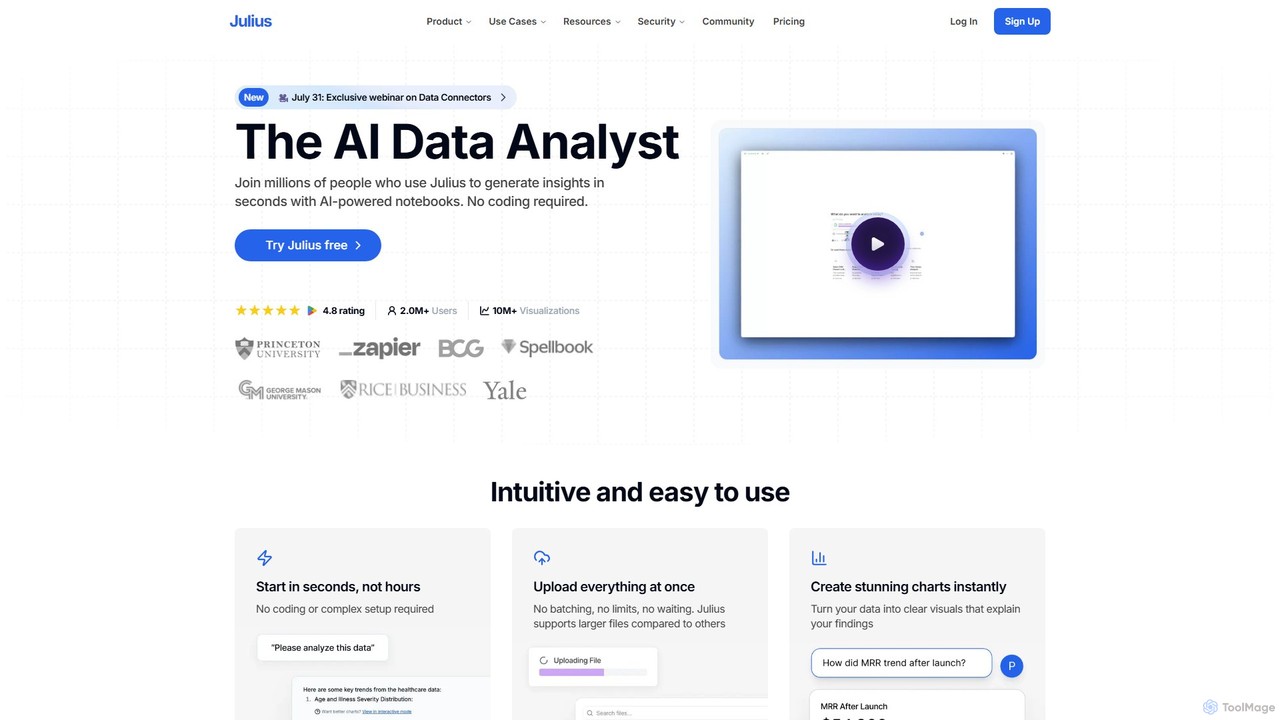
Julius AI
Julius AI is your AI Data Analyst, designed to interpret, analyze, and visualize complex data effortlessly. Connect your data from spreadsheets, databases, or PDFs, ask questions in natural language, and receive instant insights, charts, and reports. No coding is required, but it also supports Python, R, and SQL for advanced users, making data analysis accessible to everyone.
Developer Tools
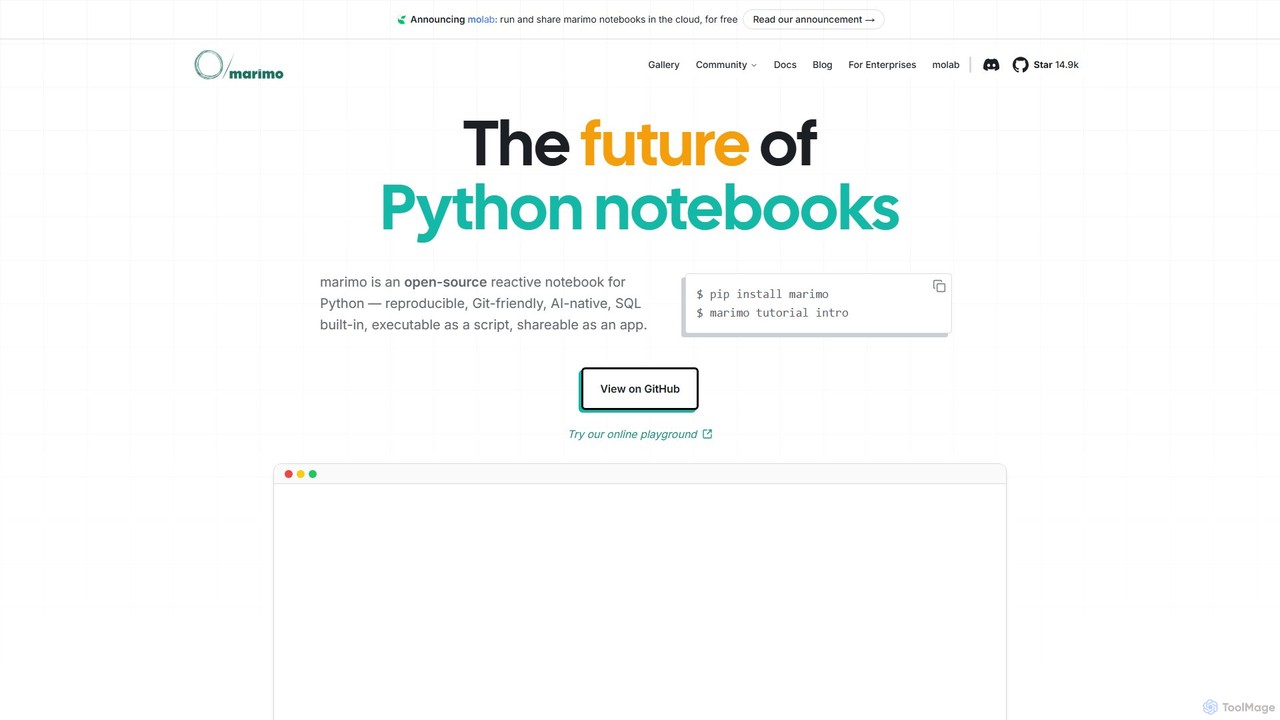
marimo
marimo is an open-source reactive Python notebook for modern data science and AI. It offers a reproducible, Git-friendly, and interactive environment where notebooks are pure Python scripts. Features include built-in AI assistance, SQL cells, and the ability to share notebooks as web apps, streamlining the workflow from experiment to production.
Data Visualization
Lightning AI
Lightning AI is a cloud platform designed to build, train, and deploy AI models at scale. It combines the popular open-source PyTorch Lightning framework with Lightning AI Studio, a collaborative, browser-based environment with zero setup. Access powerful GPUs, scale from a laptop to the cloud seamlessly, and accelerate your entire AI development workflow.
Platform As A Service (Paas)
Jovian
Jovian is an online learning platform offering practical, beginner-friendly courses in data science, machine learning, and web development. It focuses on hands-on learning using Python, PyTorch, and other modern technologies, featuring cloud-based Jupyter notebooks and real-world projects to build job-ready skills.
Coding
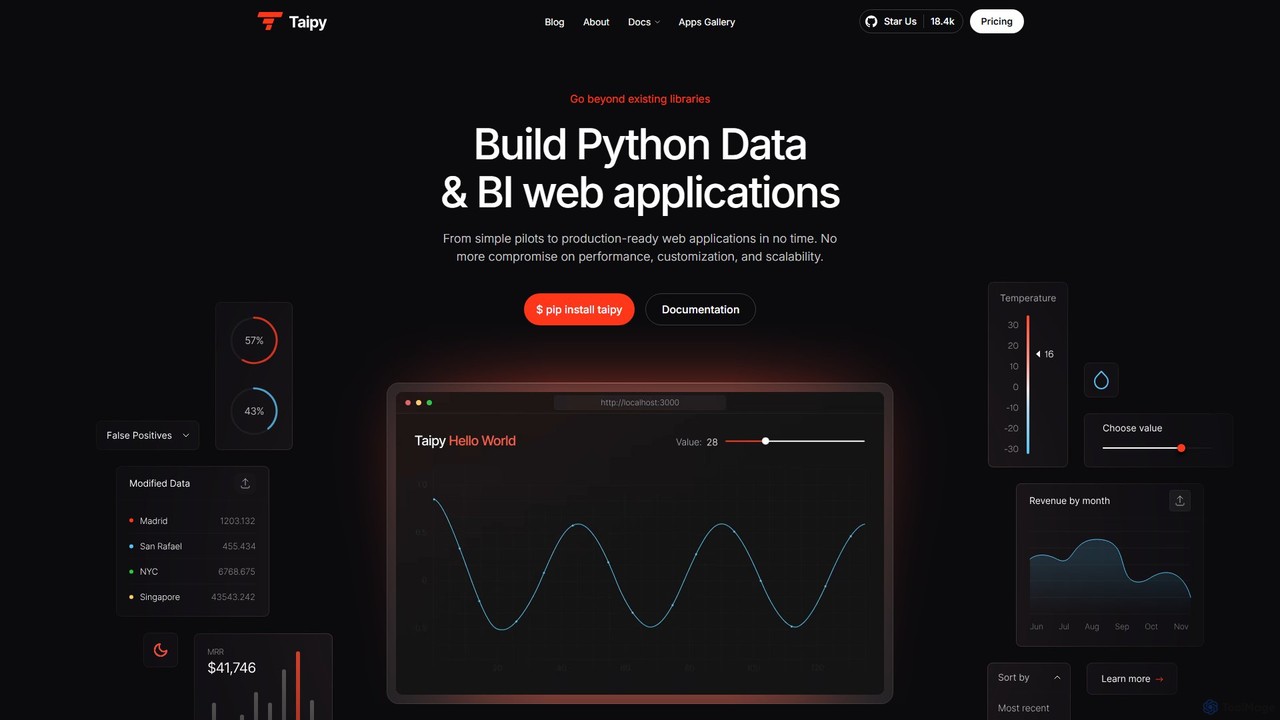
Taipy
Taipy is an open-source Python library for rapidly building powerful data and business intelligence web applications. It enables developers and data scientists to create everything from simple dashboards to complex, production-ready, multi-user applications with features like scenario management and performance optimization, all within Python.
Data Visualization
astronuts
astronuts is an AI-powered data intelligence platform that transforms complex data into clear, actionable insights. Connect your data sources, ask questions in natural language, and automatically generate interactive dashboards and reports. It's designed for teams to explore data, uncover hidden patterns, and make smarter decisions, faster.
3D
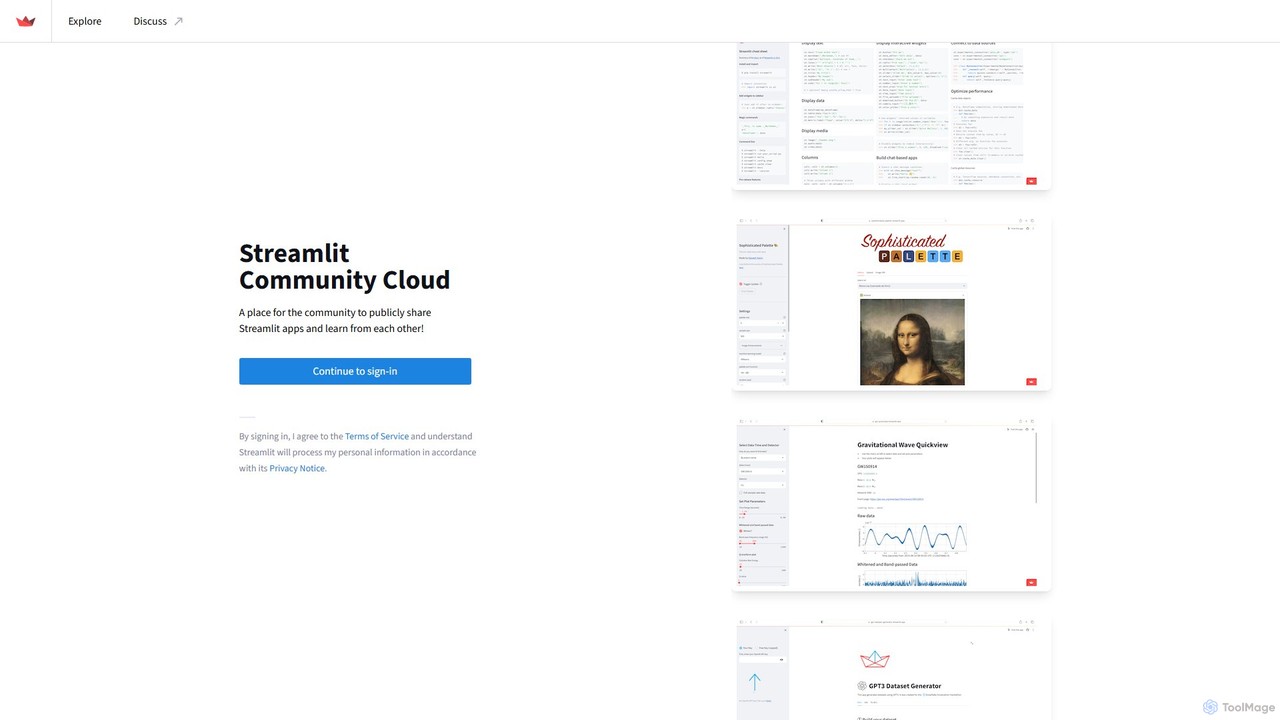
Streamlit
Streamlit is an open-source Python framework that enables developers and data scientists to build and share beautiful, custom web apps for machine learning and data science in minutes. The Streamlit Community Cloud provides a free platform to deploy, manage, and share these public applications with the world, fostering a collaborative environment for innovation.
Data Visualization
pandalyst
Pandalyst is an AI-powered data analysis platform that transforms how you interact with data. Ask questions in natural language and receive instant visualizations, insights, and reports. It automates complex data tasks, making business intelligence accessible to everyone, from analysts to business leaders, without writing a single line of code.
Low Code No Code
DataCamp
DataCamp is an interactive online learning platform for data science and AI. It offers hands-on courses in Python, R, SQL, Power BI, and more. Through a 'learn-by-doing' approach with in-browser coding, real-world projects, and career tracks, it empowers individuals and businesses to build job-ready data skills, from beginner to expert level.
Data Science
TensorFlow
TensorFlow is an end-to-end open-source platform for machine learning developed by Google. It provides a comprehensive, flexible ecosystem of tools, libraries, and community resources that lets researchers and developers build and deploy ML-powered applications. From beginners to experts, TensorFlow offers intuitive high-level APIs for easy model building and powerful low-level APIs for advanced research, enabling deployment across servers, edge devices, and browsers.
Frameworks
Fabi.ai
Fabi.ai is an AI-powered business intelligence and data analysis platform designed for lean teams. It integrates SQL, Python, and AI to help users build dashboards, automate workflows, and explore data 10x faster. The platform offers an all-in-one collaborative environment, reducing context switching and enabling both technical and non-technical users to derive insights from their data sources like data warehouses, Google Sheets, and more.
Business Intelligence