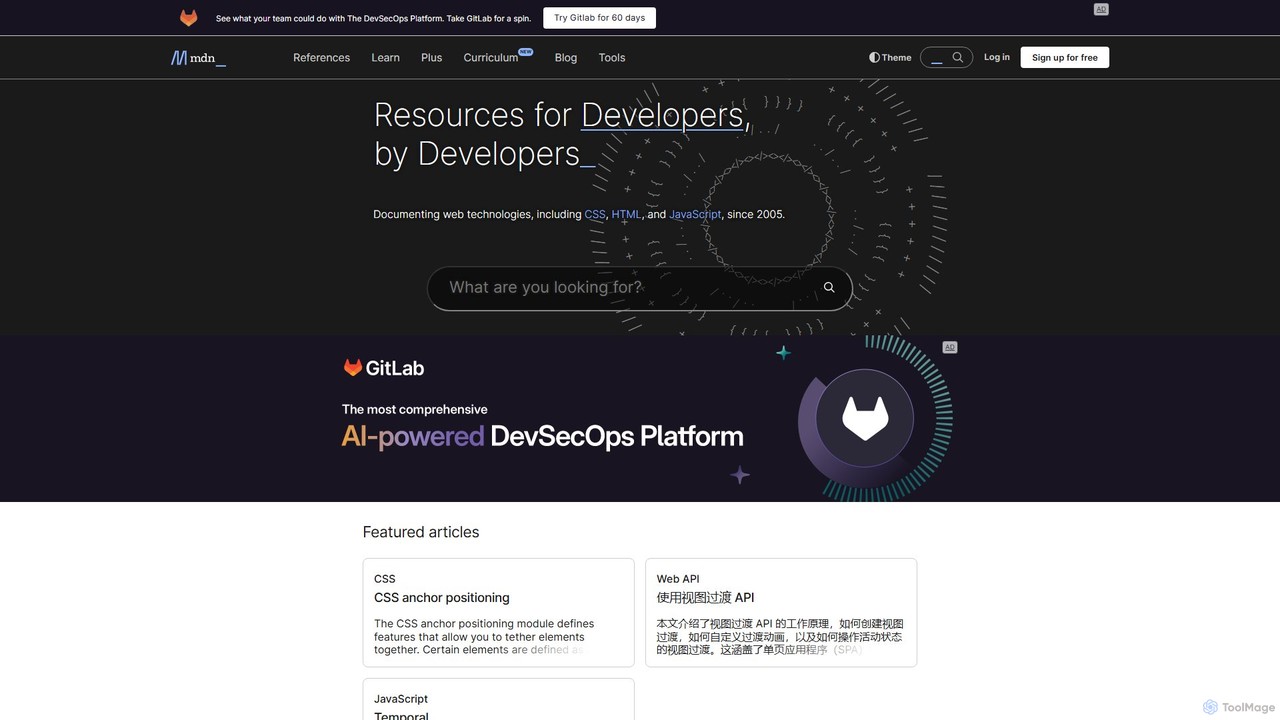
MDN Web Docs, maintained by Mozilla and contributors, is the definitive, free resource for web developers. It provides comprehensive documentation for open web standards, including HTML, CSS, and JavaScript, along with extensive tutorials and reference materials for developers of all skill levels.
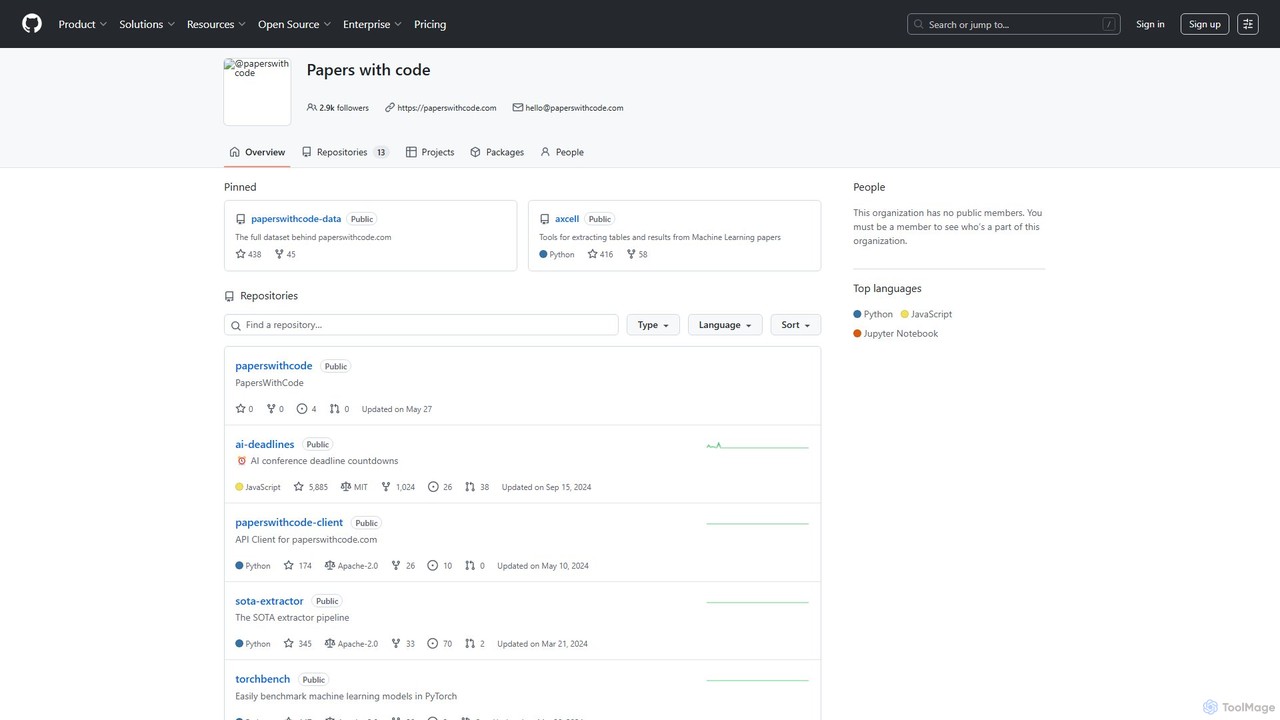
Papers with Code is a free, open resource for machine learning researchers and developers. It connects scientific papers to their corresponding open-source code, making research more accessible and reproducible. The platform features state-of-the-art leaderboards, browsable datasets, and a comprehensive collection of AI research, helping users track progress, find implementations, and accelerate their work. It is an essential tool for anyone in the AI/ML community.
Product overview
MDN Web Docs Product overview
MDN Web Docs, maintained by Mozilla and contributors, is the definitive, free resource for web developers. It provides comprehensive documentation for open web standards, including HTML, CSS, and JavaScript, along with extensive tutorials and reference materials for developers of all skill levels.
Papers with Code Product overview
Papers with Code is a free, open resource for machine learning researchers and developers. It connects scientific papers to their corresponding open-source code, making research more accessible and reproducible. The platform features state-of-the-art leaderboards, browsable datasets, and a comprehensive collection of AI research, helping users track progress, find implementations, and accelerate their work. It is an essential tool for anyone in the AI/ML community.
Detailed feature comparison
| Feature | MDN Web Docs | Papers with Code |
|---|---|---|
| Primary category | Documentation | Machine Learning |
| Added | 2025-08-06 | 2025-08-07 |
| Pricing | Free | Free |
| Official website | developer.mozilla.org | github.com |
| Product type | Website | Website |
| Performance data | ||
| User rating | Not verified | Not verified |
| Comments | 0 | 0 |
| Monthly visits | 6.9M | 636.1M |
| Monthly growth | -8.1% | 0.8% |
| Favorites | 78 | 105 |
| Details | View details | View details |
MDN Web Docs vs Papers with Code monthly traffic
Compare MDN Web Docs and Papers with Code by monthly reach, traffic trend, visit depth, top regions, and acquisition sources.
How to interpret the traffic data
In the MDN Web Docs vs Papers with Code monthly traffic comparison, MDN Web Docs currently shows 6.9M visits and Papers with Code shows 636.1M; Papers with Code has about 92.3 times the visible traffic of MDN Web Docs, an absolute difference of about 629.2M visits. This reflects visible reach, not feature quality or paid users.
Both tools provide verified traffic details, so monthly trends, visit depth, regions, and acquisition sources can be compared on the same basis.
MDN Web Docs is registered at the developer.mozilla.org/zh-CN subpage; Papers with Code is registered at the github.com/paperswithcode subpage. Because the current data does not state whether other host pages are excluded, treat this as domain-level context rather than independent traffic for one product or project.

MDN Web Docs monthly traffic:
Latest traffic
Monthly traffic trend
- 2026/1: 10M Monthly visits
- 2026/2: 8.6M Monthly visits
- 2026/3: 8.6M Monthly visits
- 2026/4: 7.5M Monthly visits
- 2026/5: 6.9M Monthly visits
Top regions
Top 5 countries/regions
| Country/region | Percentage | Traffic |
|---|---|---|
| 🇺🇸United States | 33.7% | 2.3M |
| 🇮🇳India | 24.33% | 1.7M |
| 🇩🇪Germany | 14.99% | 1M |
| 🇷🇺Russia | 14.36% | 989.4K |
| 🇧🇷Brazil | 12.62% | 869.5K |
Traffic sources
| Source type | Percentage | Traffic |
|---|---|---|
| Direct | 73.75% | 5.1M |
| Referral | 24.88% | 1.7M |
| 1.37% | 94.4K |
Search keywords
Papers with Code monthly traffic:
Latest traffic
Monthly traffic trend
- 2026/1: 542.6M Monthly visits
- 2026/2: 534.8M Monthly visits
- 2026/3: 634.3M Monthly visits
- 2026/4: 631M Monthly visits
- 2026/5: 636.1M Monthly visits
Top regions
Top 5 countries/regions
| Country/region | Percentage | Traffic |
|---|---|---|
| 🇺🇸United States | 36.14% | 229.9M |
| 🇨🇳China | 22.96% | 146M |
| 🇮🇳India | 17.41% | 110.7M |
| 🇷🇺Russia | 15.84% | 100.8M |
| 🇩🇪Germany | 7.65% | 48.7M |
Traffic sources
| Source type | Percentage | Traffic |
|---|---|---|
| Direct | 82.14% | 522.5M |
| Referral | 16.14% | 102.7M |
| 1.72% | 10.9M |
Search keywords
Usage comparison
Compare the core capabilities of MDN Web Docs and Papers with Code
MDN Web Docs Core features
Papers with Code Core features
Use cases
MDN Web Docs Use cases
Papers with Code Use cases
MDN Web Docs vs Papers with Code:In-depth comparison and selection guidance
First decide whether the products solve the same kind of need
This in-depth MDN Web Docs vs Papers with Code comparison uses only the product records, taxonomy, audience, traffic, and community signals available on this page. MDN Web Docs is primarily listed under “Documentation”, while Papers with Code is primarily listed under “Machine Learning”, so the first decision is whether your actual task matches their recorded scope.
The structured fields currently show these decision-relevant differences: Primary category (MDN Web Docs: Documentation; Papers with Code: Machine Learning); Monthly visits (MDN Web Docs: 6.9M; Papers with Code: 636.1M); Monthly growth (MDN Web Docs: -8.1%; Papers with Code: 0.8%); Favorites (MDN Web Docs: 78; Papers with Code: 105); Website (MDN Web Docs: developer.mozilla.org; Papers with Code: github.com). These facts are more useful for selection than brand visibility alone.
What market visibility and monthly traffic mean
In the MDN Web Docs vs Papers with Code monthly traffic comparison, MDN Web Docs currently shows 6.9M visits and Papers with Code shows 636.1M; Papers with Code has about 92.3 times the visible traffic of MDN Web Docs, an absolute difference of about 629.2M visits. This reflects visible reach, not feature quality or paid users.
Both tools provide verified traffic details, so monthly trends, visit depth, regions, and acquisition sources can be compared on the same basis.
MDN Web Docs is registered at the developer.mozilla.org/zh-CN subpage; Papers with Code is registered at the github.com/paperswithcode subpage. Because the current data does not state whether other host pages are excluded, treat this as domain-level context rather than independent traffic for one product or project.
Papers with Code is registered under a github.com subpath, so its large visible total may include the host platform. The current data does not justify choosing Papers with Code for traffic alone; shortlist by unique taxonomy and use case, then validate with the same tasks.
Product positioning, use cases, and roles
MDN Web Docs and Papers with Code currently overlap in shared categories: Learning Platform; shared tags: open source. This can place both on the same shortlist, but it does not prove equal implementation, depth, or cost.
MDN Web Docs's unique categories/tags are Documentation, Reference Tool, API, css, developer tools, documentation, html, and javascript; Papers with Code's are Machine Learning, Code Repository, Academic, AI research, benchmarks, code implementation, computer science, and datasets. These unique fields are the strongest differentiators: validate the product whose recorded scope matches the task instead of following traffic alone.
What ratings, comments, and favorites can tell you
MDN Web Docs has no verified rating, 0 comments, 78 favorites, and 71 likes;Papers with Code has no verified rating, 0 comments, 105 favorites, and 102 likes。
Neither product has enough rating or comment samples for a credible reputation ranking.
Selection guidance by actual need
When to evaluate MDN Web Docs first
Put MDN Web Docs on the priority trial list when the task aligns with “Documentation” and especially Documentation, Reference Tool, API, css, developer tools, and documentation. This follows recorded positioning and does not imply unlisted capabilities are absent.
MDN Web Docs also currently records: pricing is free, product type is website, 6.9M monthly visits shown for the registered host (subpage scope unknown), no verified user rating. Verify any hard requirement around price, platform, or reach before trial, and do not let sparse review data substitute for testing.
When to evaluate Papers with Code first
Put Papers with Code on the priority trial list when the task aligns with “Machine Learning” and especially Machine Learning, Code Repository, Academic, AI research, benchmarks, and code implementation. This follows recorded positioning and does not imply unlisted capabilities are absent.
Papers with Code also currently records: pricing is free, product type is website, 636.1M monthly visits shown for the registered host (subpage scope unknown), no verified user rating. Verify any hard requirement around price, platform, or reach before trial, and do not let sparse review data substitute for testing.
How to validate the recommendation before deciding
The available data describes positioning, public visibility, and community signals, but it cannot prove output quality, speed, integration effort, privacy, or long-term cost in your workflow. Before deciding, run the same representative tasks in MDN Web Docs and Papers with Code, then record completion time, accuracy, manual corrections, and the real paid threshold. A like-for-like trial turns this comparison into a defensible adoption decision.
Comparison FAQ
How should I choose between MDN Web Docs and Papers with Code?
Where does this comparison data come from?
What do unknown fields mean?
Related AI tools

Layrr
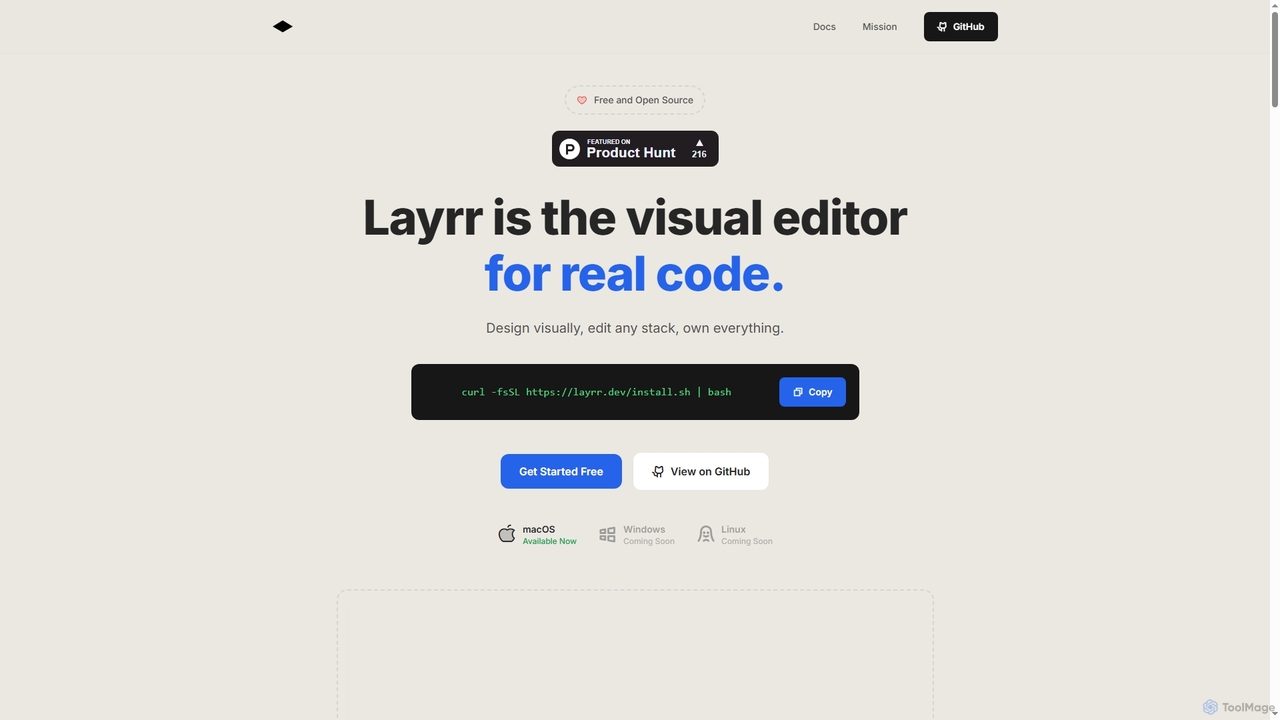
Layrr is a free and open-source visual editor that allows developers and designers to create and edit real code directly. It combines the intuitive drag-and-drop interface of design tools like Figma with the flexibility and ownership of traditional coding, supporting any tech stack and leveraging AI for design-to-code conversion and natural language interface generation.
Code Generation
Fast.ai
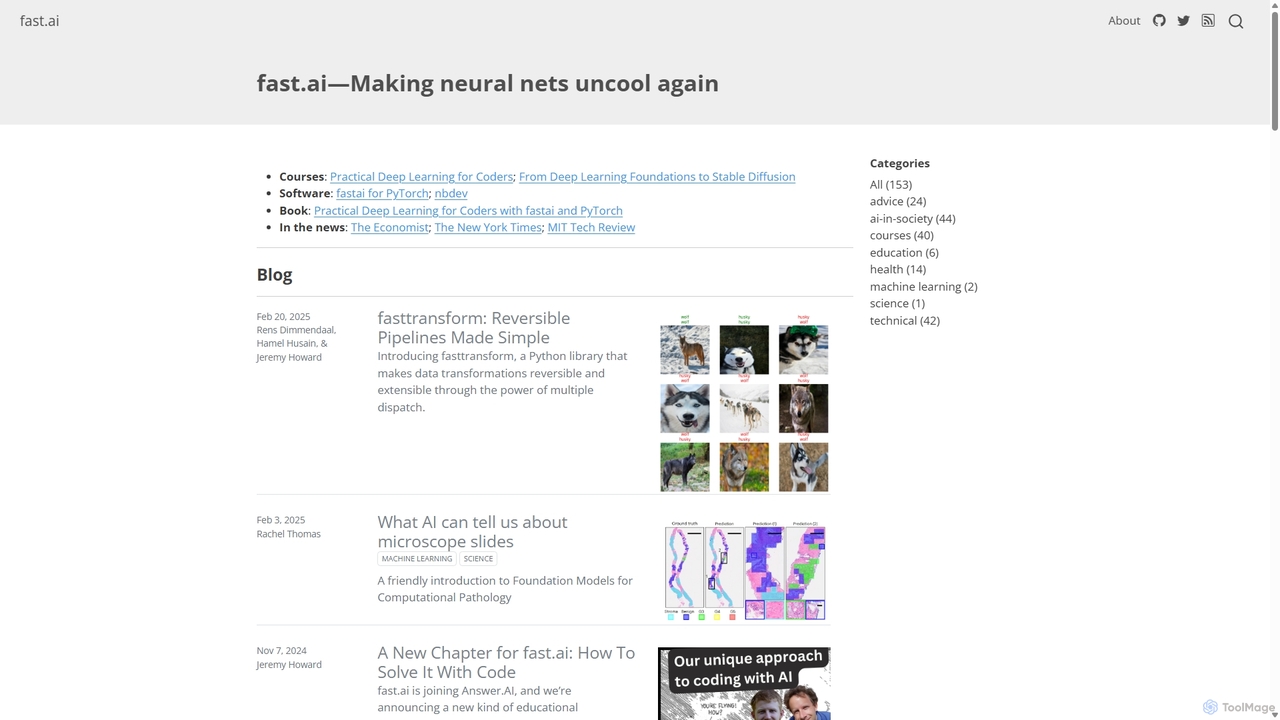
Fast.ai is a research institute dedicated to making deep learning accessible to everyone. It offers free courses, an open-source software library (fastai), cutting-edge research, and a vibrant community, empowering coders of all backgrounds to become deep learning practitioners.
Machine Learning
Ollama
Ollama is a powerful open-source framework for running large language models (LLMs) like Llama 3, Mistral, and Gemma locally on your own hardware. Available for macOS, Windows, and Linux, it simplifies the setup and management of open-source models, enabling private, offline, and cost-effective AI development and usage.
Machine Learning
Refine
Refine is an open-source, React-based framework for rapidly building enterprise-grade internal tools, admin panels, dashboards, and B2B applications. It combines the speed of low-code solutions with the flexibility of full-code development, featuring an AI-powered generator to instantly create applications from APIs.
Internal Tools
Scalar
Scalar is an open-source developer platform for creating beautiful, interactive API documentation from OpenAPI/Swagger specifications. It features a built-in, offline-first API client for seamless testing, extensive customization options, and integrations with popular frameworks, streamlining the entire API lifecycle.
Api Management
victordibia
A comprehensive resource hub by Victor Dibia, a leading researcher in Applied ML and HCI. It features open-source AI tools like AutoGen Studio and LIDA, in-depth articles, research papers, and talks on generative AI, multi-agent systems, and human-computer interaction. A valuable platform for developers, researchers, and AI enthusiasts.
Data Visualization
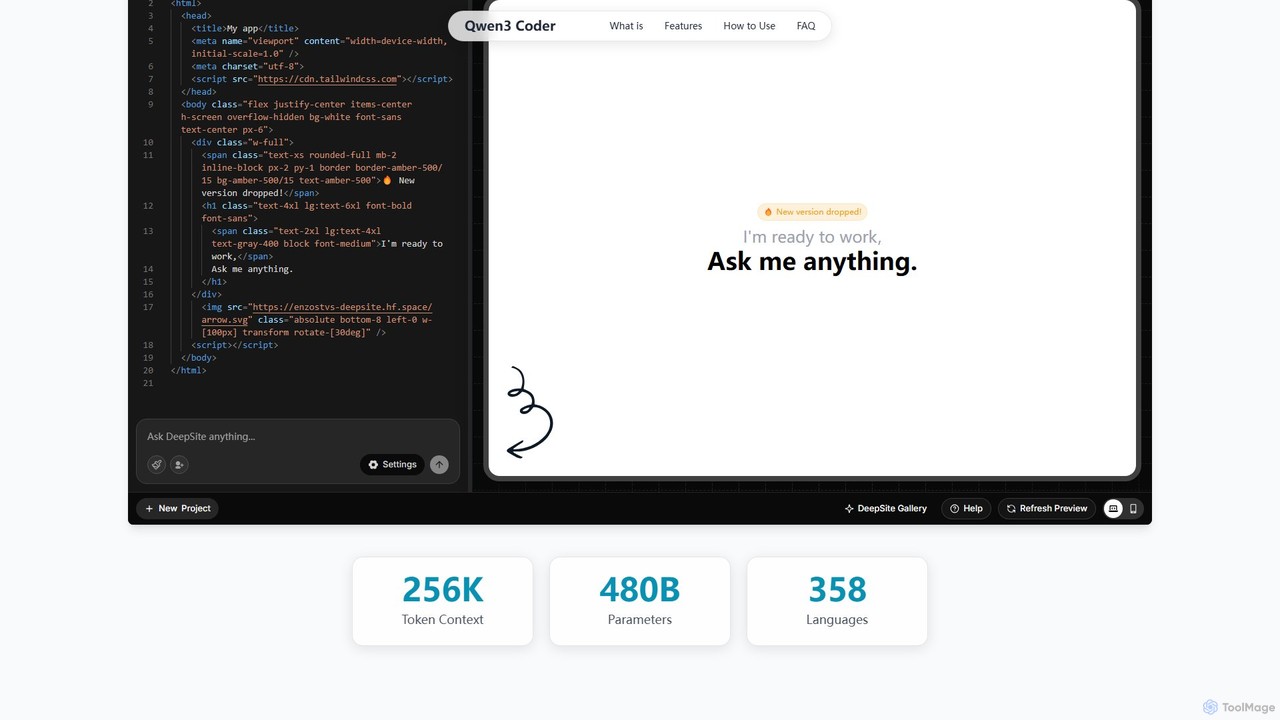
Qwen3 Coder
Qwen3 Coder is a state-of-the-art, open-source large language model by Alibaba Cloud, engineered for advanced code generation, comprehension, and agentic tasks. Featuring a 480B Mixture-of-Experts architecture and trained on 7.5 trillion tokens, it achieves GPT-4 level performance across 358 programming languages. It supports a massive 256K context window and is designed for complex, multi-step software development workflows.
Large Language Model
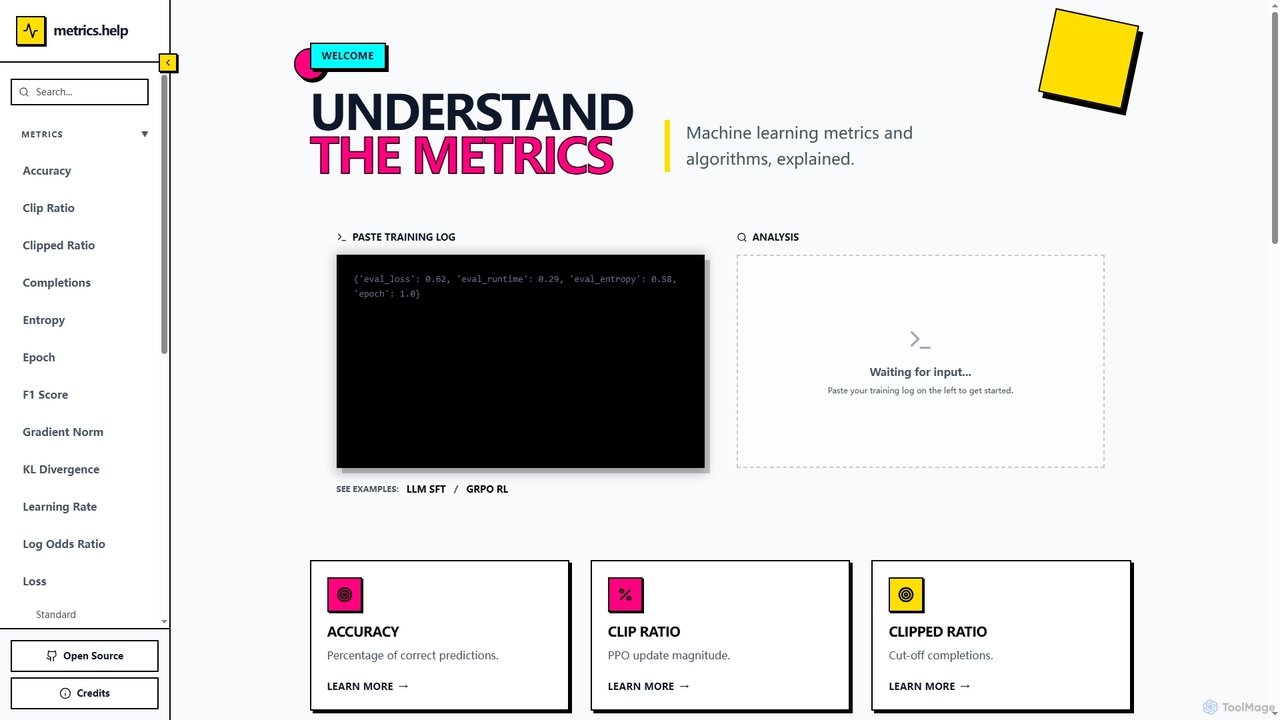
Metrics Help
Metrics Help is an open-source web tool for machine learning practitioners. It functions as a comprehensive guide and an interactive analyzer for ML training metrics. Users can paste training logs to get instant explanations for key metrics like accuracy, loss, and perplexity, aiding in model performance analysis and debugging.
Model Training
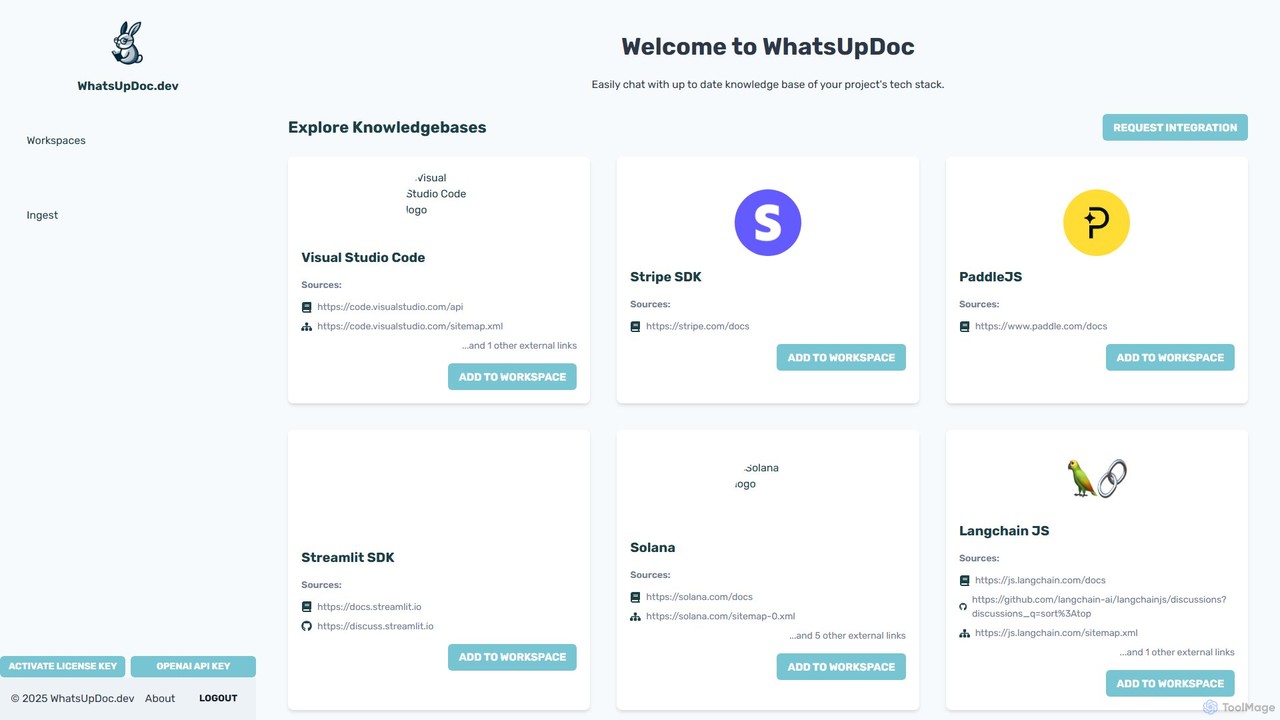
WhatsUpDoc.dev
An AI-powered tool for developers to chat directly with up-to-date technical documentation and knowledge bases. It uses a RAG model to provide instant, accurate answers from sources like official docs, GitHub discussions, and blogs, enhancing productivity and learning.
Code Assistant
Google Research
Google Research is a premier hub for exploring groundbreaking advancements in science and AI. It provides open access to a vast repository of research papers, project showcases, and open-source resources across diverse fields like machine learning, quantum computing, and healthcare. It's an essential platform for researchers, developers, and enthusiasts to stay at the forefront of technological innovation and understand its real-world impact.
Learning Platform
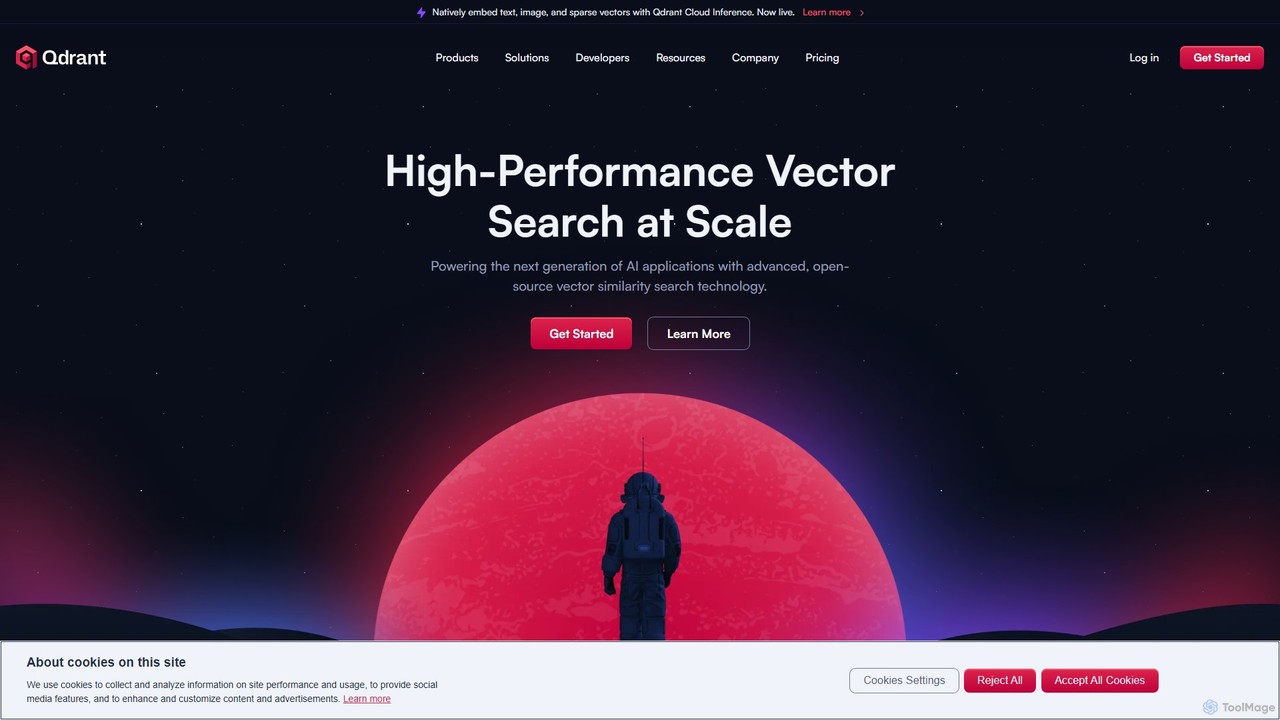
Qdrant
Qdrant is a high-performance, open-source vector database and similarity search engine built in Rust. It's designed to power next-generation AI applications by efficiently managing and searching billions of high-dimensional vectors. With advanced features like rich filtering, payload storage, and various quantization methods, Qdrant enables developers to build scalable and cost-effective solutions for semantic search, recommendation systems, and Retrieval Augmented Generation (RAG).
Vector Search
Microsoft Open Source
Microsoft's central hub for discovering, using, and contributing to a vast portfolio of open-source projects. It offers developers access to powerful tools, frameworks, and AI/ML libraries, fostering collaboration and innovation within a global community.
Platform
MOSTLY AI
MOSTLY AI is a Data Intelligence Platform that specializes in generating high-quality, privacy-safe synthetic data. It enables organizations to securely access, analyze, and share data, accelerating AI innovation and streamlining workflows while ensuring full compliance with privacy regulations.
Machine Learning
Eventual
Eventual is building the future of data infrastructure with Daft, a high-performance, open-source query engine for multimodal data. It enables engineers to process petabyte-scale images, video, audio, and text with the simplicity of SQL, drastically accelerating AI and ML workflows without the need for deep distributed systems expertise.
Machine Learning
vocode
Vocode is an open-source platform for building, deploying, and scaling hyperrealistic voice AI agents. It provides developers with a core framework and an enterprise-grade API to create sophisticated voice-based LLM applications for tasks like automated customer service, sales calls, and interactive voice response (IVR) systems.
Voicebot