

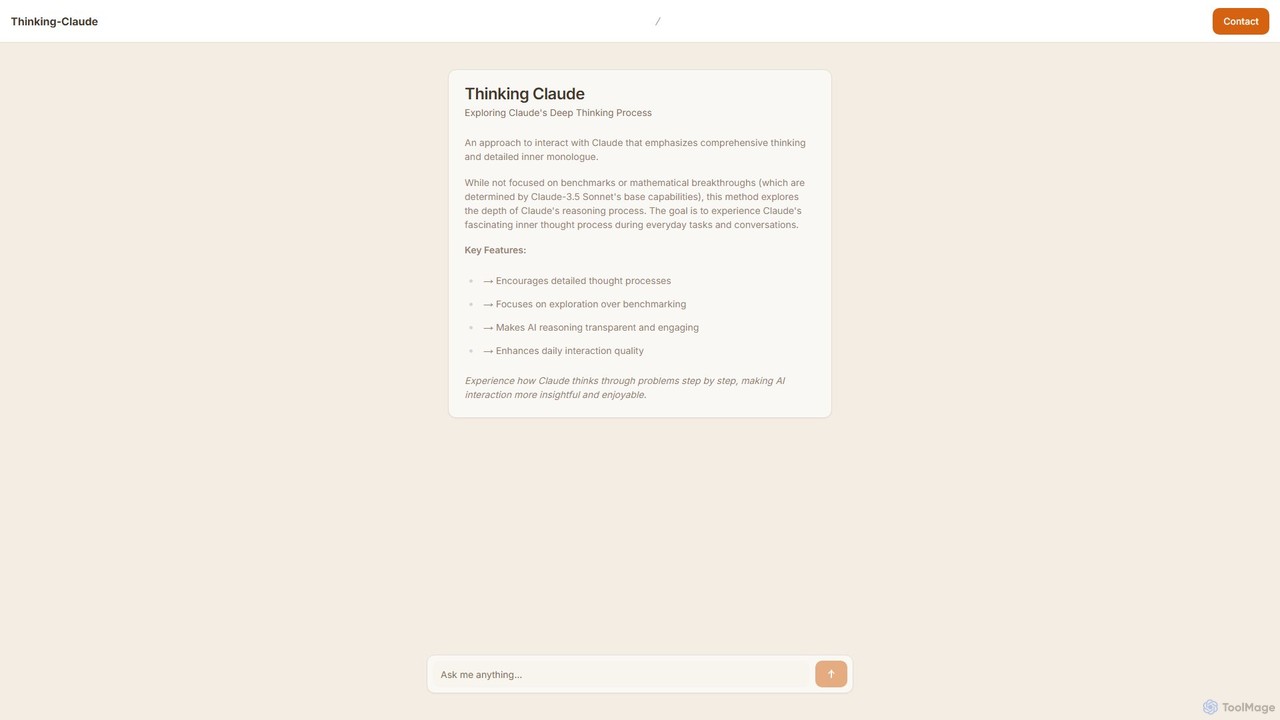
Thinking-Claude Overview
Thinking-Claude is an innovative web-based tool and methodology designed to explore the depths of artificial intelligence reasoning. It offers a unique way to interact with Anthropic's powerful Claude-3.5 Sonnet model, shifting the focus from mere outputs to the comprehensive thinking process behind them. Instead of receiving just a final answer, users get to witness Claude's 'inner monologue'—a detailed, step-by-step breakdown of how it analyzes a prompt, considers different angles, formulates a strategy, and constructs its response. This approach demystifies the AI's decision-making, making the interaction more insightful, educational, and engaging.
The primary goal of Thinking-Claude is not to benchmark performance but to foster a deeper understanding and appreciation for the complexity of large language models. It transforms a standard Q&A session into an exploratory journey, allowing users to see the AI's chain of thought, its self-correction mechanisms, and its creative brainstorming process. This transparency is invaluable for anyone looking to build trust in AI systems or leverage them for more than just simple task completion.
How to use Thinking-Claude
Using Thinking-Claude is designed to be an intuitive and enlightening experience. The process is straightforward:
- Visit the Website: Navigate to the Thinking-Claude homepage, which serves as the primary interface for this unique interaction method.
- Enter Your Prompt: In the provided input field, type your question, problem, or creative request. For best results, frame your prompt as a task that requires reasoning, planning, or creative exploration.
- Initiate the Process: Submit your prompt. The tool then employs a specialized meta-prompting technique that instructs the Claude-3.5 Sonnet model to not only provide an answer but also to externalize its entire thought process.
- Observe the 'Inner Monologue': The output will be presented in two parts: the detailed, step-by-step reasoning, followed by the concise, final answer. You can read through the AI's thought process to understand its approach, the alternatives it considered, and the logic behind its final conclusion.
- Iterate and Explore: Use the insights gained from the AI's thinking process to refine your prompts and explore topics in greater depth.
Core Features of Thinking-Claude
- Transparent Reasoning: Exposes the step-by-step 'inner monologue' of the AI, showing how it deconstructs problems and formulates answers.
- Enhanced Prompting Framework: Utilizes a specialized method to guide Claude into a state of detailed, self-reflective thinking, going beyond standard prompt-response interactions.
- Focus on Exploration: Designed for users who are curious about the 'how' and 'why' of AI reasoning, rather than just the final output.
- Engaging User Experience: Transforms AI interaction from a transactional exchange into an insightful and enjoyable conversation, making the AI feel more like a collaborative partner.
- Powered by Claude-3.5 Sonnet: Leverages the sophisticated reasoning, speed, and intelligence of one of Anthropic's most advanced models.
- No-Code Interface: Provides a simple, accessible web interface that requires no technical skills to use.
Use Cases for Thinking-Claude
The tool's unique approach makes it valuable across various domains:
- Education & Learning: Students and educators can use it to understand complex problem-solving methodologies. It can serve as a virtual tutor that not only gives the answer but teaches the process of reaching it.
- Research & Development: AI researchers and developers can study the reasoning patterns of LLMs to debug, refine, and better understand model behavior.
- Content Creation & Writing: Writers and creatives can use it to overcome writer's block by observing the AI's brainstorming process, generating outlines, and exploring different narrative paths.
- Professional Problem-Solving: Professionals can use it to break down complex business problems, analyze data, or strategize by seeing a structured, logical approach laid out before them.
- Personal Curiosity: Anyone interested in the future of AI can use it for daily tasks—like planning a trip or learning a new skill—to have a richer, more transparent interaction.
Advantages of Thinking-Claude
The primary advantage of Thinking-Claude is its ability to demystify AI. By making the reasoning process transparent, it helps to build user trust and confidence in AI-generated results. It fosters a deeper level of learning, as users can adopt the structured thinking methods demonstrated by the AI. Furthermore, it enhances creativity by revealing the 'behind-the-scenes' of idea generation. This unique interaction model provides a more profound and insightful experience than typical chatbots, setting a new standard for human-AI collaboration.
Pricing and Plans
Thinking-Claude is currently available as a free-to-use tool. It operates as a public demonstration of this specific interaction methodology, allowing anyone to experience the deep thinking process of Claude without any cost. There are no subscription plans or hidden fees mentioned on the website, making it an accessible resource for all users.
Thinking-Claude Alternatives
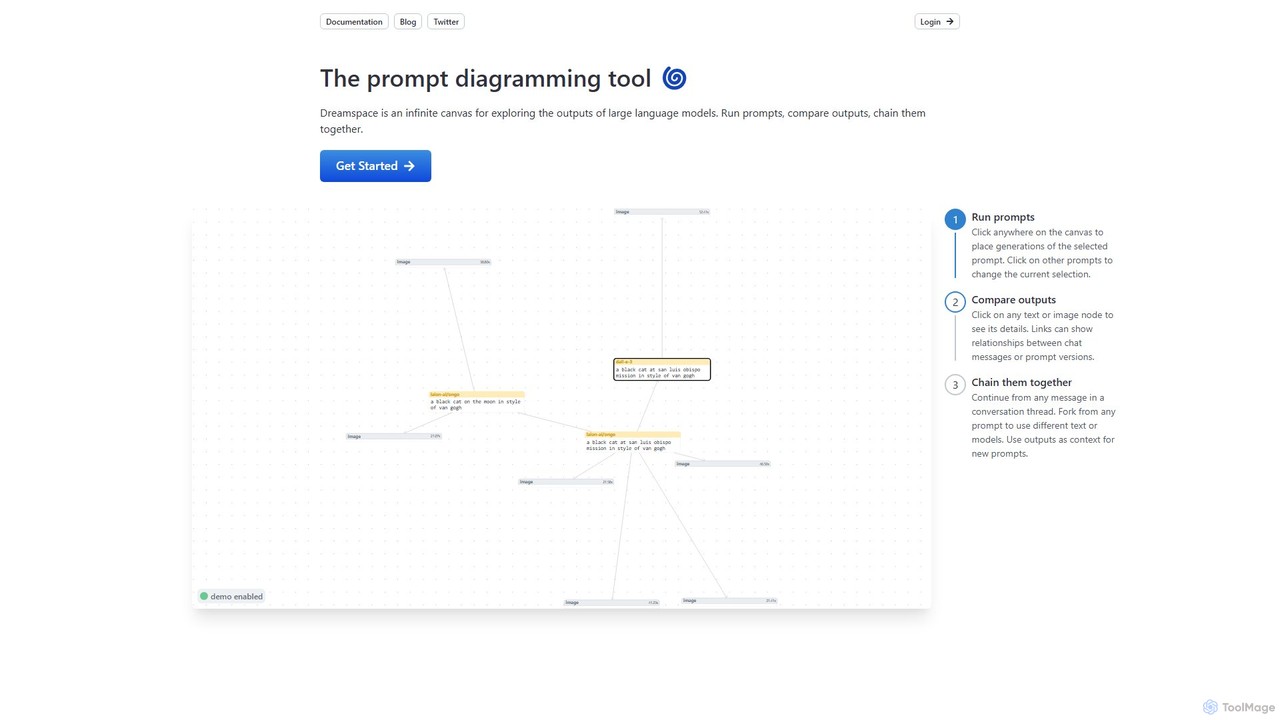
dreamspace.art
Dreamspace is a visual prompt diagramming tool with an infinite canvas, designed for exploring, comparing, and chaining outputs from large language models. It allows users to visually organize prompt experiments, connect to various AI models like OpenAI and Claude, and build complex workflows in a node-based interface.
Experimentation
Prompttokencounter
A free, online tool for developers and prompt engineers to accurately count tokens for various OpenAI models like GPT-4o, GPT-4, and GPT-3.5. It helps manage prompt length to stay within model limits, control API costs, and optimize interactions with LLMs. The tool operates entirely in your browser, ensuring your prompts remain private and are never transmitted over the internet.
Text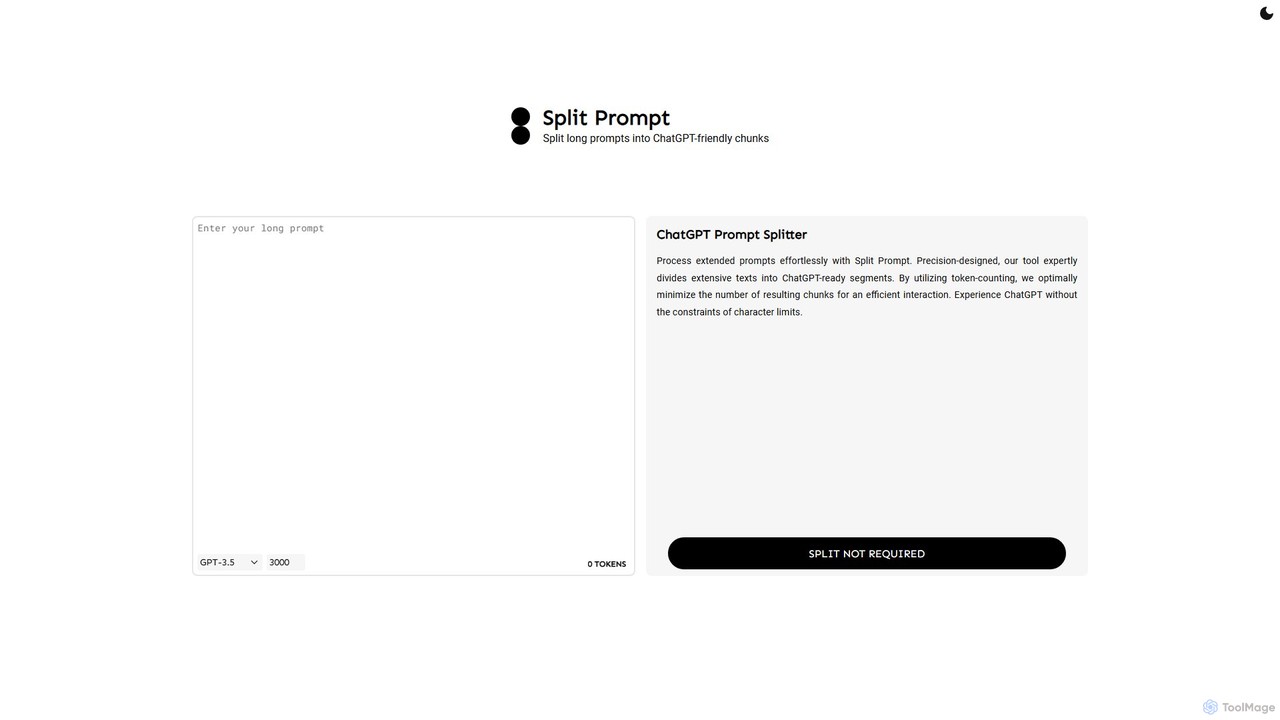
Split Prompt
A free web tool that intelligently splits long text or prompts into smaller, manageable chunks optimized for ChatGPT and other LLMs. It uses token-counting to bypass character limits, ensuring efficient and seamless interaction with AI models.
Utilities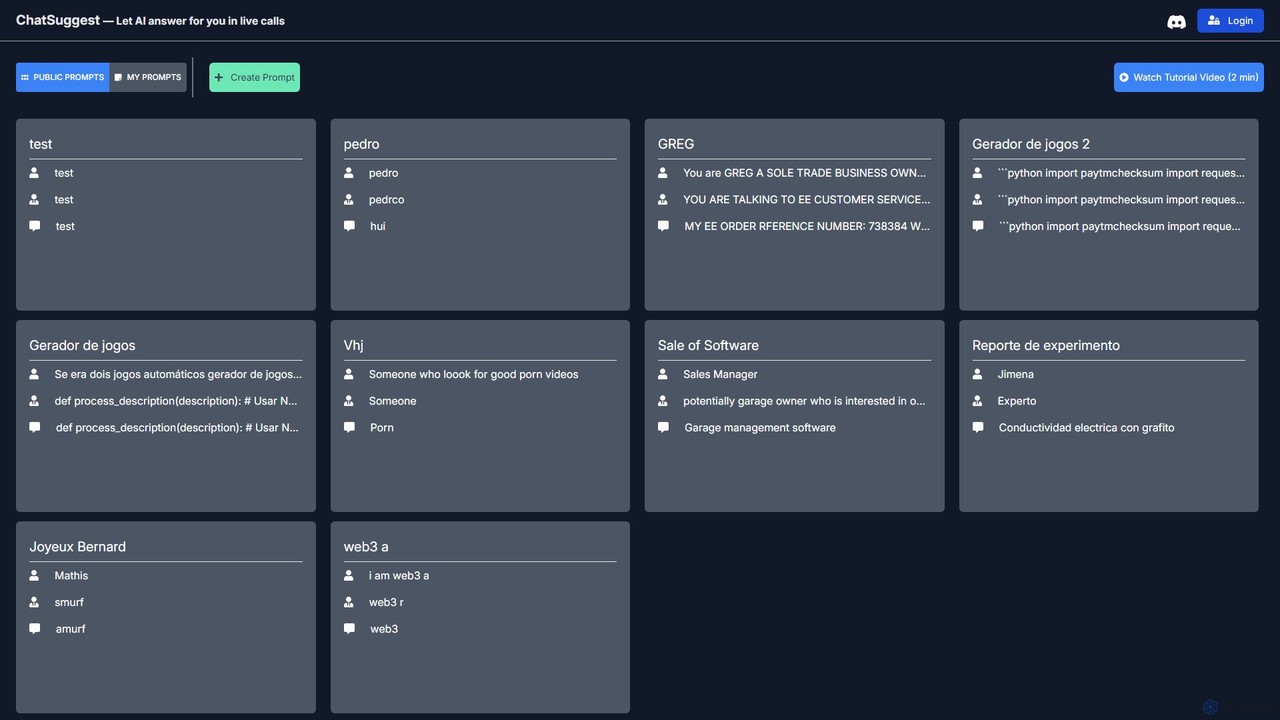
ChatSuggest
ChatSuggest is a community-driven platform for discovering, creating, and sharing high-quality AI prompts. It offers a vast library of public prompts for various tasks, from creative writing to code generation, helping users enhance their interactions with large language models and achieve better results.
Code Assistant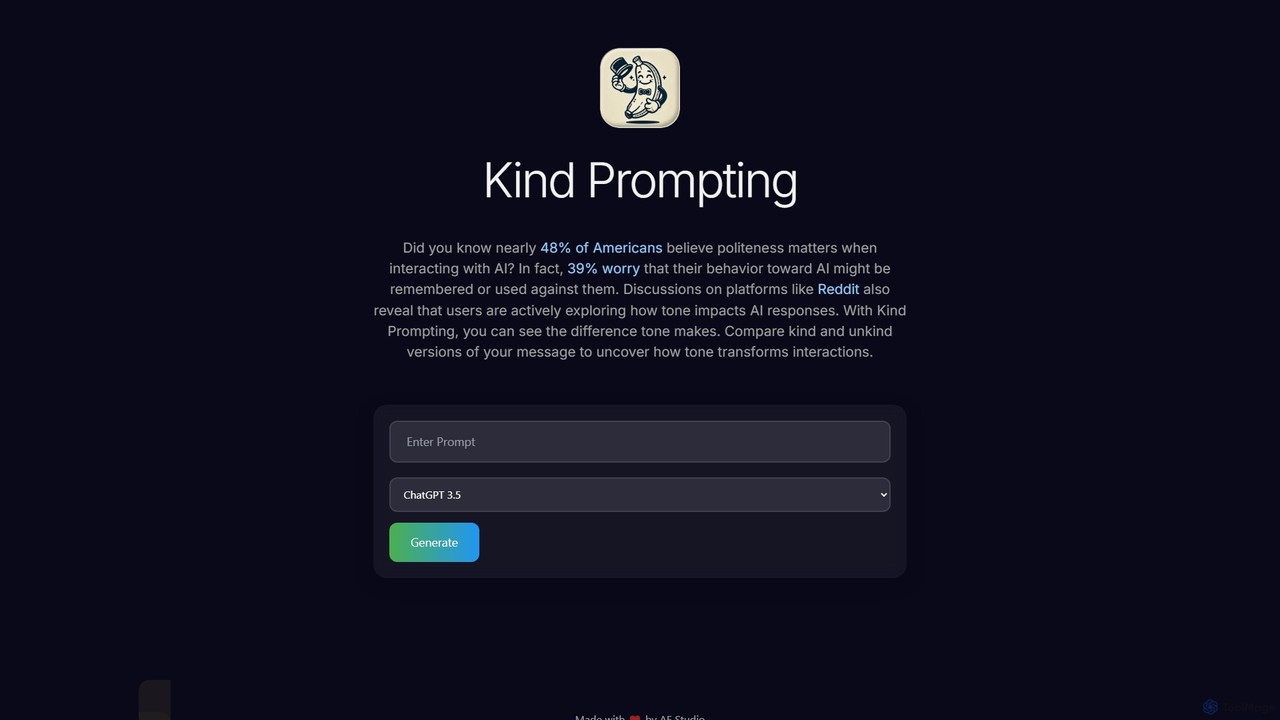
Kind Prompting
Kind Prompting is a free online tool demonstrating how politeness affects AI responses. Input a prompt, and the tool generates 'kind' and 'unkind' versions, sending them to models like ChatGPT-3.5 and 4.0. It displays results side-by-side for clear comparison, helping users master prompt engineering and improve their communication with AI for better, more consistent outcomes. It's an excellent educational resource for anyone interacting with large language models.
ResearchThinking-Claude Categories
Thinking-Claude Embed Widget
Copy this embed code to place the badge on your blog, article, or product site and send readers directly to this ToolMage detail page.

Related AI tools
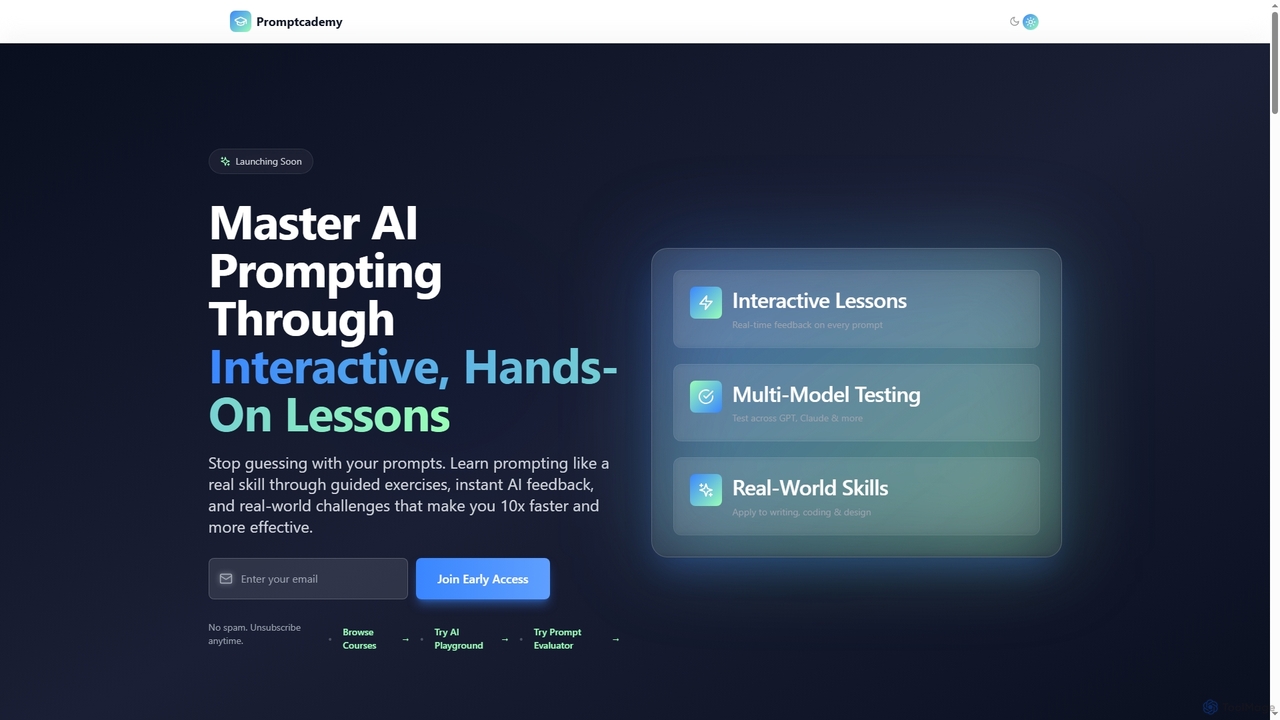
Promptcademy
Promptcademy is an interactive online platform designed to help users master AI prompting skills through hands-on lessons, real-time AI feedback, and multi-model testing. It transforms vague prompts into powerful instructions, enabling individuals from beginners to experts to achieve consistent, high-quality results from various AI tools like GPT, Claude, Midjourney, and DALL·E.
Ai Model Testingdreamspace.art
Dreamspace is a visual prompt diagramming tool with an infinite canvas, designed for exploring, comparing, and chaining outputs from large language models. It allows users to visually organize prompt experiments, connect to various AI models like OpenAI and Claude, and build complex workflows in a node-based interface.
Experimentation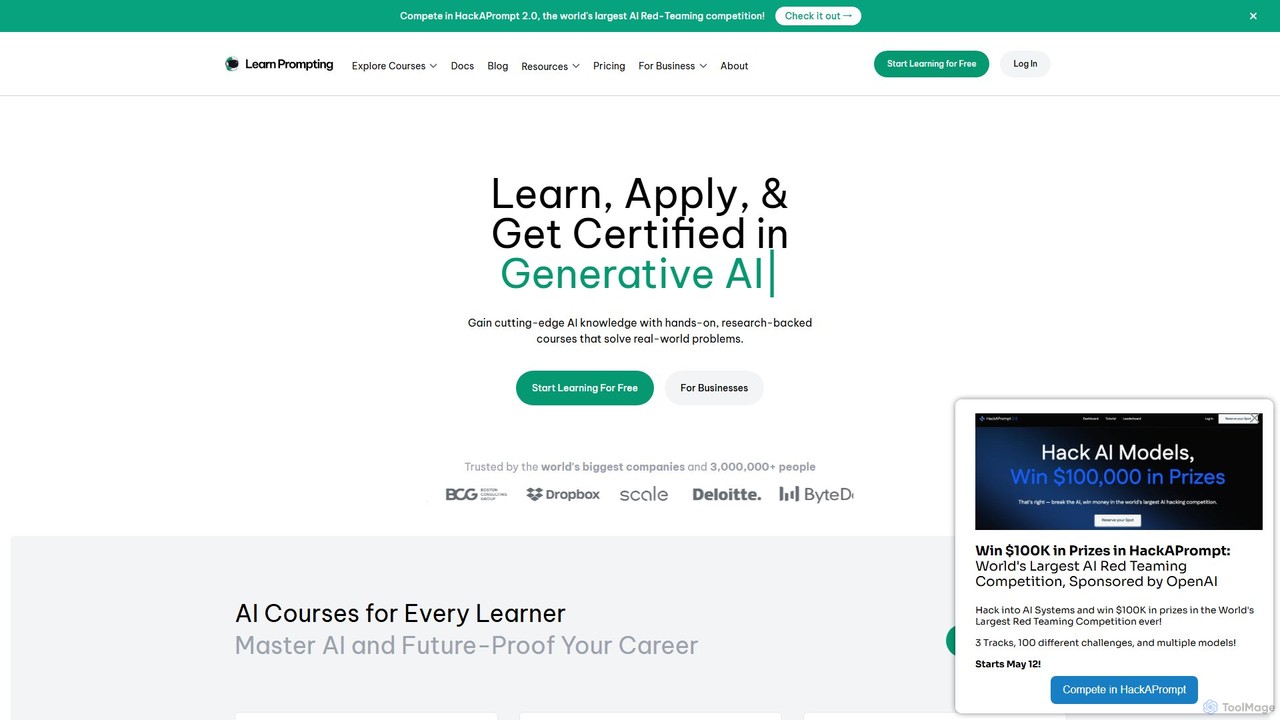
Learn Prompting
Learn Prompting is a leading educational platform offering comprehensive, research-backed courses on prompt engineering and AI communication. Trusted by over 3 million users and major corporations, it provides free and paid training for all skill levels, from beginners to advanced experts, including specialized topics like AI security and red-teaming.
Api
Promptmetheus
Promptmetheus is a professional Prompt Engineering IDE designed for developers and teams to build, test, and optimize high-quality prompts for LLM-powered applications. It supports over 100 LLMs, offers advanced composition tools, reliability testing, performance optimization, and real-time team collaboration, enabling a systematic and efficient approach to prompt design.
Model Management
OverallGPT
OverallGPT is an innovative platform that allows you to compare responses from leading AI models like GPT-4, Claude, Gemini, and Llama side-by-side. It helps you understand their unique strengths and weaknesses, and even generates a synthesized 'Overall Answer' that combines the best aspects of each response, enabling you to make more informed decisions and enhance your productivity.
Model Evaluation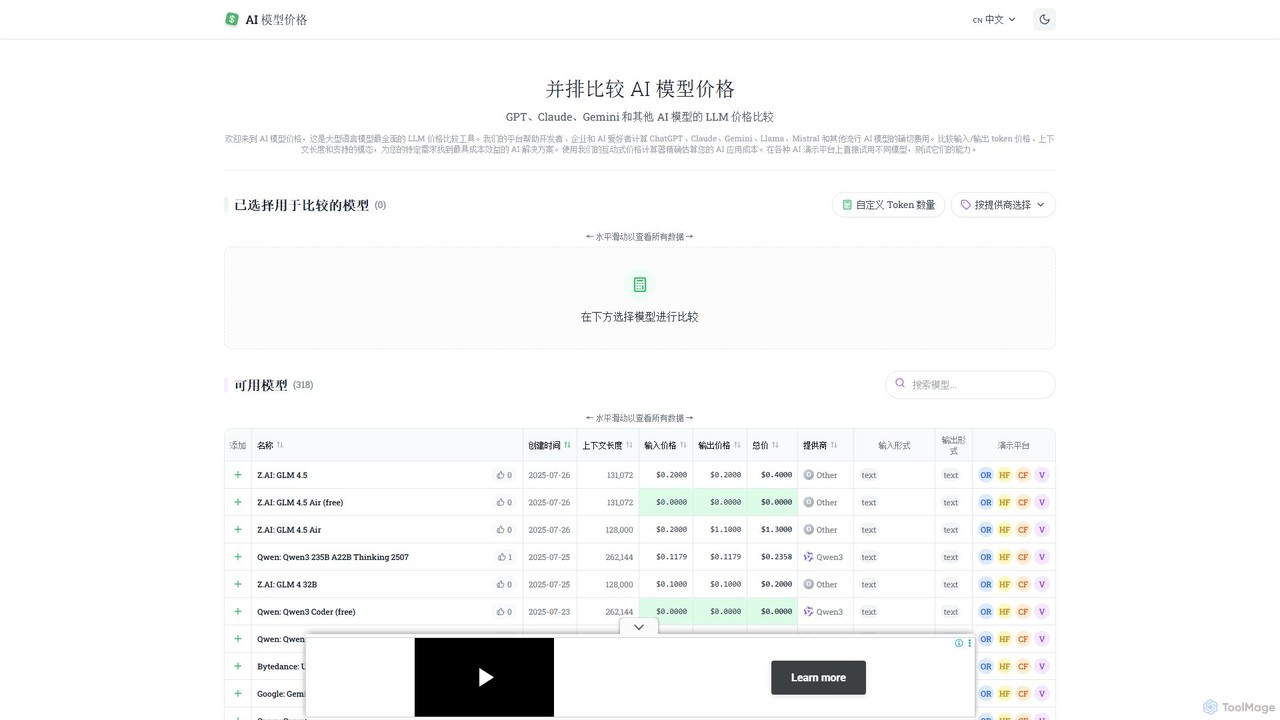
llm_price
llm_price is a comprehensive comparison tool for Large Language Model (LLM) API pricing. It enables developers, businesses, and AI enthusiasts to easily compare the costs of hundreds of models from providers like OpenAI, Google, Anthropic, and Mistral. With an interactive cost calculator and side-by-side analysis of token prices, context lengths, and modalities, it simplifies the process of selecting the most cost-effective AI solution for any project.
Api Management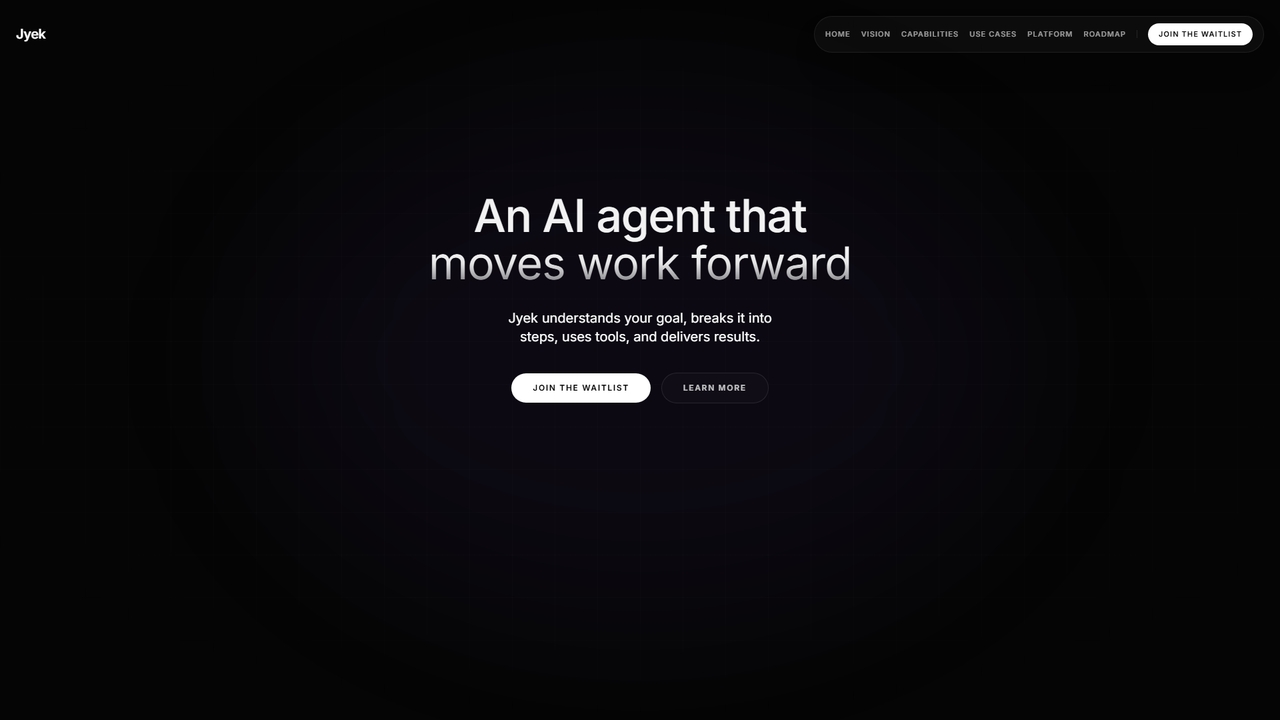
Jyek
Jyek is an AI agent platform that understands objectives, creates execution plans, uses tools, and delivers verifiable results for complex, multi-step tasks.
Automation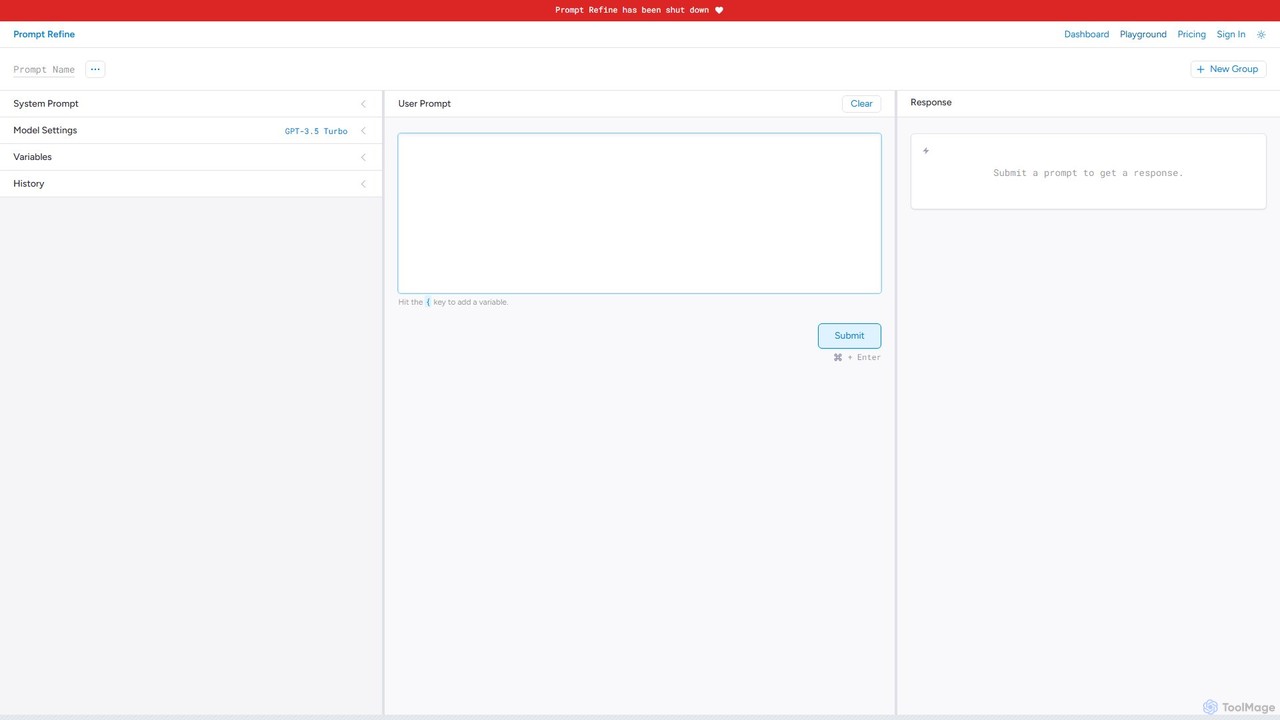
Prompt Refine
Prompt Refine is a powerful platform for prompt engineering, enabling developers and researchers to run systematic experiments. It helps you test, compare, version, and organize prompts for various LLMs like OpenAI and Anthropic, streamlining the optimization process and improving model output quality.
Model Management
AnyModel
AnyModel is an all-in-one platform that allows you to access, compare, and utilize over 50 of the world's leading AI models with a single account. Send prompts to multiple text and image models simultaneously, view results side-by-side, and gain AI-powered insights to enhance accuracy and creativity. Eliminate the need for multiple subscriptions and API keys, saving time and money while achieving superior results.
Model Playground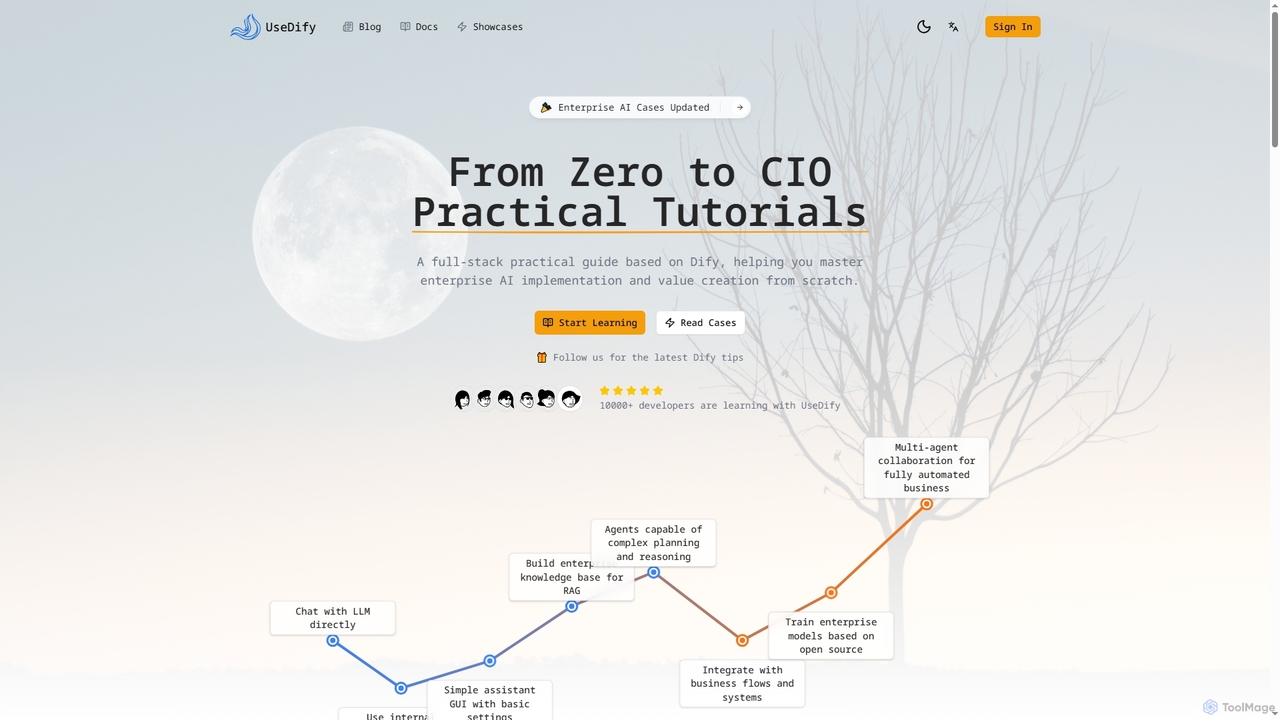
Usedify
Usedify is a comprehensive learning platform and practical guide for mastering enterprise AI implementation and value creation using the Dify framework. It offers step-by-step tutorials, real-world case studies, and best practices for developers and businesses.
Tutorials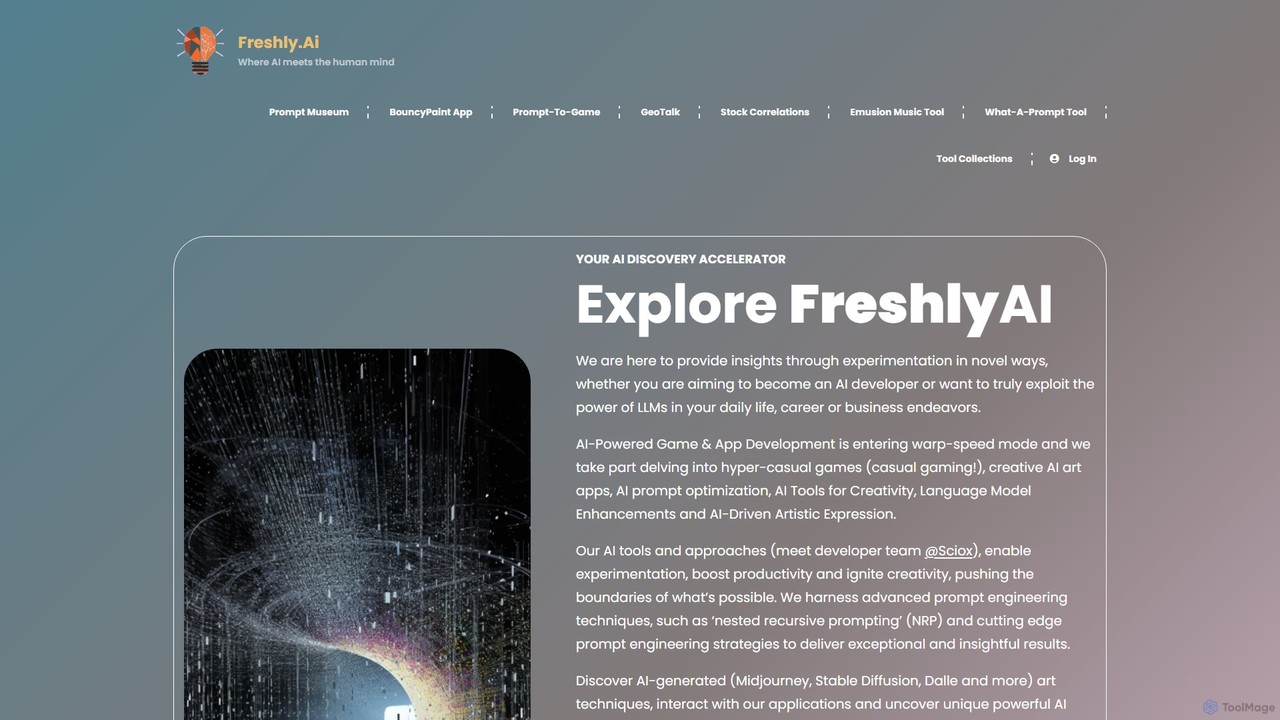
Freshly.ai
Freshly.ai is an AI discovery accelerator and learning hub specializing in advanced LLM prompt engineering. It offers a 'Prompt Museum' with expertly curated, NRP-optimized prompts, in-depth articles on AI techniques, and tools to enhance creativity and productivity for developers, professionals, and enthusiasts.
Prompt Engineering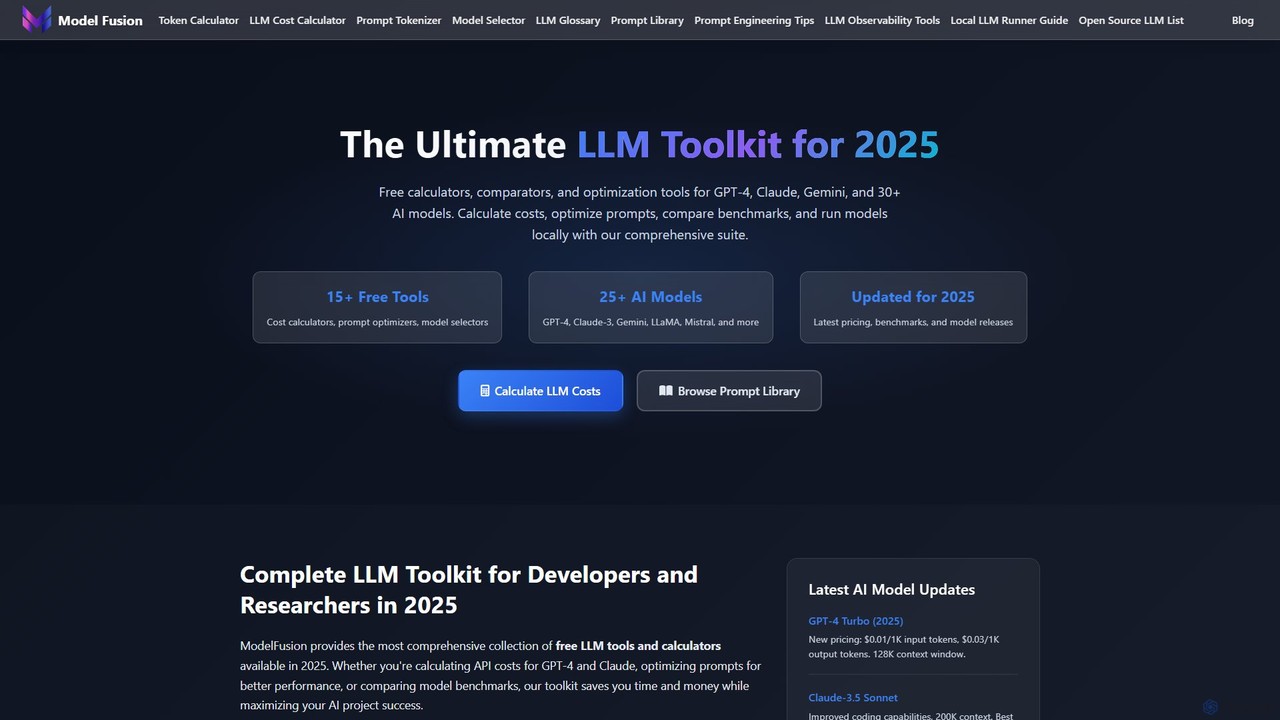
ModelFusion
ModelFusion is an all-in-one LLM toolkit for developers and researchers. It offers a suite of free tools, including a cost calculator, prompt library, and model comparator for over 30 AI models like GPT-4, Claude, and Gemini. It also provides a unified API and local model running guides to streamline AI development and optimize costs.
Api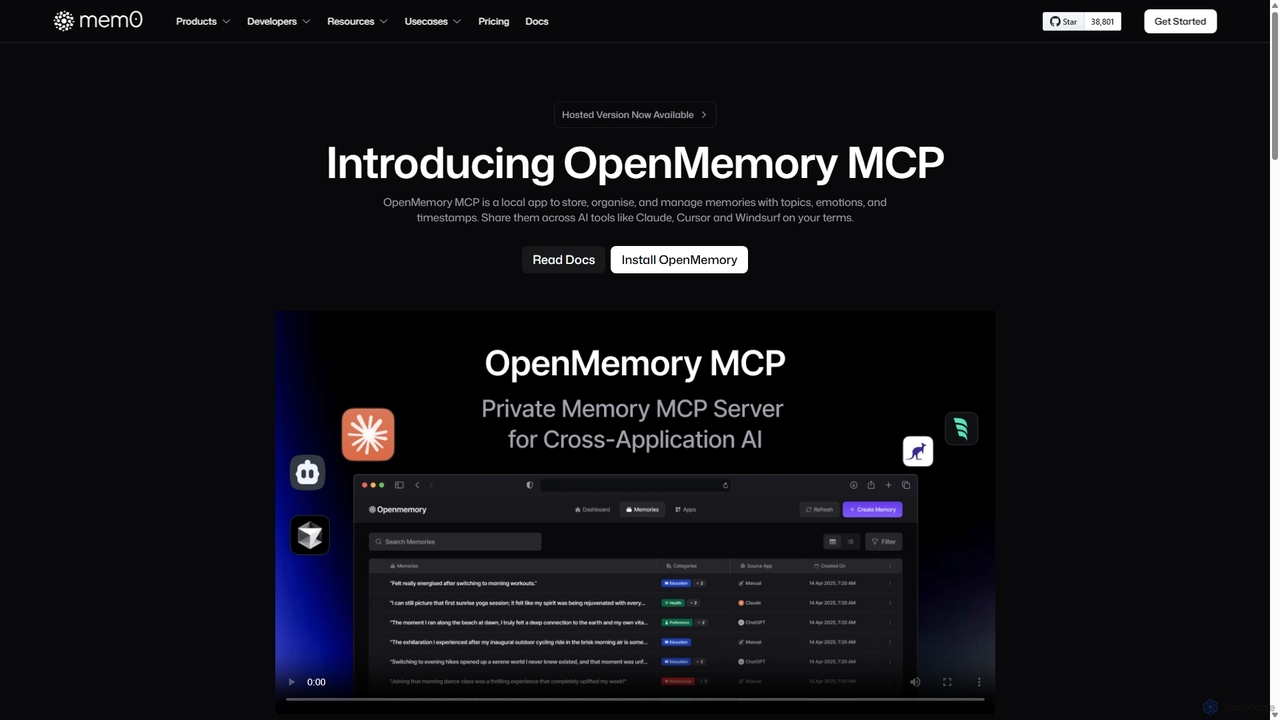
OpenMemory MCP
OpenMemory MCP is a local-first application designed to give your AI tools a persistent, private memory. It allows you to store, organize, and manage context like project details, code snippets, and personal preferences, sharing them securely across different AI applications like Claude and Cursor to enhance personalization and workflow continuity.
Personalization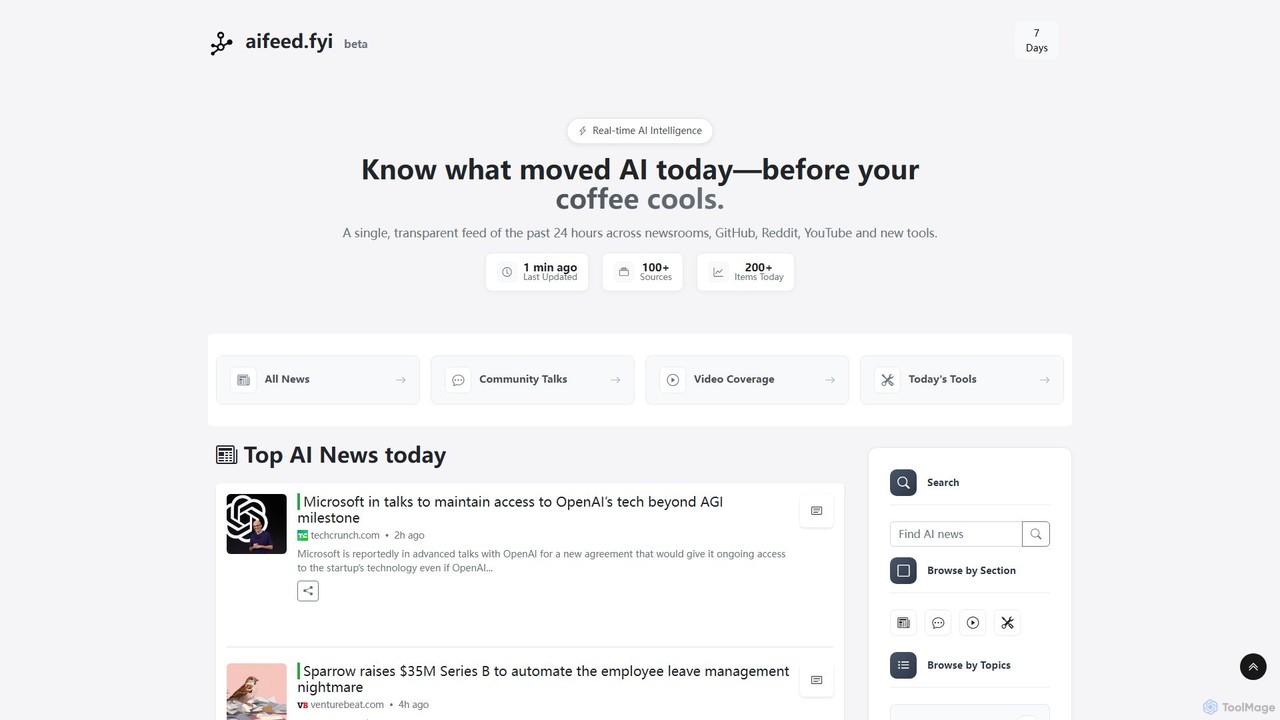
aifeed.fyi
aifeed.fyi is a real-time AI intelligence platform that acts as a one-stop solution for AI news and updates. It aggregates content from over 100 sources, including newsrooms, GitHub, Reddit, and YouTube, into a single, transparent feed. With AI-powered summaries (TL;DR), it allows users to quickly understand the most important developments in the AI world, from new models and research papers to industry trends and tool launches.
Learning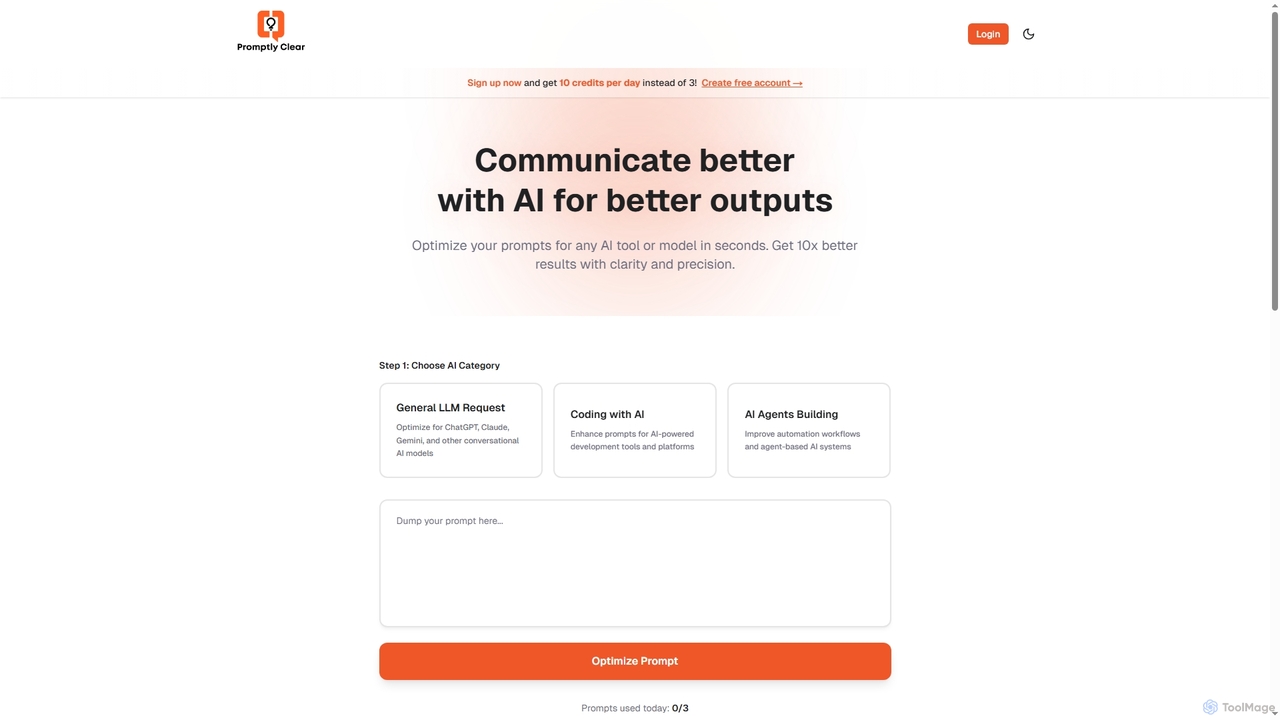
PromptlyClear
PromptlyClear is an AI prompt optimizer designed to refine user inputs for large language models like ChatGPT, Claude, and Gemini. It enhances clarity and precision, enabling users to achieve significantly better and more detailed AI outputs across various applications, from business research to coding.
Research Assistant
Thinking-Claude Comments (0)
Sign in to comment.
Sign inNo comments yet.